Forbidden City: Tickets, Palace Route and Practical Visit Planning
Contents
- 1. The decisions to make before you go
- 2. Official reservations: seven days before, not at the gate
- 3. Seasonal hours and an adult ticket budget
- 4. Reach Wumen without making Tiananmen Square compulsory
- 5. Understand the palace as you walk
- 6. Check specific closures, not just whether the museum is open
- 7. Walking, access needs, luggage and photography
- 8. Jingshan is an optional second visit
- 9. Sources and background
- 10. Frequently Asked Questions
The Forbidden City is both an imperial palace landscape and the home of the Palace Museum. For a first visit, the most useful decision is how to balance the ceremonial buildings with the museum collections. Reserve your place first, choose a realistic route and plan the exit before adding another attraction.
The decisions to make before you go
| Your priority | A useful plan | What to check |
|---|---|---|
| First visit and palace architecture | Follow the central axis from the southern Wumen entrance, then the residential precinct and Imperial Garden | Current diversions, your booking session and the chosen exit |
| Objects and collections | Choose one or two galleries rather than trying to see every exhibition | Opening, separate tickets and any exhibition reservation |
| A broader palace visit | Add selected eastern or western precincts to the main route | Which areas are open and how the extra walking fits the day |
| A view over the roofs | Consider Jingshan separately after a Shenwumen exit | Park entry arrangements, remaining energy and weather |
A half day is a sensible planning allowance for the main palace route and a selected gallery; a more detailed museum visit can take most of the day. These are editorial estimates, not timed museum itineraries or a guarantee that all listed areas will be open. Include the approach, security and breaks, not just the time walking between halls.
Things to Do
Offers are only loaded from GetYourGuide after you click. GetYourGuide can then process your IP address and set cookies. Privacy Policy
GetYourGuide partner offers. GoAsia may earn a commission if you book through these offers. Check whether tickets or transfers are included, and follow the attraction's official booking and admission rules.
Official reservations: seven days before, not at the gate
The Palace Museum visitor rules say reservations open at 20:00 Beijing time seven days before the visit. The museum does not sell same-day tickets. Use the official Palace Museum mini-program or the foreign-visitor booking site linked from its English page. A published release time does not guarantee available places.
Every visitor needs a real-name reservation, including visitors qualifying for concessions or free entry and accompanying people. Foreign visitors can reserve with a passport among the accepted documents. Use the exact details of the document you will present, and bring its original for inspection at Wumen. A booking confirmation is not a substitute for the required original identification.
Reservations have morning and afternoon sessions. The published rules give noon as the latest check-in for a morning reservation and 11:00 as the earliest check-in for an afternoon reservation. Follow the session on your booking and the seasonal final-entry cutoff. Do not treat an afternoon booking as permission to arrive at any time before the museum closes.
The museum states that it has not authorised third parties to act as agents for its tickets or exhibition reservations. Keep official admission separate from any independently purchased guide service, and do not assume a tour purchase guarantees museum entry. Check the official channel's payment, identification and cancellation conditions before paying.
The rules allow unused tickets to be cancelled through the original channel before midnight on the day preceding the visit without recording a missed reservation. Late cancellation, including on the visit day, counts as a missed reservation. Three missed reservations within 180 days can lead to a 60-day booking restriction. The current rules at purchase govern the transaction.
Seasonal hours and an adult ticket budget
The English visitor information and Chinese visitor page publish the following standard timetable and full adult prices. Checked on 5 October 2026, these are museum admission charges per person in CNY, not guided-tour or transport prices.
| Period or ticket | Opening and final entry | Full adult price |
|---|---|---|
| 1 April to 31 October | 08:30 to 17:00; final museum entry 16:00 | CNY 60 |
| 1 November to 31 March | 08:30 to 16:30; final museum entry 15:30 | CNY 40 |
| Treasure Gallery | Gallery final entry 16:10 in the April to October period, 15:40 in the November to March period | CNY 10 additional |
| Gallery of Clocks | Same published gallery final-entry cutoffs | CNY 10 additional |
A full-price adult visiting both paid galleries would therefore budget CNY 80 in the April to October period or CNY 60 in the November to March period for those admission tickets. Other exhibition reservations, a guide, audio services, food, travel and Jingshan are separate decisions. Buying a gallery ticket does not extend the museum's entry cutoff.
The museum normally closes on Mondays, with an exception for statutory holidays. Special events, holidays and conservation work can change access, so read the current announcements before choosing a date. Concessions depend on the visitor's eligibility and documentation. In particular, do not assume that every foreign tourist under 18 qualifies for the Chinese visitor page's free-entry category, which expressly specifies Chinese citizens and certain resident groups.
Reach Wumen without making Tiananmen Square compulsory
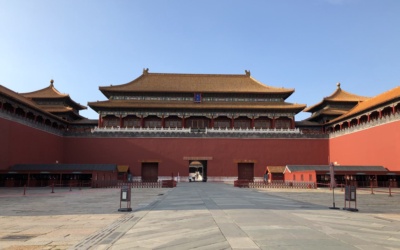
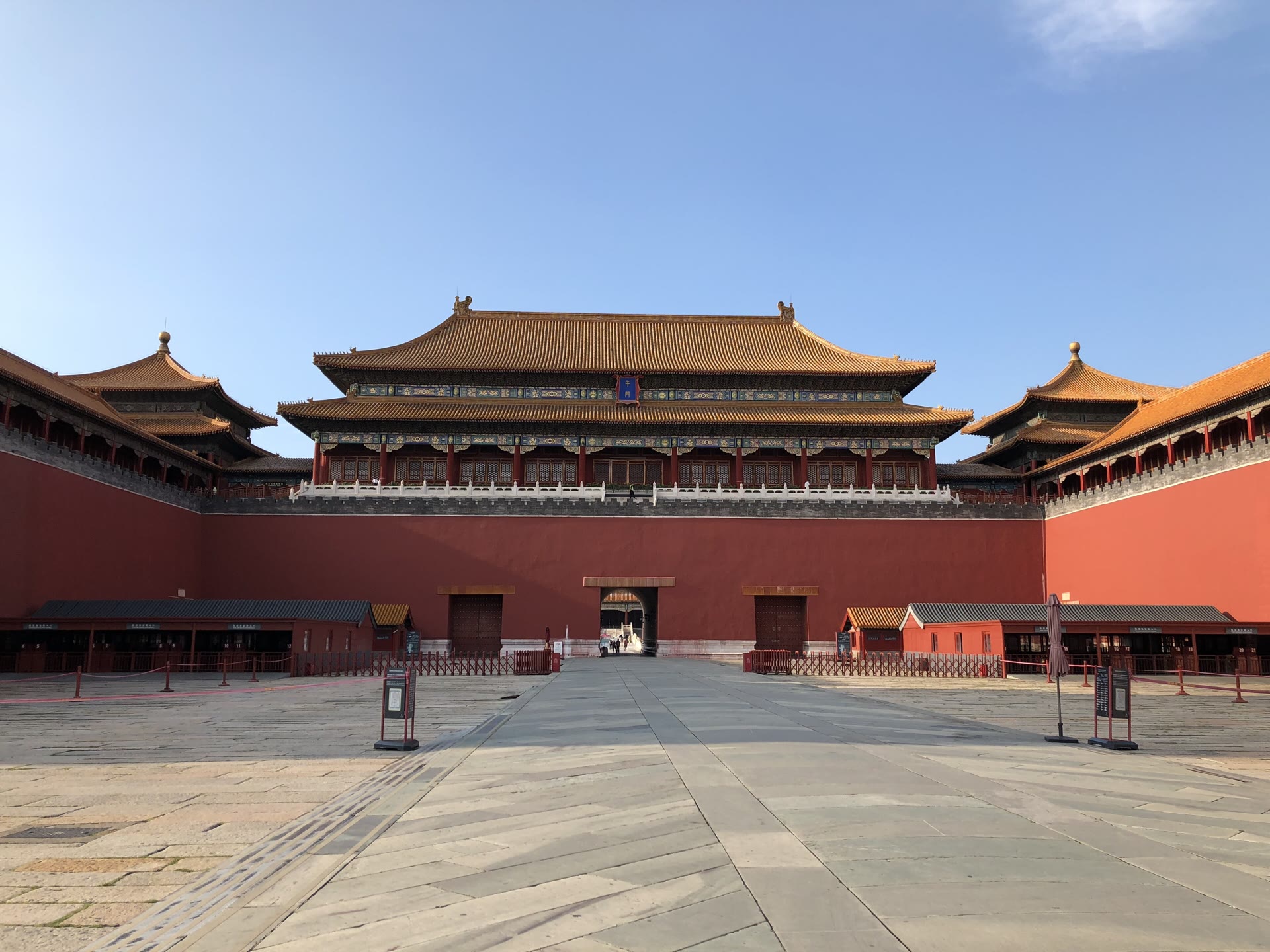
Wumen, the Meridian Gate on the south, is the only visitor entrance. Shenwumen on the north and Donghuamen on the east are exits. The normal visit proceeds south to north; arriving at the north gate is not a way to enter the palace.
For a palace-only visit, the official rules direct visitors along the eastern or western Tongzihe roads to Wumen. You do not have to include Tiananmen Square. If you have reserved both the square and the palace, the museum describes approaching through the square's security queues, with a one-way passage north from Tiananmen Tower towards Wumen. Treat the square's reservation and the palace's reservation as separate arrangements.
The Chinese visitor page lists Tiananmen East and Tiananmen West stations on Metro Line 1 among the nearby public-transport options. Choose the approach for your actual itinerary and check current exits and security directions. Allow walking and screening time. No date-specific taxi or ride-hailing drop-off restriction was verified for this guide, so agree a permitted drop-off with the driver rather than promising a car can reach Wumen.
Plan onward travel from the exit you intend to use. Shenwumen faces Jingshan across the road; Donghuamen may suit an east-side onward plan. Follow the day's staff directions and do not plan to retrace the entire visit back to the southern entrance.
Understand the palace as you walk
UNESCO's account of the imperial palaces dates the Beijing complex's construction to 1406 to 1420 and records 14 Ming and 10 Qing emperors. The Forbidden City was inscribed on the World Heritage List in 1987. The associated World Heritage property also includes the separate imperial palace in Shenyang; it is not a second name for the Beijing site.
The layout communicates hierarchy through a central axis, symmetry and the division between an outer ceremonial court to the south and an inner residential court farther north. Look at how gateways, raised halls and courtyards organise movement and visibility, rather than seeing the complex only as a succession of similar roofs.
Use the Hall of Supreme Harmony, Hall of Central Harmony and Hall of Preserving Harmony as landmarks of the ceremonial area. Continue towards the residential palaces and Imperial Garden according to the open route. Their different scale helps distinguish formal state ceremony from the imperial household's living environment. An open exterior does not mean every hall's interior is accessible.
The Palace Museum, established in 1925, holds paintings, calligraphy, ceramics and other objects associated with the imperial collections. A gallery adds a different kind of visit from the monumental central axis. Choose a subject you care about and check the exhibition description and reservation requirements. The English visitor information locates the Treasure Gallery in the Palace of Tranquil Longevity area and the Gallery of Clocks in the Hall for Ancestral Worship area. Include the detour and time to look at the objects, not just the extra ticket cost.
The eastern and western precincts can broaden the architectural and collection story when open. They are not a guaranteed escape from crowds. If the main route is congested, use permitted alternatives and staff guidance, not an assumption that any side courtyard will be available or quiet.
Check specific closures, not just whether the museum is open
At the 5 October 2026 source check, the Chinese visitor page carried a notice closing Yanxi Palace from 1 September to 31 October 2026, with reopening announced for 1 November. A 31 July 2026 conservation notice announced the closure of Taihemen from 3 August without giving an end date. Taihemen is the gate, not the Hall of Supreme Harmony, and neither notice means the entire museum is closed.
Recheck the announcement list near your visit, particularly if a specific building or exhibition is your main reason for going. A general map or catalogue of palace buildings is not evidence that every listed place is open today.
Walking, access needs, luggage and photography
The museum's rules warn of steps, steep slopes and uneven surfaces. Visitors with mobility requirements should contact the museum about the chosen route and the assistance actually available, rather than relying on a blanket claim of step-free access. Build in breaks and choose fewer areas when that makes the visit more manageable.
Check the forecast and prepare for the conditions across exposed courtyards and indoor galleries. Neither a season nor an early arrival guarantees comfortable weather, clear views or a quiet visit. Follow staff instructions during extreme weather or an unexpected closure.
Eligible large luggage can use the museum's deposit and forwarding service. The rules place deposit at the visitor service centre on the west side of Duanmen Square, with collection outside Shenwumen or Donghuamen. Check the day's times and exclusions, keep the receipt and collect on the same day. Cash, valuables, electronics, food and other excluded items must not simply be left in a bag for forwarding.
No smoking, including e-cigarettes, or climbing and touching protected structures and objects is allowed. Gallery rules prohibit flash, selfie sticks and support-type photographic equipment, as well as recording or livestream activities. Follow the signs for each exhibition and keep passages clear. Check the separate prohibited-items list before packing.
Jingshan is an optional second visit
If you leave through Shenwumen and still want another stop, Beijing's official Jingshan Park guide identifies Wanchun Pavilion on the hill as a viewpoint over the Forbidden City and central axis. The panorama is from the hill, not permission to climb onto palace roofs.
Arrange park admission separately and check current hours, any reservation or exhibition requirements and the route's suitability. The municipal guide links operating information under 2023 URLs, and this check did not independently establish the park's current booking rules or tariffs. Verify these with the park before relying on the combination. Visibility and weather also affect the view; do not make the whole palace day depend on a promised sunset photograph.
For a wider itinerary, use the China travel overview. A good palace visit is not a race through every gallery: secure admission, understand the ceremonial and residential layout, choose the collections that interest you and leave from the gate that fits the rest of your day.
Sources and background
These sources support the topics listed below, not every statement or current price in this article.
- [1] The Palace Museum: Palace Museum visitor information in English. Retrieved October 5, 2026. Access, Admission
- [2] The Palace Museum: Palace Museum seasonal hours, prices and opening announcements. Retrieved October 5, 2026. Access, Admission
- [3] The Palace Museum: Palace Museum reservations, entrance, exits and visitor rules. Retrieved October 5, 2026. Access, Admission
- [4] The Palace Museum: 31 July 2026 notice: Taihemen closure for conservation work. Retrieved October 5, 2026. Access
- [5] UNESCO World Heritage Centre: Imperial Palaces in Beijing and Shenyang: World Heritage and palace layout. Retrieved October 5, 2026. History
- [6] The Palace Museum: About the Palace Museum and its collections. Retrieved October 5, 2026. History
- [7] The People's Government of Beijing Municipality: Jingshan Park and the Wanchun Pavilion viewpoint. Retrieved October 5, 2026. Access, History
Frequently Asked Questions
Reservations open at 20:00 Beijing time seven days before the visit, subject to availability. Use the Palace Museum official mini-program or its linked foreign-visitor booking website. Every visitor needs a real-name reservation, and you must bring the original identification used to book. No same-day tickets are sold.
The standard full adult admission is CNY 60 from 1 April to 31 October and CNY 40 from 1 November to 31 March. The Treasure Gallery and Gallery of Clocks each cost CNY 10 additional. Both galleries plus main admission total CNY 80 or CNY 60 respectively, before other services. Prices checked on 5 October 2026; confirm current rules and eligibility.
Standard hours are 08:30 to 17:00 from April to October, with final museum entry at 16:00; from November to March they are 08:30 to 16:30, with final entry at 15:30. Mondays are normally closed except statutory holidays. Your booking session and special announcements can further limit access.
Enter only through Wumen, the southern Meridian Gate. Visits normally proceed south to north, and the published exits are Shenwumen on the north or Donghuamen on the east. Shenwumen is not a visitor entrance. Follow the current open route and staff instructions.
No. For a palace-only visit, the museum directs visitors via the east or west Tongzihe roads to Wumen. If visiting both the square and palace, arrange their reservations separately and allow for the square security queues. Check the current permitted approach for your date.
A half day is a useful editorial planning allowance for the main palace route and a selected gallery; deeper collection visits can take most of the day. Include the approach, security and breaks. This is not a guaranteed timed route or a promise that every building is open.
No general opening promise is possible. On 5 October 2026 the official page announced a Yanxi Palace closure through 31 October, while a separate notice closed Taihemen from 3 August without stating an end date. Recheck current notices and any exhibition reservation. These are individual-area notices, not whole-museum closures.
Consider it after a Shenwumen exit if time, access and energy permit. Wanchun Pavilion on Jingshan offers a view over the palace according to Beijing municipal information. Park admission and current operating arrangements need a separate check; the viewpoint, weather and entry are not guaranteed by a palace ticket.