Jiuzhaigou Valley: Plan Your Visit in Sichuan
Contents
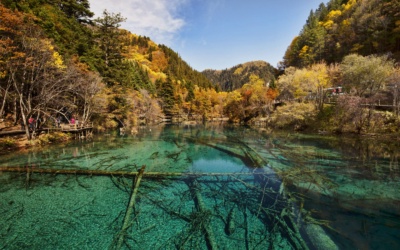
Jiuzhaigou Valley is a mountain landscape in northern Sichuan known for clear, unusually colored lakes, waterfalls and forest. UNESCO describes its 72,000-hectare property as a karst landscape with varied forest ecosystems and threatened species. The park describes its lakes and waterfalls in separate features. For a workable itinerary, separate the long arrival from the final road transfer, and use the park’s listed visitor information as a reference to recheck for your visit.
Choose your arrival route by the whole journey
Train from Chengdu: The park’s arrival page describes trains from Chengdu East to Huanglong Jiuzhai, Huangshengguan and Songpan. It gives 1 hour 39 minutes as the fastest Chengdu East to Huanglong Jiuzhai rail time, then lists Huanglong Jiuzhai station about 93 kilometres and around two hours by road from the park. These are separate legs. Add your station access and waiting time, then arrange the onward ride separately. The page links to China Railway’s 12306 site for date-specific trains and fares.
Fly: The park arrival page places Jiuhuang Airport about 88 kilometres from the Jiuzhaigou entrance and lists roughly 1.5 hours by road. Treat that as the page’s route reference, not a promised transfer time. It also warns that mountain weather can disrupt flights. Check actual flight dates and arrange the airport transfer before building a same-day connection.
Go overland: The same park page describes road approaches from Chengdu, Mianyang and Gansu. Its Chengdu route listing gives about 440 kilometres and 9 to 10 hours, before any stops or delays. Compare the full road journey with train plus transfer, and leave a buffer rather than tying your arrival to an onward departure.
Things to Do
Offers are only loaded from GetYourGuide after you click. GetYourGuide can then process your IP address and set cookies. Privacy Policy
GetYourGuide partner offers. GoAsia may earn a commission if you book through these offers. Check whether tickets or transfers are included, and follow the attraction's official booking and admission rules.
Read the park’s visitor page before choosing a date
The park visitor page checked on 6 October 2026 says hours and ticket prices vary by season, and that some scenic spots can close seasonally in the off-season. It lists park hours of 7:30 a.m. to 6 p.m. from April 1 to November 15, and 8:30 a.m. to 6 p.m. from November 16 to March 31. It also says visitors must leave before 6 p.m. and overnight accommodation inside the scenic area is prohibited. The page does not show a publication or revision date, so confirm the current notice for your visit date.
| Season named on the park page | Listed adult entrance ticket | Listed sightseeing vehicle ticket |
|---|---|---|
| April 1 to November 15 | CNY 190 per person | CNY 90 per person |
| November 16 to March 31 | CNY 80 per person | CNY 80 per person |
These are the adult amounts displayed on that undated English page when checked, not a guarantee of the amount or ticket availability on a future date. The page lists the vehicle ticket separately from entrance, and describes its insurance item as voluntary. It also shows separate off-season concessions for students, older adults and children. Check the current eligibility categories, booking steps and rates before paying.
Use the park’s own highlights to shape a day
The park’s English pages, published in 2015, describe 114 lakes spread across more than 1,000 metres of altitude and five major waterfalls. They single out Pearl Shoals and Nuorilang among the waterfalls described in their winter feature. Use those pages as orientation rather than a promise that every feature is open or accessible on your date. With one day, choose a small number of areas and leave time for the park’s internal transport and walking; a second day gives you a less compressed visit.
Season is a scenery choice as well as an operations question. The park’s 2015 page describes frozen waterfalls as a winter feature, while its visitor page notes that some sites can close in the off-season. Do not assume a particular waterfall will be frozen, or that every area or service will operate. Confirm the dated park notice and current ticket arrangement before you travel.
Plan for altitude, not just distance
The park and UNESCO describe a high mountain setting, but individual responses to altitude vary. The CDC Yellow Book advises gradual ascent, light activity during the first 48 hours at altitude, and avoiding alcohol during that period. A new headache with nausea, dizziness or unusual fatigue after ascent can indicate altitude illness. Do not ascend to sleep higher while symptomatic; if symptoms worsen at the same altitude despite rest or treatment, descend. Confusion or trouble walking can signal high-altitude cerebral edema, while breathlessness at rest can signal high-altitude pulmonary edema. These are emergency signs: seek urgent medical help, minimize exertion and arrange assisted descent promptly. This general information is not personal medical advice.
Decide whether to add Huanglong
Huanglong is a separate UNESCO-listed property in north-west Sichuan. UNESCO describes its mountain scenery, limestone formations, waterfalls and hot springs. Treat it as a separate stop when planning, not as an attraction inside Jiuzhaigou. The pages reviewed here do not establish a current transfer timetable, ticket combination or cable-car operating status, so do not build a tight same-day connection around an assumed service. For local planning, see our Huanglong guide.
For more route ideas across the country, see our China travel guide.
Sources and background
These sources support the topics listed below, not every statement or current price in this article.
- [1] Jiuzhaigou National Park: Arrival and transport to Jiuzhaigou. Retrieved October 3, 2026. Transport
- [2] Jiuzhai Valley National Park: Visitor information. Retrieved October 6, 2026. Access, Admission, Opening hours
- [3] UNESCO World Heritage Centre: Jiuzhaigou Valley Scenic and Historic Interest Area. Retrieved October 6, 2026. Nature, History
- [4] US Centers for Disease Control and Prevention, Yellow Book 2026: High-Altitude Travel and Altitude Illness. Retrieved October 6, 2026. Health, Safety
- [5] Jiuzhai Valley National Park: Lakes. Retrieved October 6, 2026. Nature
- [6] Jiuzhai Valley National Park: Waterfalls. Retrieved October 6, 2026. Nature
- [7] Jiuzhai Valley National Park: Frozen Waterfalls. Retrieved October 6, 2026. Nature
- [8] UNESCO World Heritage Centre: Huanglong Scenic and Historic Interest Area. Retrieved October 6, 2026. Nature, History
Frequently Asked Questions
Set aside at least one full park day as a planning baseline. Choose fewer stops if your visit is limited to one day, and allow a second day if you want a slower route. This is an itinerary suggestion, not a claim about the time needed for every visitor.
When checked on 6 October 2026, the park’s undated English visitor page listed adult entrance and sightseeing-vehicle tickets separately: CNY 190 and CNY 90 in its April 1 to November 15 season, and CNY 80 for each in its November 16 to March 31 season. Confirm the dated rate and availability before travel.
The park arrival page lists 1 hour 39 minutes as the fastest train time from Chengdu East to Huanglong Jiuzhai station. It separately describes about 93 kilometres and roughly two hours by road from that station to the park. Add station access and waiting time, and arrange the onward transfer separately.
The park arrival page lists Jiuhuang Airport about 88 kilometres and roughly 1.5 hours by road from the park entrance. That is a route reference, not a guaranteed transfer time. Check flights for your dates and leave room for mountain-weather disruption.
The park’s English visitor page, checked on 6 October 2026, lists 7:30 a.m. to 6 p.m. for April 1 to November 15 and 8:30 a.m. to 6 p.m. for November 16 to March 31. The page has no visible revision date and says some places may close in the off-season, so confirm the current notice.
Yes. The CDC advises gradual ascent and light activity during the first 48 hours at altitude. A new headache with nausea, dizziness or unusual fatigue after ascent can indicate altitude illness. Do not go higher to sleep while symptomatic. Confusion, difficulty walking or breathlessness at rest are emergency warning signs that require urgent medical help, minimal exertion and assisted descent. Ask a clinician about personal risk before travel.
You can plan Huanglong as a separate regional stop. UNESCO describes it as its own property in north-west Sichuan. The reviewed sources do not establish current transfer times or combined tickets, so leave enough time between visits and confirm transport and access independently.
The park’s English visitor-information page says overnight accommodation inside the scenic area is prohibited and visitors must leave before 6 p.m. Confirm the current visitor notice before booking lodging or a late departure.