Reed Flute Cave is the kind of attraction that splits travelers neatly into two camps. Some find the multicolored floodlights kitschy and over the top. Others walk out grinning, having just spent an hour wandering through one of the more theatrical natural spaces in southern China. The truth sits somewhere in the middle, and knowing what to expect before you go makes the difference between a fun stop and a disappointment.
The cave sits on the northwestern edge of Guilin, a city already famous for its surreal karst landscape of pointed limestone hills. Underground, that same geology produces a 240-meter walking route packed with stalactites, stalagmites, stone pillars, and curtain-like rock formations, all lit in shifting reds, blues, greens, and purples. It has been a recognized scenic spot for decades and remains one of Guilin's classic urban attractions, easy to reach and easy to fit into a half day.
This guide covers what the cave actually is, how to get there from central Guilin, how much time to budget, how the lighting and atmosphere work, and how to pair it efficiently with nearby sights like Elephant Trunk Hill. It also covers the honest downsides so you can decide whether it belongs on your itinerary.
What Reed Flute Cave Actually Is
Reed Flute Cave is a natural limestone cave formed over hundreds of thousands of years by the slow dissolution of carbonate rock and the patient buildup of mineral deposits. The result is a dense gallery of formations: thick stalactites hanging from the ceiling, stalagmites rising from the floor, stone curtains, and column-like pillars where the two have fused together.
The name comes from the reeds that once grew at the cave entrance, traditionally used to make simple flutes. Inside, the route follows a paved, illuminated path that loops through a series of chambers, each given an evocative name by guides and signage. The largest space, often called the main hall, is big enough to feel genuinely cavernous and is the visual highlight for most visitors.
What sets Reed Flute Cave apart from a wild or minimally developed cave is the deliberate theatrical lighting. Colored LEDs and floodlights wash the formations in saturated hues, and water pools on the floor create mirror reflections that double the effect. It is closer to a designed light show inside a natural cavern than a raw geological experience. If you go expecting subtle natural beauty, the color scheme can feel artificial. If you go expecting a dramatic, photogenic spectacle, it delivers.
Things to Do
Why It Matters in Guilin
Guilin's reputation rests on its landscape, and most of the iconic views are outdoors: the Li River, the karst peaks, the rice terraces in the wider region. Reed Flute Cave offers something different. It is the city's signature underground attraction and a longstanding fixture on Guilin tour itineraries.
For independent travelers, the cave fills a specific gap. It is fully indoors, which makes it a reliable backup when the weather turns. Guilin sees substantial rain, especially in the warmer months, and the karst scenery loses much of its magic under heavy cloud and downpours. The cave does not care about the weather. The temperature inside stays cool and stable year round, the path is sheltered, and a wet day outside has no effect on the experience.
It is also close to the city center compared with the more famous river and terrace excursions, which require significant travel time. That accessibility means you can slot it into a morning or afternoon without committing to a full-day trip.
Getting There From Central Guilin
Reed Flute Cave lies in the northwest of Guilin, a short distance from the city center. There are a few practical ways to reach it.
By taxi or ride-hailing
The simplest option for most independent travelers is a taxi or a ride-hailing app. From central Guilin the drive is short, usually well under half an hour depending on traffic and your starting point. This is the lowest-stress choice, especially if you do not read Chinese or want to avoid working out bus routes. Ride-hailing apps that operate in China can be easier than flagging a street taxi if you have one set up and a working local payment method.
By public bus
Public buses serve the cave area and are very cheap, but routes and numbers change over time, so confirm the current bus line before you set out. Buses are slower and require a bit of navigation, but they are a budget-friendly way to reach the site. Carry the cave name written in Chinese characters to show the driver or fellow passengers if needed.
As part of a tour
Many Guilin sightseeing tours bundle the cave with other city attractions. If you prefer not to handle logistics, a half-day group tour can package the cave with stops like Elephant Trunk Hill and Seven Star Park. The tradeoff is fixed timing and the usual group-tour pace. Independent travelers who want flexibility are usually better off going on their own.
Tickets, Hours, and What to Verify
Reed Flute Cave charges an entrance fee, and like most major Chinese attractions, ticket prices and opening hours are subject to change. Treat any figure you read online as approximate and confirm the current price and hours before you visit, ideally on the day or the day before.
A few practical points worth checking ahead of time:
- Current ticket price and whether it differs by season or includes any internal services.
- Opening and closing times, since the last admission is usually well before the official closing time.
- Whether a guide accompanies your group. Visits are often timed and led through the cave in batches, which affects how much you can linger.
- Payment methods. Many Chinese attractions favor mobile payment or pre-booking through apps, and cash or foreign cards may not be accepted at the gate.
Booking ahead through an official channel or a reputable platform can save time at the entrance during busy periods, though it is not always necessary for a cave of this scale.
What the Visit Is Actually Like
The walking route through the cave runs roughly 240 meters along a paved, well-lit path. It is a one-way loop in most setups, so you follow the crowd through the chambers and exit near where you started, without backtracking.
Expect to spend somewhere between 40 minutes and an hour inside, depending on how you visit. If you are part of a guided batch, the pace is set for you and the visit tends to run on the shorter end. If you can move at your own speed, you may linger longer at the main hall and the reflection pools for photos.
This short visit length is worth planning around. Reed Flute Cave is not a half-day experience on its own. It is best treated as one component of a larger day, paired with other nearby sights, rather than a standalone destination that justifies a long journey.
The lighting and the photography
The colored lighting is the defining feature. Whether you love it or not, it makes for striking photos, particularly in the main hall where still water reflects the illuminated formations into a near-perfect mirror. For the best shots, hold back slightly from the group so people are not crowding your frame, and steady your phone or camera against the low light. Flash photography tends to wash out the colored effect, so it is usually better to rely on the ambient lighting.
Be realistic about the limits. The path can get congested when multiple groups overlap, and you may not be able to stop wherever you like. The colors shift on the cave's own schedule, not yours, so a formation that looks one shade now may be lit differently a few minutes later.
Reed Flute Cave as a Bad-Weather Backup
One of the most useful things to know about Reed Flute Cave is that it works as a weather insurance policy. Guilin's outdoor attractions are heavily dependent on conditions. The river cruise, the karst peaks, and the photogenic viewpoints all suffer in heavy rain or thick haze.
If you wake up to a washout, the cave is a smart pivot. It is indoors, climate-stable, and unaffected by what is happening outside. Keep it in mind as a flexible slot in your Guilin itinerary rather than locking it to a specific day. If the forecast looks clear, prioritize the outdoor scenery and save the cave for a grayer day. If you are working with a fixed schedule, the cave is the one Guilin sight you can count on regardless of weather.
Pairing With Elephant Trunk Hill and Other Sights
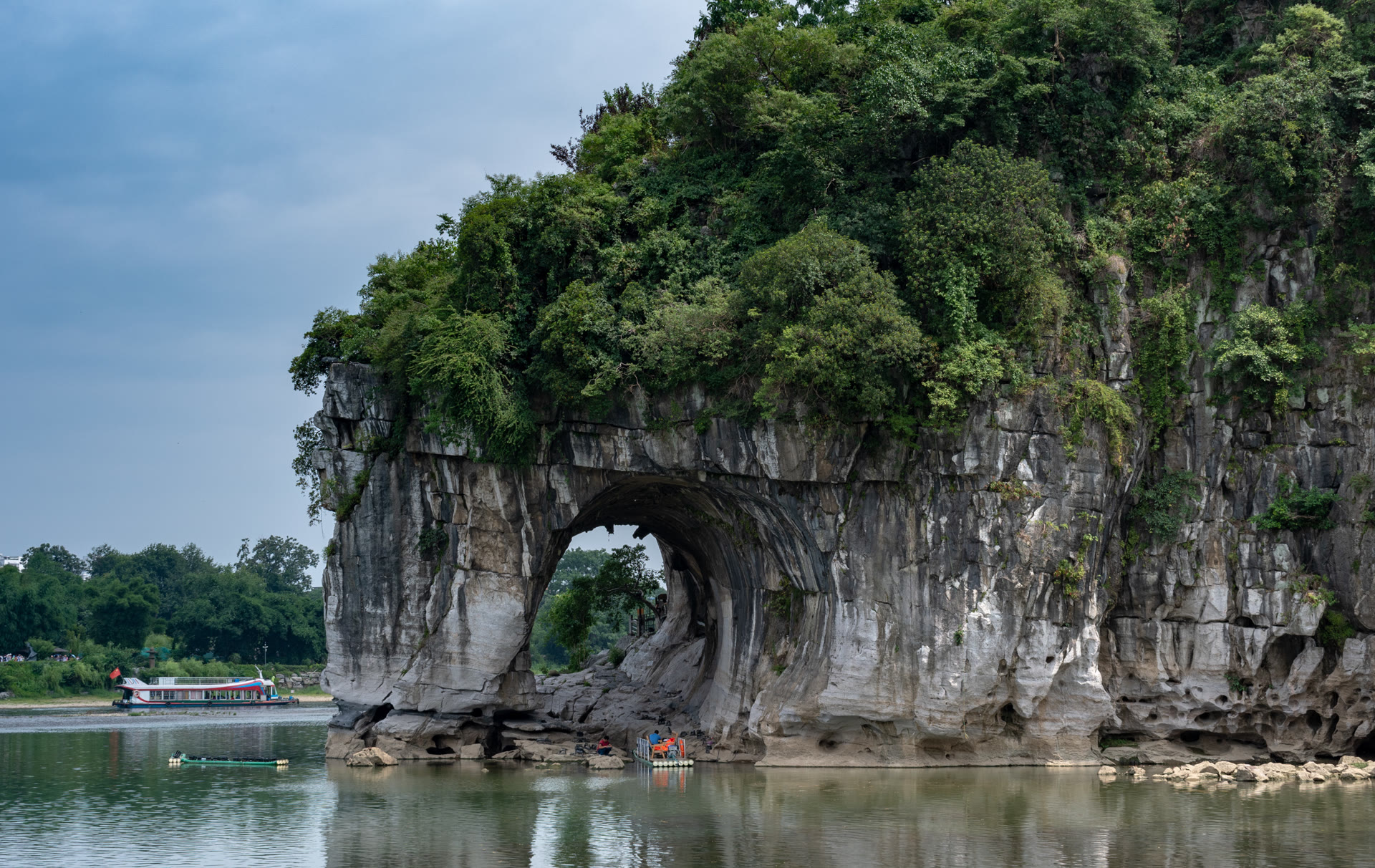
Because the cave visit is short, the smart move is to combine it with other Guilin attractions to build a satisfying half or full day. The most natural pairing is Elephant Trunk Hill, the city's most iconic landmark, named for a rock formation that resembles an elephant dipping its trunk into the river. It is one of Guilin's defining images and sits within the central city area.
A workable plan is to do Reed Flute Cave in the morning, then move toward the river and Elephant Trunk Hill, leaving time for a riverside walk. Other options within easy reach of the city include Seven Star Park, with its own caves and green spaces, and the city's lakes and pagodas, which are pleasant at dusk.
| Attraction | Type | Rough time needed | Best for |
|---|---|---|---|
| Reed Flute Cave | Indoor limestone cave | About 1 hour | Bad weather, dramatic photos |
| Elephant Trunk Hill | Riverside landmark | 1 to 2 hours | Guilin's signature view |
| Seven Star Park | Park with caves | 2 to 3 hours | Green space, leisurely walking |
| Li River area | Outdoor scenery | Half to full day | The classic karst landscape |
If you are using Guilin as a base for the wider region, the cave fits a city day rather than competing with the bigger excursions to the Li River cruise or the Longji rice terraces, both of which deserve their own days. For broader itinerary planning across China and the rest of the region, GoAsia.cc is a useful place to keep mapping out your route.
The Honest Downsides
Reed Flute Cave is not for everyone, and it helps to know the criticisms in advance.
The most common complaint is the lighting. The intensely colored floodlights strike some visitors as gaudy and far from natural. If you prefer caves lit to show off rock in its true tones, or you have visited dramatic show caves elsewhere, this one may feel more like a theme-park installation than a geological site. There is no way to see the formations without the colored lighting, since that is how the cave is presented.
The second issue is crowds. Reed Flute Cave is a well-established attraction that draws large numbers of domestic tour groups. At peak times the narrow path can feel busy, the pace can be hurried, and the noise level inside rises. Going early, or on a weekday, gives you a better chance of breathing room.
Third, the experience is short. An hour underground is the realistic ceiling for most visitors, which makes the entrance fee feel steep to some, especially if travel time to and from the cave eats into the day. Pairing it with other sights softens this, but it is worth setting expectations: this is a quick, scenic stop, not a deep half-day attraction.
Finally, the path can be slippery in places thanks to the cool, damp cave environment. Wear shoes with decent grip and watch your footing, particularly near the water features.
Practical Tips for Visiting Reed Flute Cave
- Go early or on a weekday. Tour groups cluster in the late morning and midday. An early arrival means fewer people in your photos and a more relaxed walk through the chambers.
- Use it as your rainy-day card. If the weather is good, prioritize Guilin's outdoor scenery and save the cave for a wet or hazy day when the indoor setting is a genuine advantage.
- Dress for cool air. The cave stays cool year round, so even in hot, humid weather a light layer is comfortable, especially if you came in from a sweltering day outside.
- Wear grippy footwear. The paths are paved but can be damp and slippery near reflection pools.
- Confirm tickets and hours before you go. Prices and timings change. Check the current details and note the last admission time, which is earlier than closing.
- Sort out payment in advance. Set up a mobile payment method that works in China where possible, since cash and foreign cards are not always accepted.
- Skip flash photography. The colored ambient lighting is the whole point, and flash flattens it. Steady your camera against a railing for sharper low-light shots.
- Pair it smartly. Combine the cave with Elephant Trunk Hill or a riverside walk so a one-hour visit becomes a full, satisfying half day.
- Manage your expectations on the lighting. Decide in advance whether you are there for a dramatic light spectacle or a natural cave. The cave only offers the former.
Is Reed Flute Cave Worth It
For most independent travelers spending a couple of days in Guilin, Reed Flute Cave earns a spot on the list, with caveats. It is easy to reach, weatherproof, and visually striking, and it slots cleanly into a city day alongside Elephant Trunk Hill. The dramatic lighting is exactly what some visitors come for and exactly what others find too much, so your reaction will depend on your taste.
Treat it as a short, scenic, reliable stop rather than a headline attraction. Go in with realistic expectations about the lighting, the crowds, and the brief visit length, and you will likely come away pleased. Combine it well, time it right, and it becomes a smart, low-effort piece of a Guilin itinerary rather than a regret.
Frequently Asked Questions
The walking route is about 240 meters and most visitors spend roughly 40 minutes to an hour inside. Including travel from central Guilin, plan for a half-morning or half-afternoon. Because the visit is short, it is best paired with nearby sights rather than treated as a standalone destination.
Reed Flute Cave charges an entrance fee, but prices and hours change, so confirm the current rate and the last admission time before you go. Booking through an official channel or a reputable platform can save time during busy periods. Set up a mobile payment method in advance, since cash and foreign cards are not always accepted.
A taxi or ride-hailing app is the simplest option and takes well under half an hour from the city center. Public buses serve the area cheaply, but routes change, so confirm the current number first. Many Guilin city tours also include the cave alongside other attractions.
Yes. The cave is fully indoors with a cool, stable temperature year round, so rain or haze outside does not affect the experience. It makes an excellent backup plan when Guilin's outdoor scenery is washed out. Keep it as a flexible slot and prioritize outdoor sights on clear days.
Yes, and it is a recommended pairing. A common plan is to visit the cave in the morning, then head toward the river to see Elephant Trunk Hill, Guilin's most iconic landmark. Both are within the city area, so the combination makes a full and varied half day.
The most common complaint is the intense colored floodlighting, which some find artificial compared with naturally lit caves. Crowds from tour groups can also make the path feel busy and hurried at peak times. Go early or on a weekday and set your expectations for a dramatic light show rather than a raw geological site.
Bring a light layer, since the cave stays cool even on hot, humid days outside. Wear shoes with good grip because the paved paths can be damp and slippery near the reflection pools. A jacket is rarely needed, but you will be glad of long sleeves if you came in from the heat.