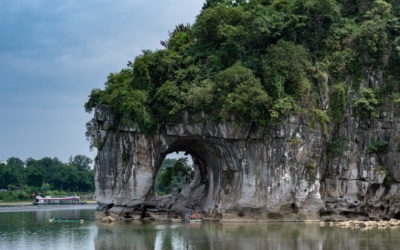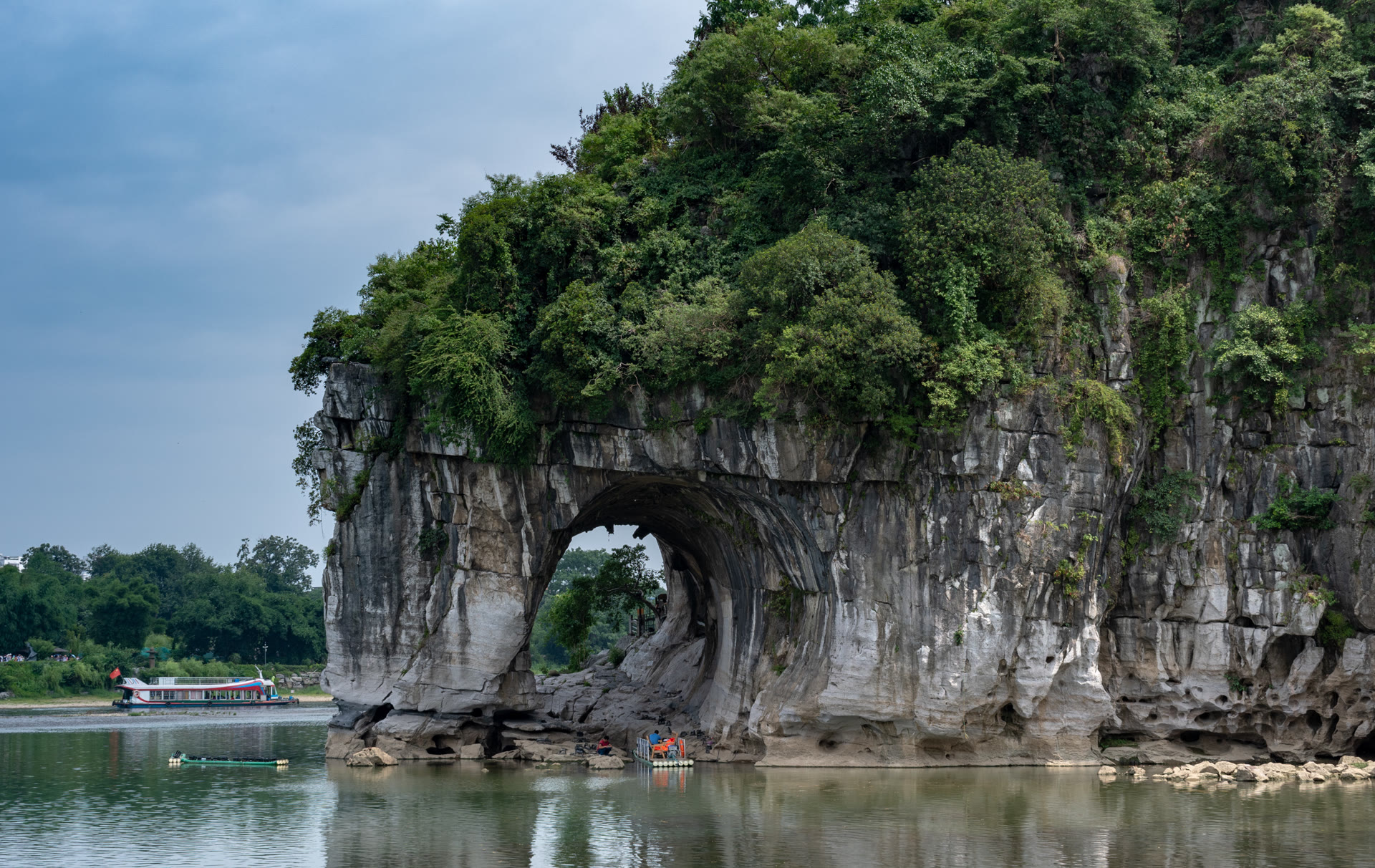
Of all the karst hills scattered around Guilin, none has become as much a symbol of the city as Elephant Trunk Hill. The rock rises at the meeting point of the Li River and the Taohua River, and from the right angle it looks unmistakably like an elephant lowering its trunk into the water to drink. Locals have treated it as the emblem of Guilin for centuries, and you will see its silhouette on everything from postcards to beer labels.
It is a short, manageable sight rather than a half-day expedition. For most independent travelers the hill is a one-hour stop, useful as an introduction to the limestone scenery that defines this corner of Guangxi. The real question is not whether the hill is beautiful, because the shape genuinely is striking, but whether you need to pay to enter the official park when the view is so easy to find from outside.
This guide covers what the hill actually is, how to get the classic photo, the best time of day for light, the free viewpoints across the river, and an honest take on whether it is worth your time if Yangshuo and a Li River cruise are already on your itinerary.
What Elephant Trunk Hill Actually Is
Elephant Trunk Hill is a limestone karst formation in central Guilin, formed over millions of years by water erosion. The defining feature is Water Moon Cave, a natural arch at the base of the hill where the rock between the elephant's head and front leg has worn away, creating the illusion of a trunk dipping into the river. When the water is calm, the arch and its reflection form a near perfect circle, which is where the cave gets its name.
The hill stands roughly 55 meters above the river and sits in a riverside park on the eastern edge of central Guilin. Beyond the famous arch, there are stone inscriptions, a small Ming dynasty pagoda on the summit called Puxian Pagoda, and paved paths that loop around the base and up to viewpoints. None of it takes long to see, and the climb to the top is short.
Culturally, the hill carries the weight of being Guilin's signature image. The classic Chinese saying that Guilin's scenery is the finest under heaven is almost always illustrated with this exact view. For Chinese domestic tourists it is close to a pilgrimage stop, which is worth keeping in mind when you think about crowds.
Things to Do
Why It Matters to Guilin's Identity
Guilin built its tourism reputation on karst landscapes, and Elephant Trunk Hill is the most accessible and photogenic example right in the city. Unlike the dramatic scenery downstream toward Yangshuo, which requires a boat or a drive to reach, this hill is walkable from much of central Guilin. That convenience is exactly why it became the city's icon.
It also functions as a kind of orientation point. Standing at the riverbank here, you can see how the Li River threads between hills, and you get a sense of the geology you will encounter for the rest of your trip. If you have just arrived in Guilin, it is a logical first stop to set the scene before heading out for longer river excursions.
Getting the Classic Photo
The signature view, the one that looks like a drinking elephant with a clean arch, is taken from the riverbank slightly to the side and across the water, not from directly in front. Inside the paid park you can walk right up to the base and even view the arch from the riverside path, but many photographers find the cleanest composition from across the river or from the embankment promenade rather than from within the grounds.
For the strongest shape, you want the elephant's head and the arch both clearly separated against the water. Calm conditions help because the reflection completes the circular effect. After rain or on overcast days the water can be muddy and the contrast flat, so a clear morning is ideal.
Best Time of Day and Light
Light makes a real difference here. The hill faces in a way that catches good morning light, and early arrival also means fewer tour groups, who tend to pour in mid morning and through the middle of the day. If you want a calm photo and a quieter walk, aim to be there shortly after opening.
Late afternoon into the golden hour is the other strong window, with warmer tones on the rock. Some travelers come back in the evening when the hill and pagoda are lit, which is attractive but turns the visit into a different, more commercial experience. Midday is the weakest combination of harsh light and peak crowds.
Seasonal notes
Guilin is wet and humid in spring and early summer, when river levels rise and haze can soften the view. Autumn generally brings clearer skies and more comfortable temperatures, making it a favorable season for the classic photo. Winter is cooler and quieter, though the scenery can look more muted. Heavy rain at any time can raise the river enough to partly submerge the lower arch, so check conditions if the reflection effect is important to you.
Tickets, Access, and the Free Viewpoint Question
The hill sits inside an official scenic park with an entrance fee. The park gives you access to the base paths, the climb to Puxian Pagoda, and the closest views of Water Moon Cave. Ticket prices, opening hours, and any seasonal adjustments change over time, so confirm the current entry fee and hours before you go rather than relying on older figures.
Here is the honest part. Many independent travelers feel the paid entry is not essential, because the iconic elephant shape is clearly visible from public riverbank areas outside the park, including viewpoints across the Li River. You can get the famous photograph for free with a short walk. What you pay for inside is proximity to the cave, the inscriptions, and the short summit climb with its rooftop view over the river bend.
Whether that is worth it depends on your priorities. If you collect close-up experiences and want to stand inside the arch area, buy the ticket. If you mainly want the postcard view and a riverside stroll, the free vantage points may be enough. Budget travelers and those short on time often choose the free route.
| Option | What you get | Best for |
|---|---|---|
| Paid park entry | Close base paths, Water Moon Cave area, summit pagoda climb, inscriptions | Travelers who want the full site and rooftop river view |
| Free riverbank viewpoints | The classic elephant silhouette and arch from across or beside the river | Budget travelers, quick stops, photographers after the icon shot |
How Much Time to Budget
For the paid park, plan around 45 minutes to an hour and a half. That covers a loop of the base, the short climb to the pagoda, photos, and a bit of unhurried walking. It is not a place you need a full morning for unless you are combining it with a long riverside walk.
If you only want the external view, you can do it in 15 to 30 minutes, including time to find a good angle and take photos. Many people fold the stop into a longer walk along the river embankment.
Nearby Riverside Walks and Combinations
One of the strengths of this hill is its position on Guilin's riverfront, which links to a chain of lakes and parks running through the city center. The Two Rivers and Four Lakes area is a connected waterway loop that makes for a pleasant flat walk, especially in the evening when the lakeside trees and bridges are lit. You can pair the hill with this walk to make a fuller half day on foot.
Other central Guilin hills, such as Fubo Hill and Diecai Hill, are within reach and offer summit climbs with city panoramas if you want more karst scenery without leaving town. Seven Star Park, with its caves and gardens, is also nearby across the river. Together these give you a self-contained day in Guilin city before you head out toward the more famous countryside.
If you are arranging your wider China route, you can keep building the itinerary on GoAsia.cc, which is useful for stitching Guilin together with Yangshuo, the Longji rice terraces, and onward destinations.
Is It Worth Visiting If You Are Going to Yangshuo?
This is the key planning decision, so it deserves a direct answer. Yangshuo and the Li River cruise deliver karst scenery on a far grander scale, with countless hills, rural riverbanks, and the dramatic landscapes that appear on the back of Chinese currency. Compared to that, a single city hill is modest.
However, Elephant Trunk Hill serves a different purpose. It is the named, recognizable icon of Guilin, and it is right in the city where you will likely spend at least one night arriving or departing. Seeing it is less about scale and more about ticking off the symbol and getting an easy first taste of the geology.
A practical recommendation: if you have a free hour in central Guilin, see the hill, ideally from the free viewpoints, and save your serious scenery time and budget for the Li River cruise and Yangshuo countryside. Do not skip Yangshuo to spend extra time at the hill, and do not feel you must pay full park admission if your main scenic experiences are happening downstream. The hill is a worthwhile quick stop, not a destination that justifies a special trip on its own.
Getting There
Elephant Trunk Hill is on the eastern side of central Guilin, near the confluence of the Li and Taohua rivers, and it is genuinely central. From most downtown hotels it is a short taxi ride, a manageable walk, or a quick ride-hail trip. Taxis and ride-hailing apps are cheap and widely used in Guilin, and showing the destination name in Chinese characters helps if there is a language gap.
If you are arriving in Guilin by train, the city's main stations are a short taxi ride from the riverfront. From the airport, the journey into the city center takes longer, so it makes sense to settle into your accommodation first and then walk or ride to the hill rather than trying to stop on the way in.
Local buses also serve the area, but for short hops within central Guilin, ride-hailing is usually simpler for international travelers who do not read Chinese bus routes. Walking is realistic if your hotel is in the central lakes district.
Practical Tips for Visiting Elephant Trunk Hill
- Go early or late. Arrive near opening time or in the late afternoon for softer light and thinner crowds. Midday brings the most tour groups and the harshest light.
- Scout the free angle first. Before paying, walk the public riverbank and look across the water. If the icon photo from outside satisfies you, you may not need the ticket.
- Confirm hours and prices in advance. Entry fees and opening times change, so verify the current details rather than trusting older information.
- Combine with a riverside walk. Link the hill to the Two Rivers and Four Lakes loop for a longer, pleasant stroll, especially attractive in the evening.
- Carry small cash and a payment app. Mobile payment dominates in China. Set up a supported app if you can, and keep some cash as backup for tickets or snacks.
- Mind the river level. After heavy rain the lower arch can partly flood and the reflection effect weakens. Clear, calm days give the best circular Water Moon Cave illusion.
- Bring sun protection in summer. Guilin gets hot and humid in the warm months, and the open riverbank offers little shade.
- Keep expectations realistic. This is a compact city landmark, not a wilderness experience. Treat it as a quick, scenic stop rather than the highlight of your Guilin trip.
Common Mistakes to Avoid
The most frequent error is over-investing time here at the expense of the Li River and Yangshuo, which offer far more. Another is visiting at midday with a tour crowd and leaving disappointed by the light and the press of people. Some travelers also assume they must enter the paid park to see the elephant shape, when the signature view is freely available nearby.
Finally, do not arrive expecting a long hike or a dramatic summit. The climb is short and the scope is small. Framed correctly as a 30 to 60 minute icon stop, the hill is a satisfying part of a Guilin day. Framed as a major attraction, it can feel underwhelming.
Frequently Asked Questions
Yes, but as a quick stop rather than a highlight. The hill is Guilin's iconic city landmark and easy to fit into a free hour, while the Li River cruise and Yangshuo deliver far grander scenery. See the hill for the symbol, then save your main scenic time for downstream.
The official park charges an entrance fee for close-up access to Water Moon Cave and the summit pagoda. However, the classic elephant silhouette is clearly visible from public riverbank viewpoints outside the park, so many travelers get the photo for free and skip the ticket. Confirm the current fee before you go.
It sits on the eastern side of central Guilin near the river confluence and is very central. A short taxi or ride-hail trip works from most downtown hotels, and walking is realistic if you are staying in the central lakes district. Showing the name in Chinese characters helps with drivers.
Early morning gives soft light and fewer crowds, while late afternoon into golden hour brings warm tones on the rock. Avoid midday, when light is harsh and tour groups peak. Calm, clear conditions produce the best circular reflection in Water Moon Cave.
Budget about 45 minutes to an hour and a half if you enter the paid park and climb to the pagoda. If you only want the external view from the riverbank, 15 to 30 minutes is enough. It pairs well with a longer riverside walk along the Two Rivers and Four Lakes loop.
The riverfront connects to Guilin's lakes and parks, making for an easy flat walk that is especially pleasant when lit in the evening. Nearby Fubo Hill, Diecai Hill, and Seven Star Park add more karst scenery and city views, giving you a full day in central Guilin before heading to the countryside.
Yes. After heavy rain the river can rise enough to partly submerge the lower arch and muddy the water, which weakens the famous circular reflection. Clear, calm days are best for the iconic image, so check recent weather and river conditions if the reflection matters to you.