Pha That Luang: Vientiane’s Great Stupa
Photo: Life on the road / Unsplash
Contents
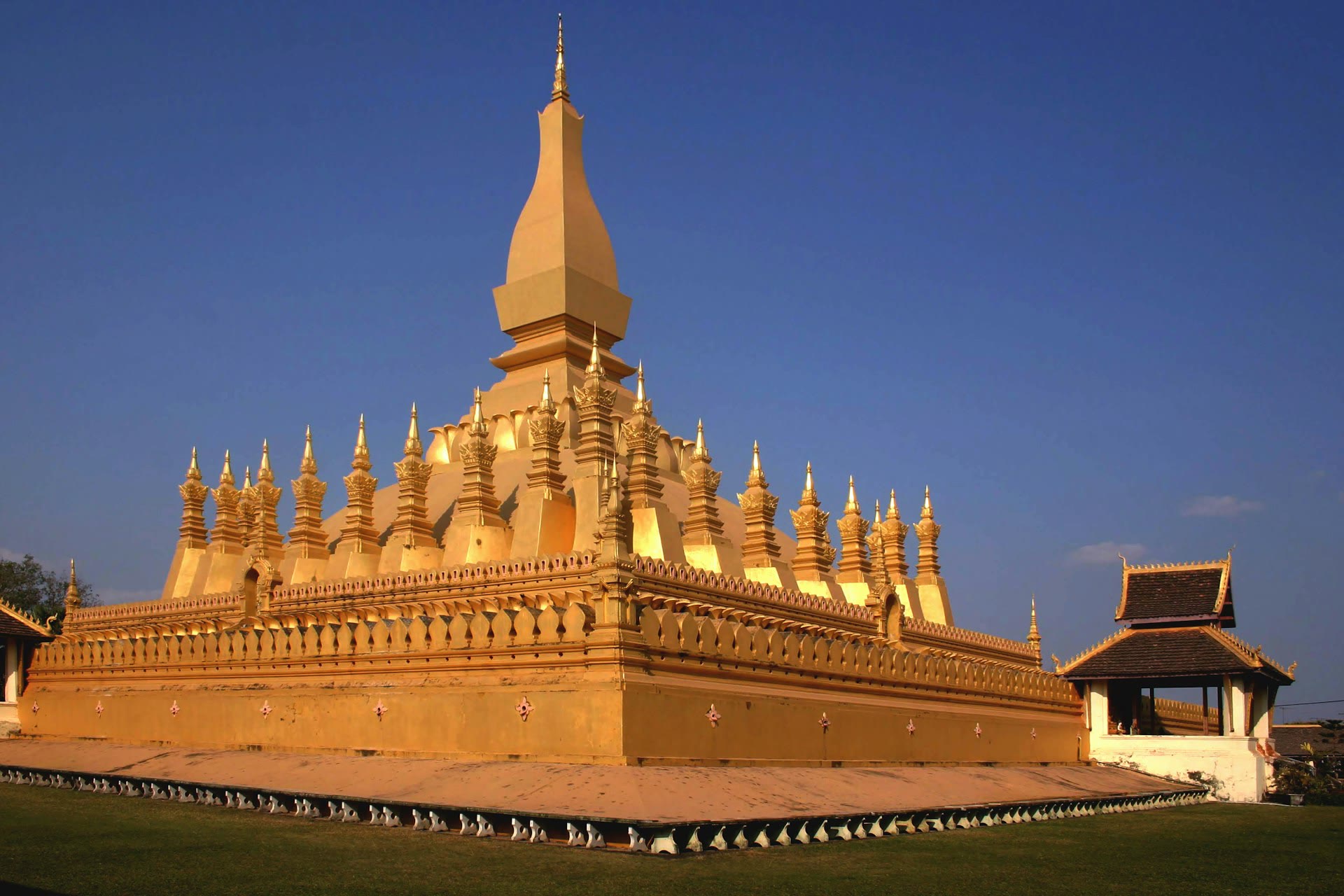
Pha That Luang, or the Great Stupa, is a Buddhist monument in Vientiane and one of Laos’s most important national symbols. A visit makes more sense when you look beyond the gold color: the central spire, the tiered base and the monument’s layered history each tell part of its story. The Tourism Laos overview identifies it as a major national cultural monument, while its landmarks page places it in the center of Vientiane.
A site with more than one historical layer
Tourism Laos presents an account of an earlier structure on the site in 307 BC, attributed to Vientiane’s first governor. This is the tourism page’s historical account, not a claim here of independently verified archaeological dating. The same page dates the original stupa on the site to 1566, under King Saysetthathirath, and notes a restoration in 1953. A separate Tourism Laos landmarks page says the stupa underwent several reconstructions, including work as recently as the 1930s. These short accounts point to a long and changing history, rather than an untouched structure surviving from antiquity.
The UNESCO World Heritage Centre lists That Luang de Vientiane on the country’s Tentative List, with a submission date of 1992. That is not the same as inscription on the World Heritage List, and the Centre notes that the content of a Tentative List is the responsibility of the submitting state. The entry’s description presents the stupa as a Buddhist monument with cosmic symbolism. Read that as the submitted heritage interpretation, not as a current visitor guide.
Things to Do
Offers are only loaded from GetYourGuide after you click. GetYourGuide can then process your IP address and set cookies. Privacy Policy
GetYourGuide partner offers. GoAsia may earn a commission if you book through these offers. Check whether tickets or transfers are included, and follow the attraction's official booking and admission rules.
Read the shape and the gold
The 1992 Tentative List description calls out the central spire, a three-tier base, lotus-petal decoration and thirty smaller reliquaries around the main stupa. It describes the monument’s spire reaching a height of 45 meters and describes the wider enclosure as a larger architectural composition. These details can help you notice the structure’s relationship between its central tower and surrounding levels, rather than treating it as a single gilded surface.
Also, “golden stupa” does not mean the whole monument is covered with real gold. Tourism Laos says only the pinnacle is covered in real gold and the rest is painted gold. Its description compares the gold centerpiece to an elongated lotus bud. That distinction gives you a more accurate way to read the monument’s appearance when you see it in person.
If you are planning around Boun Pha That Luang
Tourism Laos’s festival page describes Boun Pha That Luang as a multi-day event around a full-moon period, usually in November and sometimes in late October. The same page is explicitly marked as a past event and lists the 2022 edition as November 4 to 8. It describes a wax-castle procession associated with Vat Simeuang, alms-giving at the stupa, the traditional Ti Khee game, and trade fairs and performances. Treat those details as an example from that dated edition, not a schedule for a future year.
If the festival is important to your trip, confirm the current year’s dates and program before booking around it. The lunar timing can shift on the Gregorian calendar, and the cited event page does not establish the next edition’s dates, event layout, transport arrangements or accommodation availability.
What to confirm before setting out
The sources linked here explain the monument’s location in central Vientiane, historical meaning and architecture, but they do not provide reliable current visitor hours, admission prices, transport fares, photography rules or access arrangements for each level and nearby temple. Confirm the details that matter for your visit with a current local tourism or site notice. This is especially useful if you have limited time, need step-free access, or are visiting during a festival period.
For a first visit, make the stupa itself the focus and allow your itinerary to depend on the current access information you can verify. Do not rely on old prices, opening schedules or claims about which areas are open. If you are deciding whether to visit during Boun Pha That Luang, use a current event announcement rather than the 2022 listing linked above.
For more places to explore in the capital, see our Laos travel guide.
Sources and background
These sources support the topics listed below, not every statement or current price in this article.
- [1] Tourism Laos: That Luang. Retrieved October 6, 2026. History, Culture
- [2] Tourism Laos: Legendary Landmarks. Retrieved October 6, 2026. History, Culture
- [3] Tourism Laos: That Luang Festival, 2022 event page. Retrieved October 6, 2026. Culture, History
- [4] UNESCO World Heritage Centre: That Luang de Vientiane, Tentative List entry. Retrieved October 6, 2026. History, Culture
Frequently Asked Questions
Pha That Luang, also called the Great Stupa, is a Buddhist monument in central Vientiane. Tourism Laos describes it as an important national cultural monument and national symbol of Laos.
No. Tourism Laos says only the pinnacle is covered in real gold and that the rest of the stupa is painted gold. Its overview compares the gold centerpiece to an elongated lotus bud.
Tourism Laos presents an account of an earlier structure in 307 BC, rather than evidence that the present monument survives from that date. Its page and the 1992 Tentative List description date the stupa to 1566. The tourism pages also describe later reconstructions in the 1930s and a restoration in 1953.
The UNESCO World Heritage Centre page lists That Luang de Vientiane on Laos’s Tentative List, with a 1992 submission date. A Tentative List entry is not the same as inscription on the World Heritage List.
The 1992 Tentative List description interprets the stupa as a symbol of the cosmic mountain. It describes a central spire rising from a three-tier base with lotus-petal decoration and thirty smaller reliquaries around it.
A Tourism Laos event page says the multi-day festival is held around a full-moon period, usually in November and sometimes in late October. Its listed event is from 2022, so confirm the dates for the year you plan to travel.
The past 2022 event page describes a wax-castle procession associated with Vat Simeuang, alms-giving at Pha That Luang, the Ti Khee game and fairs and performances. It is a historical example, not a promise that the next edition will have the same program.
The linked history and heritage pages do not establish today’s opening hours, admission, transport fares, photography rules or access arrangements. Check a current local tourism or site notice for the details that affect your visit, especially if you have limited time or access requirements.