White Temple Chiang Rai: Wat Rong Khun, Thailand's Most Dazzling Modern Masterpiece

White Temple Chiang Rai: Wat Rong Khun, Thailand's Most Dazzling Modern Masterpiece

Last updated: March 18, 2026

Most Thai temples are centuries old, built by kings and maintained by monks across generations. The White Temple in Chiang Rai breaks every one of those conventions. Designed and funded by a single living artist, constructed entirely in white and mirror glass, and filled with murals that place Superman and Hello Kitty alongside Buddhist deities, Wat Rong Khun is unlike anything else in Thailand. It is a temple, an art installation, and a philosophical statement all at once.

Chalermchai Kositpipat, one of Thailand's most celebrated visual artists, began building Wat Rong Khun in 1997 on the site of a dilapidated temple near his hometown. He has poured his personal fortune into the project, refusing government funding to maintain full creative control. The temple remains unfinished and construction continues to this day, with Kositpipat aiming to complete it as a gift to the people of Thailand and to the Buddhist faith. Visiting now means seeing a work in progress, which somehow makes it even more compelling.

Why the Temple Is White

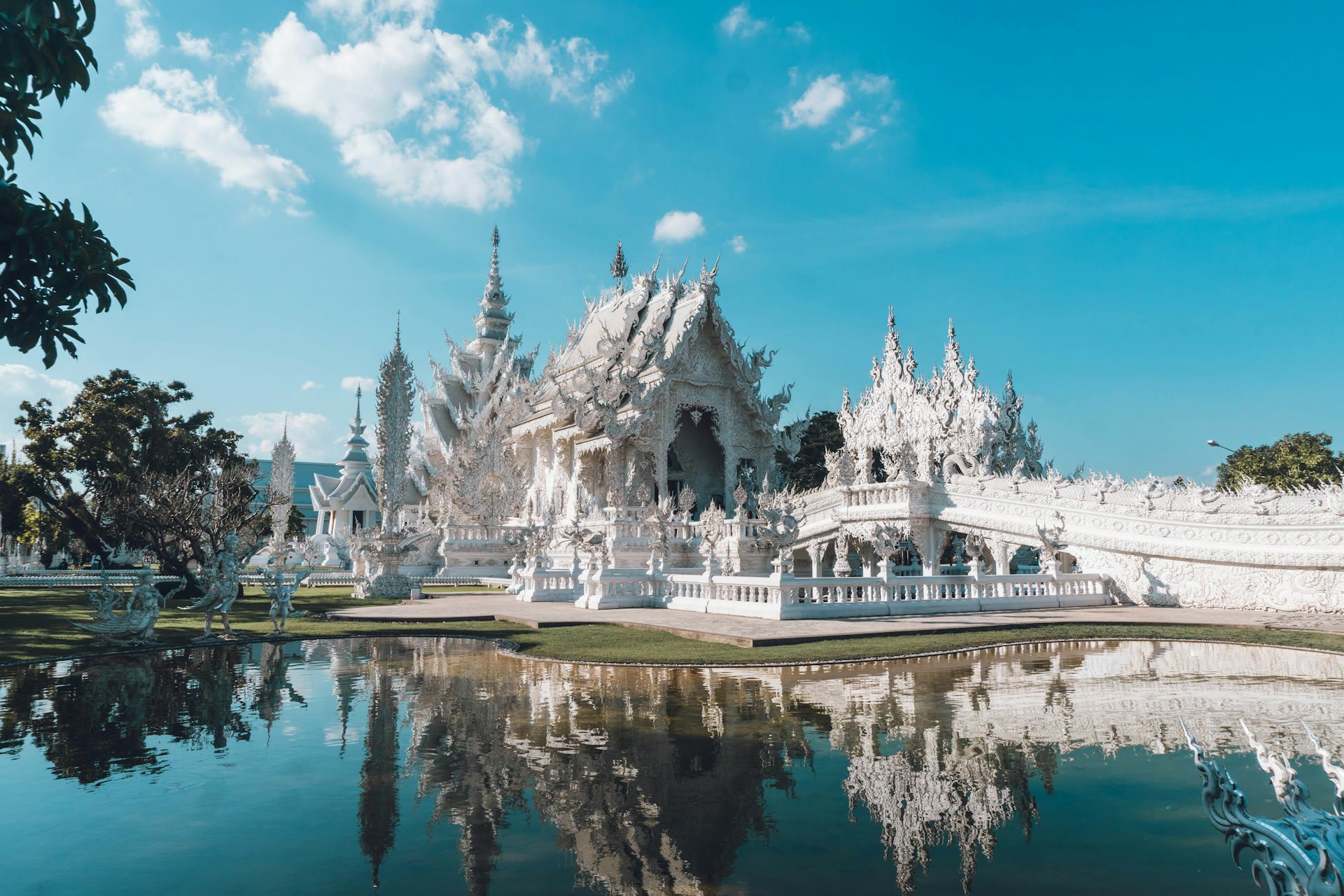
In traditional Thai temples, gold represents the wealth and glory of the Buddha. Kositpipat chose white instead, symbolizing the purity of the Buddha's teachings. The mirror glass embedded throughout the exterior represents the wisdom of the Buddha radiating across the world. On a bright day, the effect is staggering. The entire structure shimmers and glows, almost painful to look at in direct sunlight, as if the building itself is made of light.

The symbolism extends to every detail. The white bridge leading to the main hall crosses over a field of outstretched hands reaching up from below, representing desire and greed. Walking across the bridge symbolizes the journey from the cycle of rebirth to the enlightenment found within. It is theatrical, intentionally unsettling, and impossible to forget.

Things to Do

Inside the Main Hall (Ubosot)

Photography is strictly forbidden inside the main hall, which only adds to the sense of entering something sacred and strange. The interior murals are where Kositpipat's vision becomes truly wild. Alongside traditional Buddhist imagery of heaven, hell, and the cycle of rebirth, you will find painted depictions of Neo from The Matrix, the Twin Towers burning, Spiderman, Kung Fu Panda, and various other pop culture icons.

This is not irreverence. Kositpipat uses these images to illustrate how modern temptations, from technology to consumerism to violence, trap human beings in cycles of suffering. The murals chart a journey from a chaotic modern hell toward Buddhist enlightenment at the center of the ceiling. It is provocative, densely layered, and worth the entire trip to Chiang Rai on its own.

The Temple Grounds

The White Temple complex extends well beyond the main hall. The grounds include several buildings and art installations, each with its own purpose and style.

The Golden Building

A striking gold structure stands in sharp contrast to the white temple. This is, rather humorously, the bathroom. Kositpipat designed it in gold to represent the body and material wealth, while the white temple represents the mind and spiritual purity. It may be the most photographed public toilet in Southeast Asia.

A separate building houses Kositpipat's paintings and prints. Many are for sale, ranging from affordable small prints to major original works priced in the hundreds of thousands of baht. Even if you are not buying, the gallery offers valuable context for understanding the artist's broader body of work and the philosophy driving the temple's design.

The Wishing Well and Hanging Tree

Near the main hall, a large tree is covered in small metal leaves on which visitors have written wishes. For a small donation, you can add your own leaf. A nearby wishing well invites coin tosses. These feel like classic temple rituals given a Kositpipat twist.

Other Structures

The grounds also include a meditation hall, a monks' quarters, and several sculptural installations featuring mythical creatures, demon figures, and skeletal heads. New elements appear regularly as construction continues. Each visit to the temple can reveal something that was not there the time before.

Visiting the White Temple

Practical Details

DetailInformation
Opening hoursDaily, 8:00 AM - 5:00 PM (grounds open from 6:30 AM)
Admission (foreigners)100 baht (about $3)
Admission (Thai nationals)Free
LocationPa O Don Chai, Mueang Chiang Rai, about 13 km south of Chiang Rai city center
Time needed60 - 90 minutes
PhotographyAllowed on grounds, forbidden inside the main hall

How to Get There

The White Temple sits about 13 kilometers south of Chiang Rai city along Highway 1 (Phahonyothin Road), roughly a 15-minute drive.

  • Songthaew (shared pickup truck): Blue songthaews run from Chiang Rai bus station 1 to the temple area. The fare is around 20 baht per person, but departures are irregular and you may wait a while.
  • Tuk-tuk or Grab: A tuk-tuk from Chiang Rai center costs around 200-300 baht one way. Grab rides are slightly cheaper and easier to arrange for the return trip.
  • Motorbike rental: Renting a motorbike in Chiang Rai costs about 200-300 baht per day and gives you the freedom to combine the White Temple with the Blue Temple (Wat Rong Suea Ten) and the Black House (Baan Dam Museum) in a single loop.
  • Organized tour: Many half-day tours from Chiang Rai combine the White Temple, Blue Temple, and Black House for around 500-800 baht per person. These are efficient but limit your time at each stop.

Getting to Chiang Rai

Most visitors reach Chiang Rai from Chiang Mai. Buses run frequently (about every hour) from Chiang Mai bus terminal, taking roughly three hours and costing 150-300 baht depending on the bus class. Flights from Bangkok take about 90 minutes. For detailed route guides and transport options across Thailand, GoAsia.cc covers all the connections.

The Three Temples of Chiang Rai

The White Temple is the most famous, but Chiang Rai has two other contemporary art-temples that make a natural trio for a day of sightseeing.

  • Blue Temple (Wat Rong Suea Ten): Located in the city center, this temple is decorated entirely in vivid blue with gold accents. It features a striking white seated Buddha and intricate murals. Free admission.
  • Black House (Baan Dam Museum): Created by artist Thawan Duchanee, this is a complex of around 40 dark wooden structures filled with animal skins, bones, horns, and surreal art. It represents the darker side of human nature and stands in stark philosophical contrast to the White Temple. Admission is 80 baht.

Visiting all three in one day is easily doable by motorbike or hired car. The Black House is about 20 minutes north of the city, the Blue Temple is in the center, and the White Temple is 15 minutes to the south.

Tips for Visiting Wat Rong Khun

  • Arrive early. The temple opens at 8:00 AM but the grounds are accessible from 6:30 AM. Tour buses from Chiang Mai start arriving by 10:00 AM, and by midday the main bridge can feel uncomfortably crowded. Getting there by 8:00 AM gives you the best light for photos and far fewer people.
  • Bring sunglasses. This is not a joke. The all-white, mirror-covered exterior is blindingly bright in the morning sun. Squinting through your entire visit is not ideal.
  • Wear appropriate clothing. Shoulders and knees must be covered. The temple provides cover-up garments for those who arrive underdressed, but they are not flattering. Save yourself the hassle and dress modestly.
  • Remove shoes before entering the main hall. Shoe racks are provided outside. The floor inside can be cool, which is a relief after the sun-baked walkways.
  • The one-way system on the bridge is strict. You cross the bridge to the main hall and exit via a different path. There is no going back for a second look or a missed photo. Take your shots before you cross.
  • Budget 60-90 minutes. The main hall visit is quick, but the grounds, gallery, and various installations deserve unhurried exploration. Do not rush through on a tight tour schedule if you can help it.
  • Combine with the Blue Temple and Black House. Together, these three sites offer a fascinating study in contrasting artistic visions. A motorbike rental makes the loop easy and gives you full control over your schedule.
  • Check for temporary closures. Sections of the temple occasionally close for ongoing construction. The main hall and bridge are almost always open, but newer buildings may be roped off.

Frequently Asked Questions

What is the White Temple in Chiang Rai?

Wat Rong Khun, known as the White Temple, is a contemporary Buddhist temple designed by Thai national artist Chalermchai Kositpipat. Unlike traditional Thai temples, it is built entirely in white with mirror glass to symbolize the purity and wisdom of the Buddha. Construction began in 1997 and continues to this day as Kositpipat's personal lifelong project.

How much does it cost to visit the White Temple?

Foreign visitors pay an admission fee of 100 baht (roughly $3). Thai nationals enter for free. There are no additional charges for the grounds, gallery, or other buildings within the complex.

How do I get to the White Temple from Chiang Rai?

The temple is about 13 kilometers south of Chiang Rai city center, roughly 15 minutes by car. You can take a tuk-tuk for 200-300 baht, use Grab, rent a motorbike for about 200-300 baht per day, or join a half-day tour that typically includes the Blue Temple and Black House as well.

Can I take photos inside the White Temple?

Photography is strictly forbidden inside the main hall (ubosot) where the murals are located. However, you can freely photograph the exterior, the bridge, the grounds, and all the other buildings and sculptures in the complex.

What is the dress code for the White Temple?

Visitors must cover their shoulders and knees, as at any Thai temple. The temple provides loose cover-up garments at the entrance for those who arrive in inappropriate clothing, but bringing your own modest attire is recommended for comfort and convenience.

Is the White Temple a real temple or just an art gallery?

It is a fully consecrated Buddhist temple with an active ubosot (ordination hall) and monks' quarters. However, it also functions as a large-scale art installation. The murals, sculptures, and architectural choices all serve Kositpipat's artistic vision while remaining rooted in Buddhist theology and practice.

How long should I spend at the White Temple?

Most visitors spend 60 to 90 minutes exploring the full complex. The guided path through the main hall takes only about 15 minutes, but the surrounding grounds, art gallery, sculptures, and installations deserve time to absorb. Rushing through in 30 minutes means missing most of what makes the place special.

Can I visit the White Temple, Blue Temple, and Black House in one day?

Absolutely. All three are within a 30-minute drive of each other and easily combined into a half-day or full-day itinerary. Renting a motorbike or hiring a car gives you flexibility. Many organized tours also combine all three for 500-800 baht per person.