Plan your Laos ferry trip on the Mekong River. Covers slow boats, speedboats, booking tips, classes, and what to expect on board for an unforgettable journey.
Laos is one of the few countries in Southeast Asia with no coastline, yet water travel here is anything but an afterthought. The Mekong River and its tributaries have served as the country's primary highways for centuries, long before roads cut through the mountainous terrain. Traveling by ferry and river boat in Laos is less about modern maritime infrastructure and more about surrendering to the unhurried rhythm of the water, watching limestone karsts and dense jungle slide past.
River boats in Laos are both a practical lifeline for remote communities and one of the most atmospheric ways for visitors to experience the country's interior. The experience is basic, sometimes uncomfortable, and memorable.
The Ferry Network in Laos
Laos has no ocean ferries, so all water-based transport operates on rivers and reservoirs. The Mekong River is the backbone of the network. The most famous and well-traveled route runs between Huay Xai (Houai Xay, across the border from Chiang Khong in Thailand) and Luang Prabang, a two-day journey south down the Mekong.[1] Huay Xai is a popular river port for slow boats and cruisers running down the Mekong to Pakbeng, Luang Prabang and beyond.[1]
Beyond the Mekong, smaller boats operate on the Nam Ou River in the north. Muang Ngoi can currently be reached only by boat, and a public boat leaves Nong Khiaw for Muang Ngoi daily at 11:00 and 14:00 (about one hour), returning from Muang Ngoi at 09:00.[2] Local longtail boats serve as informal ferries on other tributaries, shuttling passengers across rivers or to nearby villages where no bridge exists.
Cross-river ferries operate at various points along the Mekong and its tributaries as links where bridges have not yet been built. The network is not centralized under a single operator. Instead, private boat owners, local cooperatives and small companies run services, which means schedules can be fluid and routes may appear or disappear depending on water levels and demand.
Forget plush cabins and buffet restaurants. Ferry travel in Laos is basic, though comfort levels vary depending on which type of vessel you board.
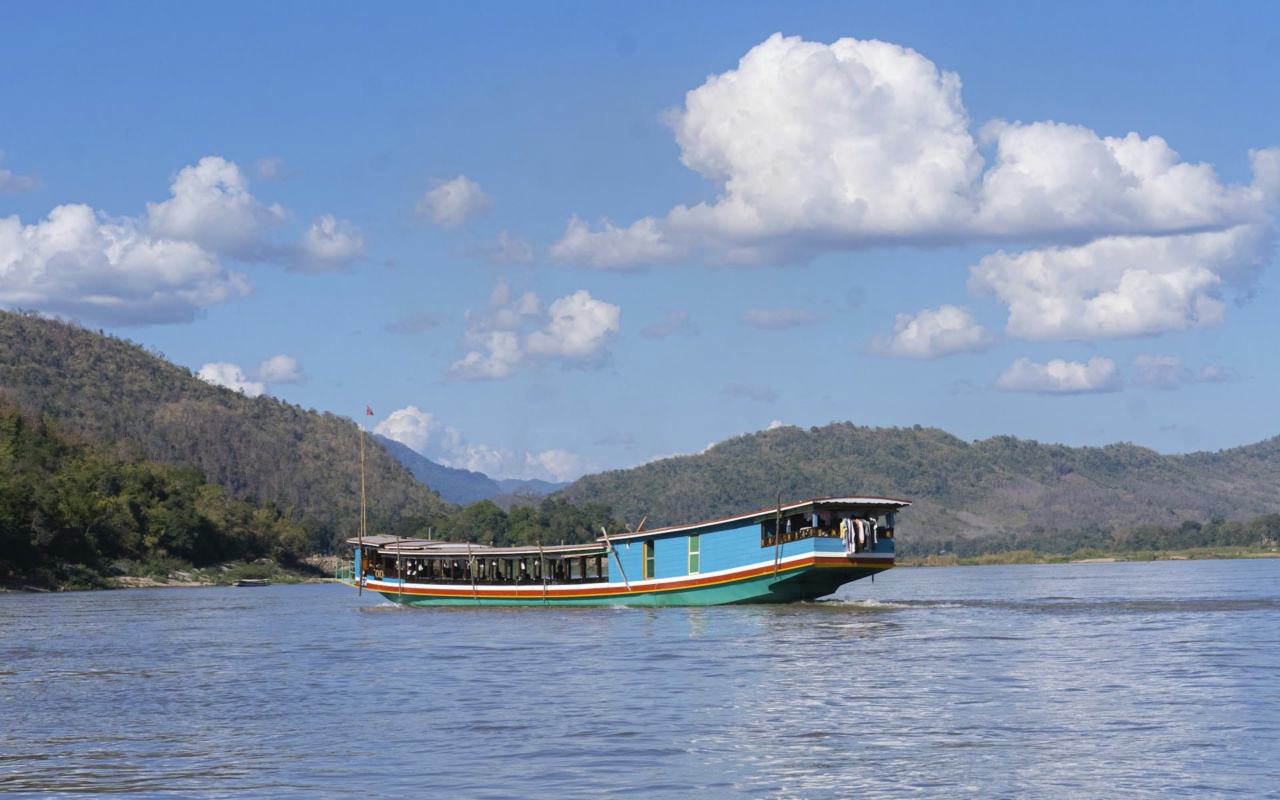
Slow boats (Huay Xai to Luang Prabang): These long wooden boats offer simple seating, and some have been upgraded with padded seats and better roofing, but legroom remains tight. The trade-off is the pace itself: the boat glides slowly enough for you to absorb every detail of the riverbank. Many travelers consider this the best-value way to combine transport and sightseeing in Laos.
Speedboats: Faster boats run on some stretches of the Mekong. They are loud and physically demanding, and they are generally recommended only for those truly pressed for time. Mekong travel can be dangerous because of changing water levels and strong currents, and the UK government advises avoiding overcrowded vessels and checking that life jackets are available.[3]
Local longtail boats: The most basic option. These slim wooden boats with long-shaft engines are the workhorses of Lao river life. Seating is usually a plank or the floor of the boat. Comfort is minimal, but trips are typically short.
Tourist charter boats: On popular routes, some operators offer private or semi-private boats with cushioned seating and refreshments. These come at a premium but can be worthwhile for small groups.
Booking and Tickets
For the popular Huay Xai to Luang Prabang slow boat, tickets are sold at the boat landing in Huay Xai, and guesthouses and travel agents in town also sell them, sometimes with a small markup. On booking platforms, a combined songthaew and slow boat ticket from Huay Xai to Luang Prabang is listed at about $34, with a morning departure (October 2026).[4] Advance booking is not strictly necessary in the low season, but during peak travel months boats can fill up, so securing a ticket the day before is wise.
For Nam Ou routes, tickets are bought at the boat landings in Nong Khiaw or Muang Ngoi, or you can charter a private boat.[2]
Online booking options for Lao river ferries are limited compared to bus or air travel, but platforms like GoAsia.cc let travelers compare available river transport alongside other modes, which makes it easier to plan multi-leg itineraries. Payment at local ticket offices is usually cash in Lao kip, so bring small denominations, as change can be scarce.
What to Expect on Board
The slow boat from Huay Xai is the quintessential Lao ferry experience. The journey splits over two days, with an overnight stop in Pakbeng, where simple restaurants and guesthouses cater to the boat crowd.
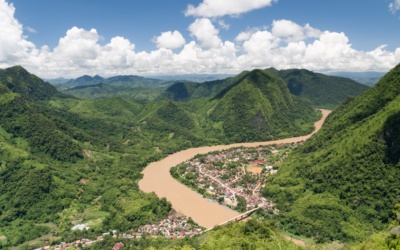
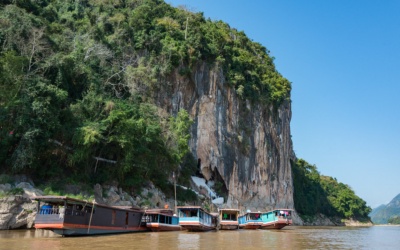
Scenery dominates the experience. The Mekong here cuts through forested mountains, passing remote villages and stretches of river where the only sounds are the engine and birdsong. The landscape shifts between narrow gorges and wide, placid stretches.
Food and drink on slow boats is basic. Savvy travelers stock up on provisions in Huay Xai before departure: baguettes, fruit and water are essentials.
Luggage is stored at the back of the boat or under seats. There is no formal luggage handling, so keep valuables with you. Charging outlets are rare, and there is no reliable connectivity on the water. Toilets, where they exist, are basic, so bring your own tissue; on smaller boats and cross-river ferries there are usually none.
Lao passengers tend to be quiet and friendly. Loud music or boisterous behavior is frowned upon, and shoes are sometimes removed when sitting on the floor of smaller boats.
Tips for Ferry Travel in Laos
Sit strategically on slow boats. Seats near the front offer the best views and the least engine noise. Arrive early to claim a good spot.
Water levels matter. Water levels change with the seasons, and the rainy season normally runs from May to October.[3] Ask locally whether your route is running before you travel, especially on smaller rivers such as the Nam Ou.
Bring layers and sun protection. Mornings on the river can be surprisingly cool, especially in the north in the cool season. By midday, the sun reflects intensely off the water. A hat, sunscreen, and a light jacket cover all scenarios.
Pack a cushion or sarong. Seats on slow boats are not designed for all-day comfort. A folded sarong or inflatable travel cushion makes a real difference.
Check life jackets. Life jackets may not be available on every vessel. Smaller boats on tributaries are the most likely to lack them, so consider carrying your own if safety is a concern.[3]
Learn a few Lao phrases. English is rarely spoken by boat crews outside the main tourist routes. Knowing how to say hello (sabaidee), thank you (khop jai), and the name of your destination goes a long way.
Carry cash. Do not count on finding an ATM in small river towns. Make sure you have enough kip for tickets, meals and accommodation before boarding.
Sources and background
Numbers in the text such as [1] refer to these sources.
[1]Tourism Laos: Bokeo Province. Retrieved October 19, 2026.