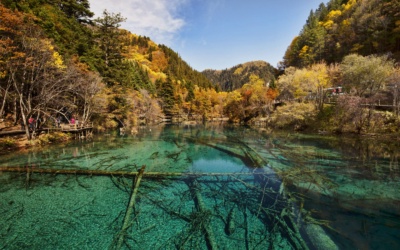
High in the mountains of northern Sichuan, a long valley of golden limestone steps down a forested slope, holding hundreds of shallow pools that glow turquoise, jade, and amber in the sun. This is Huanglong, which translates as Yellow Dragon, named for the way the tiered travertine resembles a dragon's scaly back winding up the mountain. The colors are real and not the result of dye or trickery. They come from calcium carbonate deposits, mineral content, and the angle of the light passing through clear water.
Huanglong is a UNESCO World Heritage natural site and one of the most striking travertine landscapes on earth. It sits at high altitude, which shapes nearly every decision you make about visiting, from how fast you walk to whether you take the cable car. For most travelers, it is also a natural companion to nearby Jiuzhaigou, the more famous valley of lakes and waterfalls a few hours away by road.
This guide covers what Huanglong actually is, how to walk the route, how to handle the thin air, when the pools look their best, and how to fit it into a wider Sichuan trip. It is written for independent travelers who want to do this without a packaged tour.
What Huanglong Is and Why It Matters
Huanglong is a single long valley filled with travertine formations. As mineral-rich water flows down the slope, it deposits calcium carbonate, slowly building natural rims that trap water into terraced pools. Over centuries this creates the stepped, ridged landscape that gives the place its name. The site sits beneath the snow-capped peak of Mount Xuebao, the highest summit in the Minshan range.
The valley contains several famous clusters of pools, along with waterfalls, mineral-stained slopes that genuinely look like a golden cascade, and an old Buddhist temple near the top. The most celebrated feature is the cluster of colored pools at the upper end of the valley, where dozens of basins sit side by side, each a slightly different shade depending on depth and mineral concentration.
The wider region is also rich in Tibetan and Qiang cultural presence. You are in the eastern edge of the Tibetan plateau here, and the landscape, architecture, and prayer flags reflect that. Huanglong earned its World Heritage listing for its exceptional travertine formations and the diversity of its mountain ecosystem, which supports rare wildlife including the giant panda and the golden snub-nosed monkey, though you are very unlikely to see either as a casual visitor.
Things to Do
Understanding the Altitude
The single most important thing to understand about Huanglong is its elevation. The valley floor sits at roughly 3,100 meters at the entrance, and the boardwalk climbs to around 3,550 to 3,600 meters at the highest pools near the temple. This is high enough that many visitors feel the effects of altitude, including shortness of breath, headache, fatigue, and a racing heart on the climb.
Altitude affects fit and unfit travelers alike. Walking that would be trivial at sea level becomes genuinely tiring here. The classic mistake is to arrive, see the boardwalk, and march up quickly because it does not look steep. Within minutes you are gasping. The correct approach is to slow down dramatically, take frequent short breaks, and let your body set a sustainable pace.
A few practical points on altitude:
- If your itinerary allows, spend a night or two at moderate altitude before arriving. Coming straight from low-elevation Chengdu to Huanglong in one day increases the chance of feeling rough.
- Bottled oxygen is widely sold at the site and at hotels in the region. Many visitors carry a small canister. It helps temporarily but is not a substitute for pacing yourself.
- Avoid alcohol the night before and stay well hydrated.
- If you have heart or lung conditions, or are pregnant, consult a doctor before planning high-altitude activity here.
- Anyone with severe symptoms such as confusion, persistent vomiting, or breathlessness at rest should descend. Altitude sickness is real and should not be pushed through.
Children and older travelers can absolutely visit, but the altitude makes the trip more demanding than the gentle boardwalk suggests, so plan extra time and rest stops.
The Boardwalk Route and the Cable Car
Huanglong is essentially a one-way uphill walk to the colored pools at the top, followed by a return down the other side of the valley. The entire route is on raised wooden boardwalks that protect the fragile travertine, so you stay on a defined path the whole time.
You have two basic strategies, and the cable car is the key decision.
Option one: cable car up, walk down
A cable car runs from near the entrance up toward the higher part of the valley. Taking it up saves a large portion of the strenuous climb and the altitude gain on foot. From the cable car upper station, there is still a connecting walk and some climbing to reach the topmost colored pools, but it removes the hardest sustained ascent. You then walk down through the valley, passing the pools, waterfalls, and golden travertine slopes on the way back to the entrance. For most visitors, especially those worried about altitude, this is the recommended approach.
Option two: walk up and down
You can do the entire route on foot in both directions. This is more physically demanding because of the continuous climb at altitude, and it adds significant time. Fit, well-acclimatized walkers who enjoy the effort may prefer it, but be honest about your condition before committing.
Either way, budget more time than the distance suggests. A typical full visit, walking at altitude with photo stops, takes roughly four to six hours. Rushing it is unpleasant and risks the altitude catching up with you.
What you see along the way
From bottom to top, the highlights generally include:
- Welcoming Pond: a cluster of colored pools near the lower part of the route, often the first big visual reward.
- Golden travertine slopes and waterfalls: wide sheets of mineral deposit over which water flows in thin films, glowing gold in sunlight.
- Bonsai Pond and mid-valley pools: terraced basins among the forest.
- The Multicolored Pools (the top cluster): the signature view, with dozens of pools in graded shades of blue and green, set against the mountain backdrop. This is the photograph everyone comes for.
- The ancient temple: a historic Buddhist temple near the upper end of the valley, just beyond the highest pools.
When to Visit and How Weather Affects the Pools
The look of Huanglong depends heavily on water and light, and both change with the seasons. The pools need flowing water and sunlight to show their full color. In dry conditions or under heavy cloud, the famous turquoise can look muted or even dull.
Broadly:
- Late spring to early autumn is the most reliable window for water and pleasant conditions. This period generally has more flow in the pools and accessible boardwalks.
- Autumn adds golden and red foliage to the surrounding forest, which is the most photogenic combination of color and remains very popular.
- Summer brings rain to Sichuan, and afternoon storms are common. Mornings often have the best light before clouds build.
- Winter is cold and the high altitude makes it harsh. Parts of the experience can be frozen or limited, and some facilities or access may be reduced. If you consider a winter visit, verify what is open before committing.
Because mountain weather changes fast, arriving early in the day gives you the best chance of clear light on the pools and time to walk slowly. Sun directly on the water is what makes the colors pop, so a sunny morning is ideal.
Pack for cold and changeable conditions regardless of season. Even in summer, the upper valley can be cool, windy, or wet, and the sun at altitude is intense. Bring layers, a waterproof shell, sun protection, and sturdy shoes with grip for the boardwalk.
Tickets, Access, and Practicalities
Huanglong charges an entrance fee, and the cable car is a separate cost. Prices and seasonal variations change over time, so confirm current ticket rates and any seasonal pricing before you go. During the busiest periods, the site can introduce daily visitor caps or advance booking requirements, so check whether you need to reserve in advance, especially in peak autumn and holiday weeks.
Other practical points to verify close to your trip:
- Opening hours: the site opens in the morning and closes in the afternoon. Arrive early; you need the daylight hours for a full visit.
- Cable car operation: confirm it is running, as maintenance or weather can affect it.
- Closures: the region has experienced disruptions and recovery work in the past, and access arrangements can change. Always check the current status of Huanglong and the surrounding roads before planning.
- Facilities: there are rest points and oxygen for sale along the route, but bring your own water and snacks.
For broader trip planning across the region, GoAsia.cc is a useful place to keep building your Sichuan itinerary alongside this stop.
Getting There
Huanglong is remote, and reaching it is part of the planning challenge. The two common approaches are by air and by road.
By air
The regional airport, often referred to as Jiuzhai Huanglong Airport, serves both Huanglong and Jiuzhaigou and connects to major cities including Chengdu. The airport itself sits at very high altitude, which means you can land and immediately feel the thin air, so take it slow on arrival. From the airport, Huanglong is reachable by road in a matter of hours, but confirm transfer times and options when you book, since road connections and shuttle availability vary.
By road from Chengdu
Driving or taking a bus from Chengdu is a long journey through mountain terrain, typically taking the better part of a day. The route climbs steadily, which has the advantage of more gradual altitude gain compared to flying. The disadvantage is the time and the winding mountain roads, which can be affected by weather, landslides, or construction. Many travelers break the journey with an overnight stop along the way.
Whichever way you arrive, the practical reality is that Huanglong is not a quick day trip from a major city. It anchors a multi-day mountain itinerary in northern Sichuan.
Combining Huanglong with Jiuzhaigou
Huanglong and Jiuzhaigou are the two headline natural attractions of this part of Sichuan, and they pair naturally because they share the same airport and broadly the same region. They are, however, different experiences.
| Feature | Huanglong | Jiuzhaigou |
|---|---|---|
| Main attraction | Terraced travertine pools and golden slopes | Lakes, waterfalls, and colored forest valleys |
| Format | One long boardwalk climb up a valley | Large multi-valley park with shuttle buses |
| Physical effort | High; sustained climb at altitude | Easier; buses move you between sights |
| Time needed | Roughly half a day to a full day | A full day, often more |
| Altitude challenge | Significant, especially on foot | Present but less strenuous |
A common plan is to fly into the regional airport, visit Huanglong on one day and Jiuzhaigou on another, allowing a buffer day for weather and rest. Doing both back to back is feasible but tiring, particularly given the altitude. If you only have energy for one and you prefer dramatic water-and-forest scenery with less climbing, Jiuzhaigou is the gentler choice. If you specifically want the travertine pools, Huanglong is unique and worth the effort.
Note that the two sites have had different operational histories and recovery periods, so always confirm that both are open and accessible for the dates you want.
Realistic Downsides and Common Mistakes
Huanglong is spectacular, but it is not effortless, and it is worth being honest about the tradeoffs.
- The altitude is no joke. The boardwalk looks easy in photos, but climbing at over 3,000 meters tires almost everyone. Underestimating this is the most common mistake.
- The colors depend on conditions. On a cloudy, low-water day the pools can look gray rather than turquoise. You are partly at the mercy of weather and timing.
- It is remote. Travel time eats into your itinerary, and weather can disrupt both flights and mountain roads. Build in buffer days.
- Crowds in peak season. Autumn foliage and Chinese holiday periods draw large numbers, which can mean queues for the cable car and busy boardwalks. Arrive early and consider shoulder timing.
- Cold and sun together. The upper valley can be cold while the high-altitude sun burns. People who dress for only one of these regret it.
The biggest planning error is treating Huanglong as a casual stop rather than a high-altitude mountain excursion that needs pacing, acclimatization, and a flexible schedule.
Practical Tips for Walking the Valley
- Start early. Morning light is best for the pools, and you want maximum daylight to walk slowly without rushing.
- Take the cable car up if altitude worries you. Walking down is far easier than walking up at this elevation, and you still see the full valley.
- Set a slow pace from the first step. Breathe steadily and stop often. There is no prize for climbing fast here.
- Carry water, snacks, and sun protection. Hydration helps with altitude, and there is little shade on the open travertine slopes.
- Dress in layers with a waterproof outer. Mountain weather flips quickly between sun, wind, and rain.
- Wear shoes with good grip. Boardwalks can be wet, and damp wood is slippery.
- Consider oxygen as a backup. A small canister can ease symptoms on the upper climb, though pacing matters more.
- Stay on the boardwalks. The travertine is fragile and protected. Stepping off damages the formations and is not allowed.
- Plan a rest day around the visit. Pair it with lighter activities so you are not exhausting yourself two days in a row at altitude.
Who Should Visit and Who Should Reconsider
Huanglong rewards travelers who love unusual natural landscapes and are willing to deal with remoteness and altitude. The travertine pools are genuinely rare, and on a clear day the colors are unforgettable. Photographers, nature lovers, and anyone building a northern Sichuan itinerary around Jiuzhaigou should strongly consider it.
Those with heart or respiratory conditions, very young children, or anyone uncomfortable with high altitude should weigh the climb carefully and seek medical advice. The reward is real, but it asks something of you in return. Plan well, pace yourself, watch the weather, and Huanglong delivers one of the most distinctive natural sights in China.
Frequently Asked Questions
Plan for roughly four to six hours inside the scenic area, and effectively a full day once you include travel to and from your accommodation. The high altitude slows everyone down, so do not rush. Ideally build a rest or buffer day around the visit, especially if you are also seeing Jiuzhaigou.
Huanglong charges a separate entrance fee and cable car fee, and prices vary by season. Because rates and any seasonal discounts change over time, confirm the current entrance and cable car prices before you travel. In peak periods there may also be daily visitor caps or advance booking, so check whether you need to reserve.
The most direct route is flying into the regional Jiuzhai Huanglong Airport, which connects to Chengdu and other cities, then continuing by road to the site. Alternatively you can travel overland from Chengdu, which takes most of a day but allows more gradual altitude gain. Confirm current transfer options and road conditions when you plan.
The valley sits above 3,000 meters and climbs higher, so many visitors feel breathless, tired, or headachy. Most healthy travelers manage it by walking slowly, resting often, and staying hydrated. If you have heart or lung conditions or are pregnant, consult a doctor first, and descend if you develop severe symptoms.
Yes, they pair well because they share the same airport and region but offer different scenery. Huanglong is travertine pools on a climbing boardwalk, while Jiuzhaigou is lakes and waterfalls with shuttle buses and less effort. Allow at least a day for each plus a buffer, and confirm both sites are open for your dates.
Late spring through early autumn generally offers the most reliable water flow and conditions, with autumn adding colorful foliage. Sunlight on the water is what makes the turquoise and gold colors stand out, so a clear morning is ideal. Cloudy or very dry conditions can make the pools look muted.
They can, but the altitude and sustained climb make it more demanding than the gentle boardwalk appearance suggests. Taking the cable car up and walking down reduces the hardest effort. Move slowly, plan rest stops, and watch for altitude symptoms in anyone in the group.