Tumpak Sewu: viewpoint, canyon access and transport
Photo: Joni Agung / Pexels
Contents
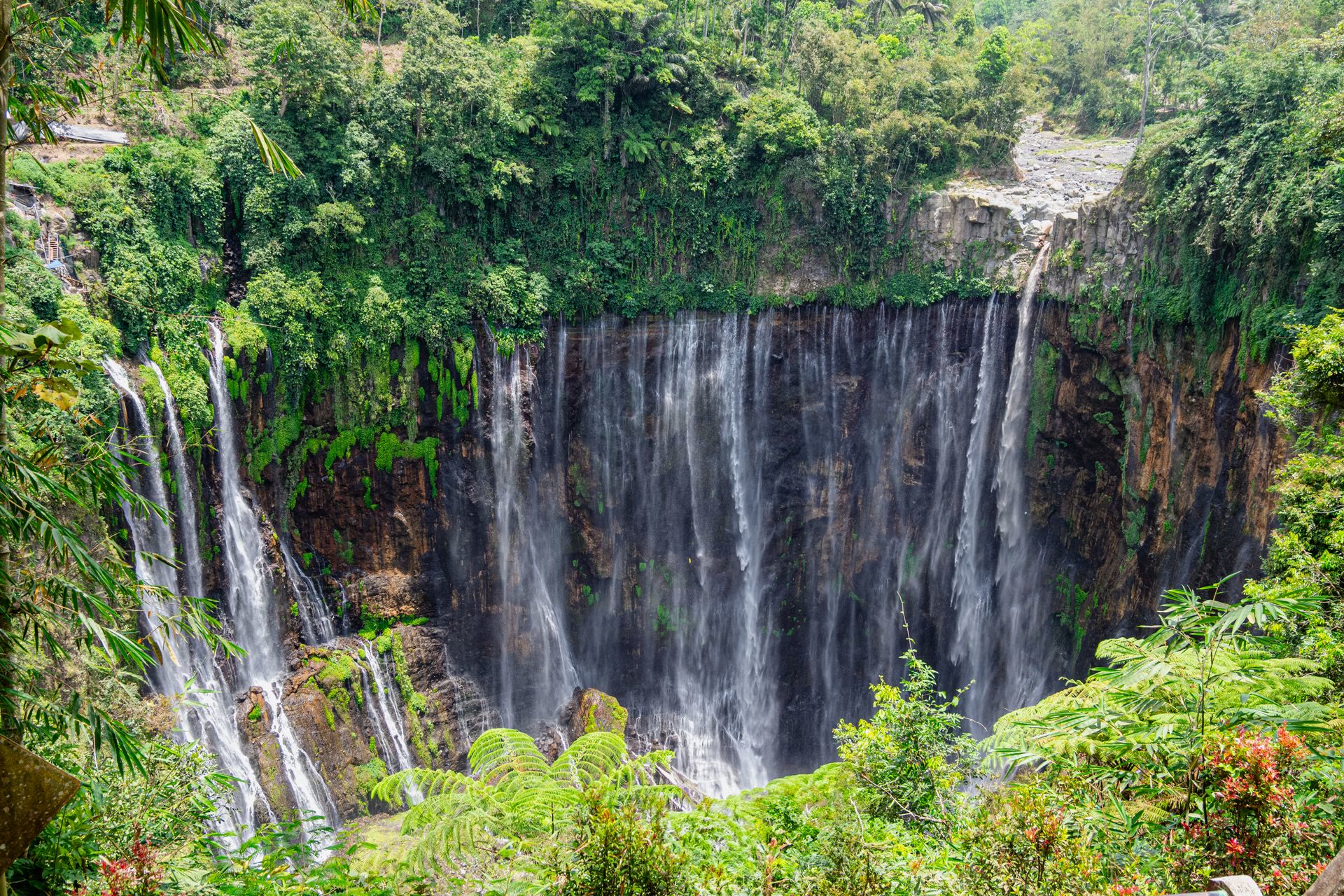
Tumpak Sewu is the waterfall that looks like a curtain falling into a green amphitheatre. A broad view from the upper viewpoint is already a worthwhile stop. The canyon descent to the base is a separate, more demanding choice, so decide how much walking you want before you pick a ticket or a tour, and keep a plan B in case the route is closed.
The waterfall straddles the border between Malang and Lumajang in East Java. A wide cascade about 120 metres high falls like a curtain of water, wrapped in tropical forest. Its water comes from the Glidik River, which rises high on Mount Semeru, and on a clear day you can see the Semeru peak from the viewpoint.[1]
Choose the viewpoint or canyon
The upper viewpoint looks down into the waterfall's amphitheatre without the full canyon descent. It is the easier choice, but still a walk with steps. Ask the entrance staff about the current path and closures, especially if you have limited mobility. The trek to the waterfall leads over rugged terrain, and it is best to start early in the morning and bring experienced companions.[1]
Goa Tetes is a nearby cave and waterfall in Sidomulyo whose water flows from natural springs in the cave.[1] Treat it as an optional extra. The cave sections are wet and slippery, so skip it if the water is high or the route is closed.
Things to Do
Offers are only loaded from GetYourGuide after you click. GetYourGuide can then process your IP address and set cookies. Privacy Policy
GetYourGuide partner offers. GoAsia may earn a commission if you book through these offers. Check whether tickets or transfers are included, and follow the attraction's official booking and admission rules.
Identify the entrance and ticket
Coban Sewu is the name of the waterfall destination on the western side of the Glidik river, entered through Sidorenggo village in Ampelgading, Malang Regency. Tumpak Sewu is the panorama destination on the opposite eastern side, entered through Sidomulyo village in Pronojiwo, Lumajang Regency.[2] Use the entrance named on your booking and ask which viewpoint and routes it covers, because an east-side ticket does not open the west-side paths.
The provincial tourism portal lists the roadside Panorama Tumpak Sewu entrance in Sidomulyo with a ticket of IDR120,000 for foreign visitors and IDR20,000 for domestic visitors.[3] A joint agreement of the site operators effective 24 December 2024 introduced a single one-gate ticket for three attractions in Sidomulyo (Tumpak Sewu, Goa Tetes and Grojogan Sewu) at IDR100,000 for foreigners and IDR10,000 per attraction for domestic visitors.[4] The two sources disagree, so ask at the ticket counter what you pay, which areas the ticket covers and whether parking or a guide cost extra.
Plan transport from Malang
From Malang the road leads through Bululawang, Dampit, Tirtomoyo and Pronojiwo to the border of Malang and Lumajang. You can arrive by private vehicle or by public minibus.[3] A driver or an organised transfer is the easiest way for the last stretch and the return trip. Agree the total price for the vehicle, including waiting time and stops, or check the per-person inclusions of a tour. If you ride a scooter yourself, carry the right licence and insurance and wear a helmet.
Check guides and equipment
Ask at the entrance whether a guide is required or offered for the route you want, and agree the language, the route, the return time and the total price. A guide cannot make a closed route or high water safe. Choose the viewpoint if the descent is more than you want, and turn back if you feel uncomfortable on the way.
Wear shoes with good grip, protect your phone and camera from the spray, carry water in a small bag and bring dry clothes. Take enough cash, because card and ATM services in the area cannot be relied on. Do not carry your passport and valuables into the canyon.
Choose by conditions, not a promise
Dry season does not make the descent safe on its own. Check local notices, the weather and volcano warnings before you travel and again at the entrance. The UK Foreign Office warns that flash floods and landslides occur across Indonesia, and that valleys beyond the exclusion zones of volcanoes can be hit by mud and debris flows. In most of Indonesia the rainy season usually runs from October to March.[5] Follow every closure and evacuation instruction. Early arrival gives you cooler air and fewer people, but no guarantee of an empty path, good light or a rainbow.
Add other East Java stops carefully
Give an upper-view visit time for the transfer and the checks. Add a canyon descent or Goa Tetes only if time, weather and your fitness allow. Bromo, Ijen and Madakaripura are separate destinations with their own tickets, access rules and long road journeys. A package that puts a Bromo sunrise and a canyon descent into one day is a long day, so ask about the transfers, the driver's rest and a plan B in case of closures.
Sources and background
Numbers in the text such as [1] refer to these sources.
- [1] Indonesia Ministry of Tourism: Tumpak Sewu and Goa Tetes in East Java. Retrieved October 22, 2026.
- [2] Malang Regency Government: June 2026 mediation: west Coban Sewu and east Tumpak Sewu administrative destinations. Retrieved October 22, 2026.
- [3] East Java Provincial Culture and Tourism Office, SIDITA: Panorama Tumpak Sewu: named entrance, Malang approach and displayed domestic and foreign tariffs. Retrieved October 22, 2026.
- [4] Lumajang Tourism Department: Tumpak Sewu combined-ticket agreement, December 2024. Retrieved October 22, 2026.
- [5] UK Foreign, Commonwealth and Development Office: Indonesia travel safety: driving, flooding and volcanic hazards, not a local trail clearance. Retrieved October 22, 2026.
- [6] Lumajang Regency Government: Implementation of the combined-ticket agreement. Retrieved October 4, 2026.
- [7] Lumajang Regency Government: March 2025 opening notice: dated distinction between Tumpak Sewu and Grojogan Sewu. Retrieved October 5, 2026.
Frequently Asked Questions
It is a wide cascade about 120 metres high that falls like a curtain into a green amphitheatre on the border of Malang and Lumajang. Its water comes from the Glidik River, which rises on Mount Semeru, and on a clear day you can see Semeru from the viewpoint.
The provincial tourism portal lists IDR120,000 for foreign visitors and IDR20,000 for domestic visitors at the Panorama Tumpak Sewu entrance. A joint agreement effective 24 December 2024 set a one-gate ticket for three attractions at IDR100,000 for foreigners. The sources disagree, so ask at the ticket counter what you pay, which areas the ticket covers and whether parking or a guide cost extra.
The road from Malang leads through Bululawang, Dampit, Tirtomoyo and Pronojiwo. You can arrive by private vehicle or public minibus. A driver or an organised transfer is the easiest way for the last stretch and the return. Agree the total price including waiting time and stops.
Ask at the entrance which route is open and whether a guide is required or offered. Check the weather and volcano warnings, because floods, landslides and mud flows are a risk. Wear shoes with good grip, protect your phone from spray and turn back if you feel uncomfortable.
Tumpak Sewu is entered on the east side through Sidomulyo village in Pronojiwo, Lumajang. Coban Sewu is the destination on the west side, entered through Sidorenggo village in Ampelgading, Malang. Use the entrance named on your booking, because an east-side ticket does not open the west-side paths.
Only as an optional extra. It is a cave and waterfall in Sidomulyo fed by natural springs in the cave. The sections are wet and slippery, so skip it if the water is high or the route is closed.
Start early in the morning for cooler air and fewer people. Dry season does not make the descent safe by itself: check local notices, the weather and volcano warnings before you travel and again at the entrance. In most of Indonesia the rainy season usually runs from October to March.
They are separate destinations with their own tickets, access rules and long road journeys. A day that combines a Bromo sunrise and a canyon descent is very long, so ask about the transfers, the driver's rest and a plan B in case of closures.