
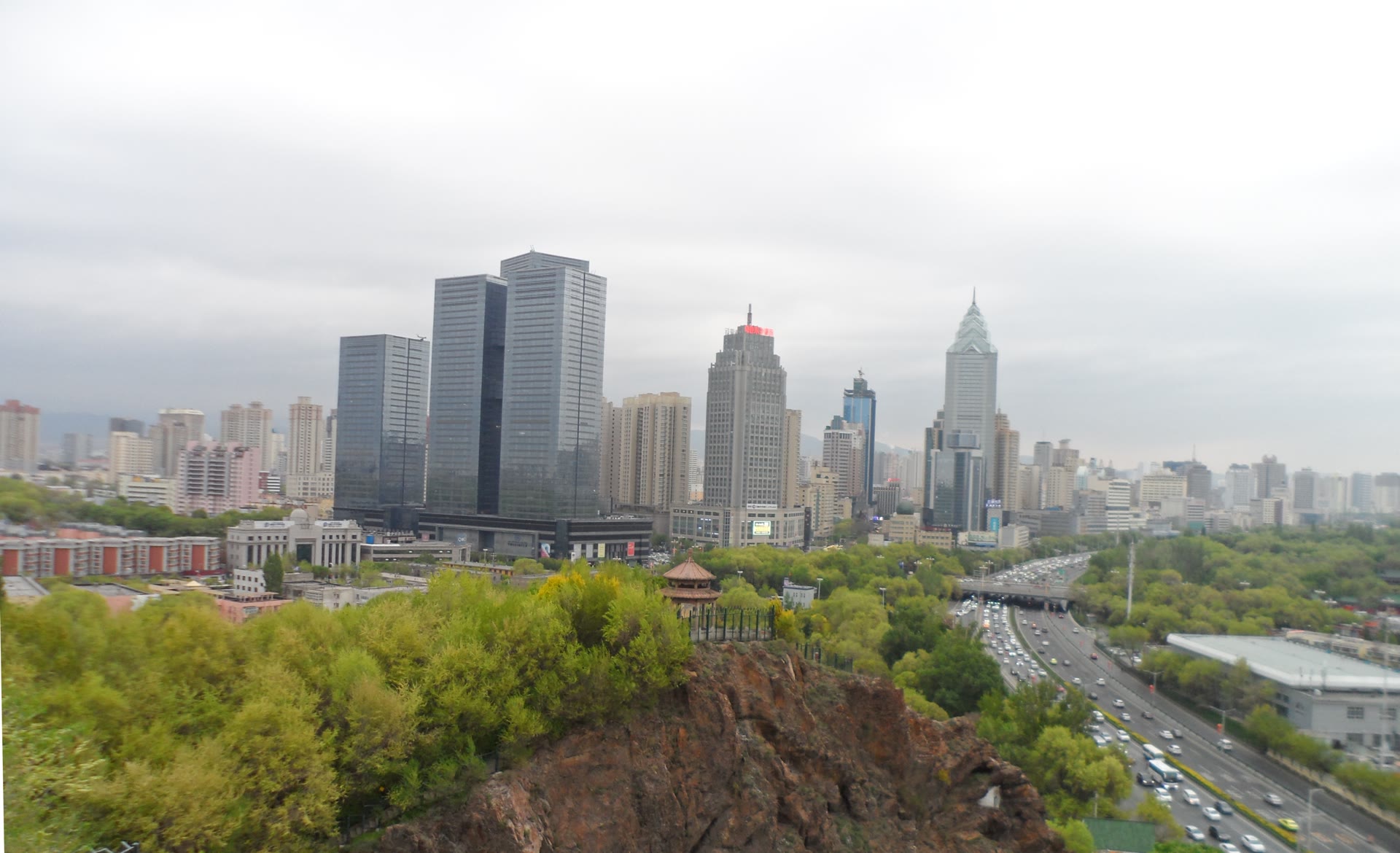
Photo: 螺钉 / Wikimedia Commons, CC BY-SA 4.0
Contents
- 1. Getting Around Urumqi by Metro
- 2. Getting Around Urumqi by BRT
- 3. Getting Around Urumqi by City Bus
- 4. Getting Around Urumqi by Taxi
- 5. Getting Around Urumqi by Ride-Hailing
- 6. Getting Around Urumqi on Foot
- 7. Getting Around Urumqi by Bicycle and Bike Share
- 8. Comparing Your Options
- 9. Practical Tips for Getting Around Urumqi
- 10. Popular Routes and Destinations
- 11. Frequently Asked Questions
Urumqi sprawls across a long valley between the snow-tipped Tianshan mountains, and the first thing that strikes most arrivals is the scale of the place. This is the most landlocked major city on earth, the regional capital of Xinjiang, and it stretches for tens of kilometers along a north-south axis rather than radiating neatly from a center. You will not stroll from one sight to the next here. Distances are real, and you will lean on public transport and ride-hailing far more than your feet.
The rhythm of the streets blends Han Chinese commerce with Uyghur, Kazakh and Hui culture. You will hear Mandarin and Uyghur in the same bus queue, smell cumin-dusted lamb skewers near the bazaar, and watch sleek electric buses glide past men selling dried apricots from carts. Traffic is heavy on the central arteries during peak hours, security checkpoints appear at stations and bazaars, and the city runs on Beijing time officially even though daylight follows a far western clock, so plan around long bright evenings in summer and dark afternoons in winter.
For a traveler, the good news is that local transport is cheap, widespread and increasingly modern. Buses blanket the city, a bus rapid transit network speeds up the main corridors, a subway has opened up the spine of the city, and ride-hailing through Chinese apps makes door-to-door travel painless once you have set up local payment. You can compare transport options for the city on GoAsia.cc before you arrive.
Getting Around Urumqi by Metro
Urumqi's subway is the newest and most comfortable way to move along the city's central corridor. The first line runs roughly north to south, linking the international airport in the north with the railway and commercial districts further south, passing key interchange points along the way. Trains are clean, air-conditioned and signed in Chinese, Uyghur and English, which makes them the least intimidating option for first-time visitors.
Fares are distance-based and very cheap, typically starting around 2 yuan (under a dollar) for short trips and rising modestly for longer journeys. You buy a token from a machine at the station, tap in and out, or use a transit card. Expect airport-style security screening at every entrance, with bag scanners and ID checks, so allow a few extra minutes and carry your passport. Trains run from early morning until late evening, and while they get busy at rush hour, crowding rarely reaches the crush levels of eastern Chinese megacities.
Getting Around Urumqi by BRT
The Bus Rapid Transit, locally known as the BRT, was for years the backbone of fast city travel and still covers ground the subway does not reach. These long articulated buses run in dedicated lanes down the major avenues, with raised platform stations where you pay before boarding rather than on the bus. Because they bypass the worst of the traffic jams, the BRT is often the quickest surface option across town.
Fares are a flat 1 yuan per ride within the BRT system, and you can transfer between BRT lines at interchange stations without paying again, which makes it extraordinarily good value. Pay with a transit card or coins at the platform gate. Stations are clearly numbered, and route maps inside the platforms show the stops in sequence. The BRT is comfortable in design but can pack tightly during morning and evening peaks, roughly 8 to 9:30am and 6 to 8pm. If you are carrying luggage, avoid those windows.
Getting Around Urumqi by City Bus
Ordinary city buses form the densest web of any transport mode here, reaching neighborhoods that the metro and BRT skip entirely. Most fares are a flat 1 yuan, occasionally 2 yuan for longer or air-conditioned routes, paid into a farebox with exact change or tapped with a transit card. There is no change given, so keep small coins handy.
Buses are how locals get everywhere, and they are cheap and frequent, but they come with caveats for visitors. Route information and announcements are largely in Chinese, the buses can be very crowded, and figuring out which one goes where takes some homework. The Chinese mapping app Baidu Maps or Amap (Gaode) will plot bus routes for you and tell you which number to catch and where to alight, which transforms the experience. Buses are perfectly safe but keep an eye on your bag in packed conditions. Service tends to thin out and stop in the late evening, so do not rely on buses after about 10pm.
Getting Around Urumqi by Taxi
Metered taxis are plentiful and reasonably priced, with flag-fall starting around 10 yuan and a per-kilometer rate that keeps most cross-town trips comfortably affordable, often in the range of 15 to 40 yuan depending on distance and traffic. Drivers are generally honest and use the meter without prompting, though confirming the meter is running is always wise.
The main hurdle is language. Few drivers speak English, so have your destination written in Chinese characters, or better still drop a pin in a mapping app and show the screen. Hotel business cards with the address in Chinese are gold. Hailing on the street works during the day but gets harder during shift changes (often late afternoon) and in bad weather, when demand surges. Tipping is not expected. At the airport and railway station, stick to the official taxi queue rather than touts who approach you in the arrivals hall, as freelance drivers may quote inflated flat fares.
Getting Around Urumqi by Ride-Hailing
Didi Chuxing is the dominant ride-hailing app and arguably the single most useful tool for a visitor. You request a car much as you would with Uber, see the fare up front, and the app handles navigation so the language barrier disappears entirely. Prices are competitive with metered taxis and sometimes cheaper off-peak, with surge pricing during rush hour and storms.
The catch is payment and setup. Didi requires linking to a Chinese payment method, usually Alipay or WeChat Pay, both of which now allow foreign cards to be added. Set this up before you arrive if you can, as it unlocks not just rides but most everyday payments in the city. Didi is available in English within the Alipay mini-program, which is the easiest route for tourists. Cars come quickly in central districts and arrive with the driver knowing exactly where to go, making this the most stress-free way to reach awkward addresses or travel late at night.
Getting Around Urumqi on Foot
Walking works well within compact pockets rather than across the city. Around the International Grand Bazaar, the central shopping streets and the area near People's Square, you can comfortably explore on foot, soaking up the markets, the food stalls and the street life. The bazaar district in particular rewards wandering, with its mosques, spice vendors and carpet shops clustered together.
Beyond these zones, distances stretch out and major roads are wide and busy, so walking long stretches is tiring and not always pleasant. Use pedestrian underpasses and crossings at big junctions. In winter, pavements ice over and temperatures plunge well below freezing, while summer afternoons are hot and dry, so dress for the season and treat walking as a way to enjoy a neighborhood rather than to cover real ground.
Getting Around Urumqi by Bicycle and Bike Share
Shared bikes from operators like Meituan and Hellobike are scattered around central districts, unlocked by scanning a QR code through the relevant app linked to Alipay or WeChat Pay. Rates are minimal, typically a yuan or two for a short ride. They suit flat central areas and short hops between bazaar streets and metro stations.
That said, cycling is not the natural choice here for most visitors. The city's scale, heavy traffic on main roads, hilly fringes and harsh seasonal weather all limit when biking is comfortable. On a mild spring or autumn day a bike can be a pleasant way to potter around the center, but it is a supplement to public transport rather than a primary mode.
Comparing Your Options
| Mode | Typical Cost | Duration | Best For |
|---|---|---|---|
| Metro | From around 2 yuan | Fast along the corridor | Crossing the city quickly north to south |
| BRT | Flat 1 yuan | Fast in dedicated lanes | Beating traffic on main avenues |
| City Bus | 1 to 2 yuan | Slow in traffic | Reaching neighborhoods on a budget |
| Taxi | From around 10 yuan | Direct, traffic-dependent | Door-to-door comfort |
| Didi ride-hailing | Similar to taxi | Direct, traffic-dependent | Late nights and awkward addresses |
| Walking | Free | Short distances only | Exploring the bazaar and central streets |
| Bike share | 1 to 2 yuan | Short hops | Quick central trips in good weather |
Practical Tips for Getting Around Urumqi
Setting up digital payment before you arrive will change your whole trip. Alipay and WeChat Pay accept many foreign cards now, and between them they cover ride-hailing, bike share, transit top-ups, food stalls and shops. Cash still works for buses and many taxis, so carry a stash of 1 yuan coins and small notes for fareboxes that give no change.
- Download the right apps: Amap (Gaode) or Baidu Maps for routing and bus numbers, Didi (via the Alipay mini-program) for ride-hailing, and a translation app like Pleco or Google Translate's camera mode for signs and menus.
- Carry your passport at all times: Security checkpoints at metro stations, bazaars and transport hubs are routine across Xinjiang, and you will need ID to pass through. Allow extra time for screening.
- Mind the clock: The city officially runs on Beijing time, but local life often follows a later unofficial schedule. Confirm opening and departure times to avoid confusion.
- Avoid peak crush: Roughly 8 to 9:30am and 6 to 8pm bring crowded buses and surge ride-hailing prices. Travel between these windows when you can.
- Show addresses in Chinese: Few drivers read English. Save destinations as Chinese-character screenshots or pins, and keep a hotel card on you.
- Watch for airport touts: Use the official taxi rank or Didi rather than drivers who approach you offering flat fares.
- Dress for the climate: Winters are bitterly cold and pavements ice over, while summers are dry and hot. This affects how far you will want to walk or cycle.
Pickpocketing is uncommon but possible in packed buses and crowded markets, so keep valuables zipped and in front. Public transport itself is safe by day and night, and the visible security presence, while bureaucratic, means stations feel orderly. As a foreign visitor you may occasionally be asked extra questions at checkpoints; stay patient and have your documents ready.
Popular Routes and Destinations
The International Grand Bazaar is the city's must-see and sits in a central district well served by bus and reachable by metro or BRT plus a short walk. From there, taxis and Didi handle the gaps to other sights efficiently. For the airport in the north, the metro now offers a cheap and reliable connection, while a taxi or Didi gives a direct door-to-door alternative when you have luggage or arrive late. For the main railway station, buses, the BRT and the metro all converge nearby, so reaching your onward train is straightforward whichever mode you favor.
Frequently Asked Questions
Use this guide to compare local transport in Urumqi. When bookable tickets are available, the booking tool shows current options and prices.
For most visitors a combination of the metro or BRT for long stretches along the central corridor and Didi ride-hailing for door-to-door trips works best. The metro and BRT are fast and cheap, while Didi removes the language barrier entirely once you have set up Alipay or WeChat Pay.
Transport is very affordable. City buses and the BRT are around 1 yuan per ride, the metro starts from roughly 2 yuan, and taxis begin at about 10 yuan flag-fall. Most cross-town taxi or Didi trips fall in the range of 15 to 40 yuan depending on distance and traffic.
Yes, public transport in Urumqi is safe by day and night, and stations have routine security screening that keeps things orderly. Keep an eye on your belongings in crowded buses and markets, and always carry your passport since ID checks at stations are standard.
Yes, Didi Chuxing is widely available and is the easiest option for foreign visitors. You can access it in English through the Alipay mini-program, and it handles navigation so you do not need to explain your destination. You will need a Chinese payment method like Alipay or WeChat Pay linked to your card.
A transit card is convenient for tapping onto buses, the BRT and the metro, but it is not essential. You can pay buses with exact-change coins, buy metro tokens at machines, and use Didi for everything else, so many short-stay visitors skip the card entirely.
Few drivers or bus staff speak English. Use a mapping app like Amap or Baidu Maps to plot routes, drop pins for taxi drivers, and carry your hotel address written in Chinese characters. A translation app such as Pleco or Google Translate's camera function helps with signs.
The airport sits in the north of the city and is connected by the metro line, which is the cheapest and most reliable option. If you arrive late or have heavy luggage, take a taxi from the official rank or book a Didi for a direct door-to-door ride.
Guide prices and journey times are indicative, not live quotes. A booked package may include transfers and waiting time as well as the main journey. Check the selected offer, pickup point and current conditions before booking.