Ta Prohm: Roots, History and Planning Your Visit
Contents
- 1. History of Ta Prohm
- 2. The Trees of Ta Prohm
- 2.1 Pale trunks and spreading roots
- 2.2 Roots around doorways
- 3. Exploring Ta Prohm
- 3.1 Main Entrance and Approach
- 3.2 Key Areas to Explore
- 3.3 Visitor Route
- 4. Visiting Ta Prohm
- 4.1 Tickets and Access
- 4.2 Best Time to Visit
- 4.3 Getting There
- 5. Tips for Visiting Ta Prohm
- 6. Sources and background
- 7. Frequently Asked Questions
Ta Prohm is an Angkor temple where huge roots wrap around stone galleries and carved doorways. Entry opens at 07:30, the shared Angkor park pass covers it, and the visit takes about one to one and a half hours, or up to two hours at a slower pace.[1] Follow the open walkways and barriers. It is part of the Small Circuit from Siem Reap, and its Khmer architecture deserves as much attention as its famous trees.[2]
Ta Prohm stands east of Angkor Thom, within the Angkor Archaeological Park near Siem Reap. Its use as a filming location for Lara Croft: Tomb Raider in the early 2000s significantly raised its international profile, as Cambodia's tourism minister said in August 2026.[3] The galleries, religious carvings and royal history give the visit interest well beyond the film. Roots and masonry form the scene that conservation teams work to preserve.
History of Ta Prohm
The temple dates to the late 12th century under Jayavarman VII, with a dedication in 1186. Originally called Rajavihara, or Royal Monastery, it was a Buddhist foundation. In 1186 the king consecrated several statues here, the most important of which was Prajnaparamita, the Perfection of Wisdom, whom he identified with his mother. Some years later he dedicated Preah Khan to his father, identified with Lokesvara.[1]
The area enclosed by the outer wall was comparable to a modern monastery, where many people of diverse capacities made up a cult.[1]
The temple was initially kept more or less in the state in which it was discovered in the 19th century, and it was selected to give visitors a romantic vision of ruins, above all because of the spectacular trees. To avoid damage to the monument and to keep a very large number of visitors safe, consolidation and restoration works were carried out.[1]
Things to Do
Offers are only loaded from GetYourGuide after you click. GetYourGuide can then process your IP address and set cookies. Privacy Policy
GetYourGuide partner offers. GoAsia may earn a commission if you book through these offers. Check whether tickets or transfers are included, and follow the attraction's official booking and admission rules.
The Trees of Ta Prohm
Pale trunks, spreading roots and carved stone make up Ta Prohm's defining scene. Look at the different root shapes rather than trying to identify every tree.
Pale trunks and spreading roots
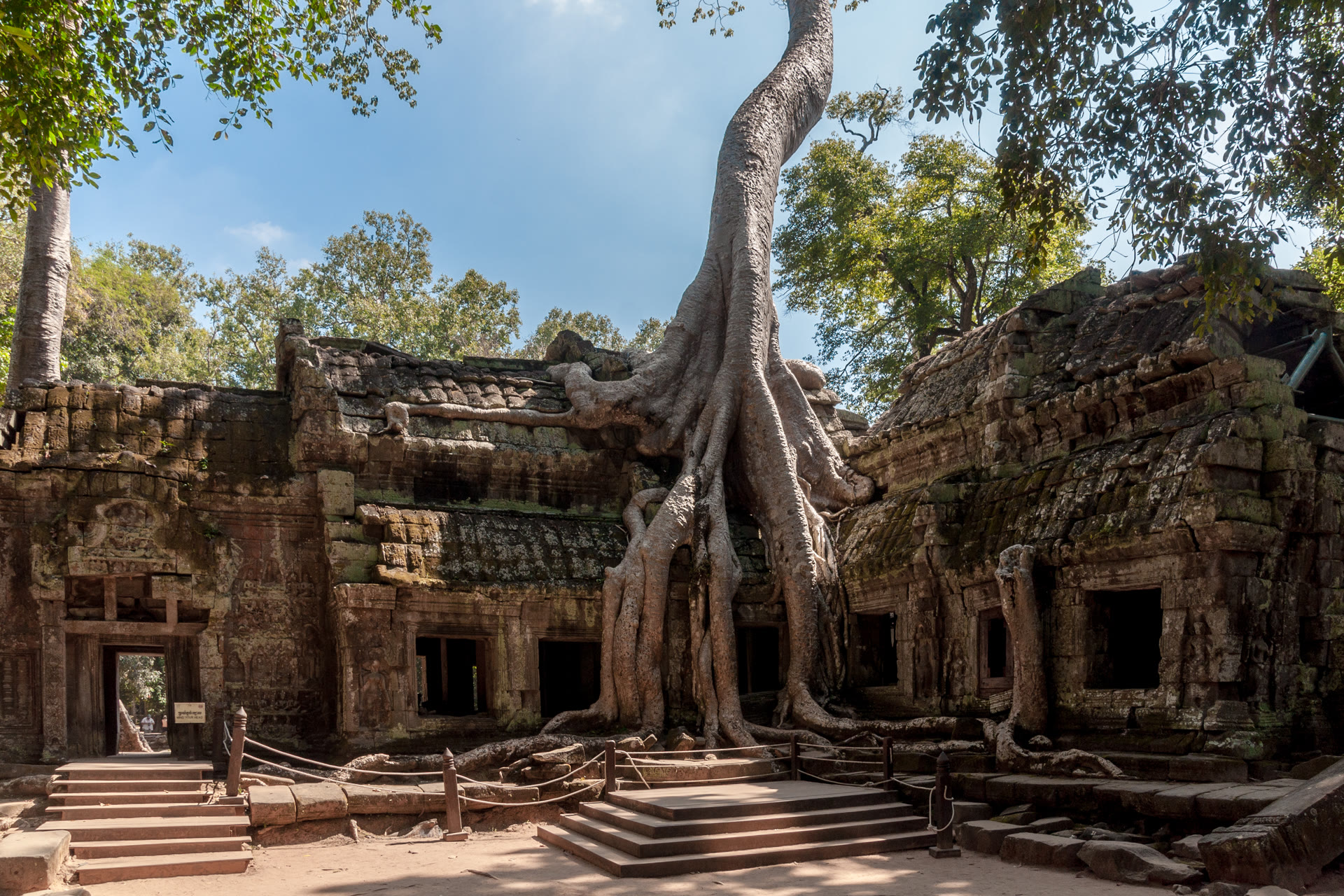
The enormous pale trunks and spreading roots stand out against the sandstone galleries. Beneath the canopy, roots follow walls and roofs, sometimes covering the lines of a doorway. Notice the difference in scale between a carved stone block and the root crossing it. The trees give shade, and the light changes markedly as you move between a courtyard and a covered passage.
Roots around doorways
In other places, the roots form dense networks around openings and pillars rather than broad, smooth sweeps. A doorway framed by roots can look almost like a natural arch. The visitor path lets you see both the plant growth and the masonry it surrounds without touching the carving.
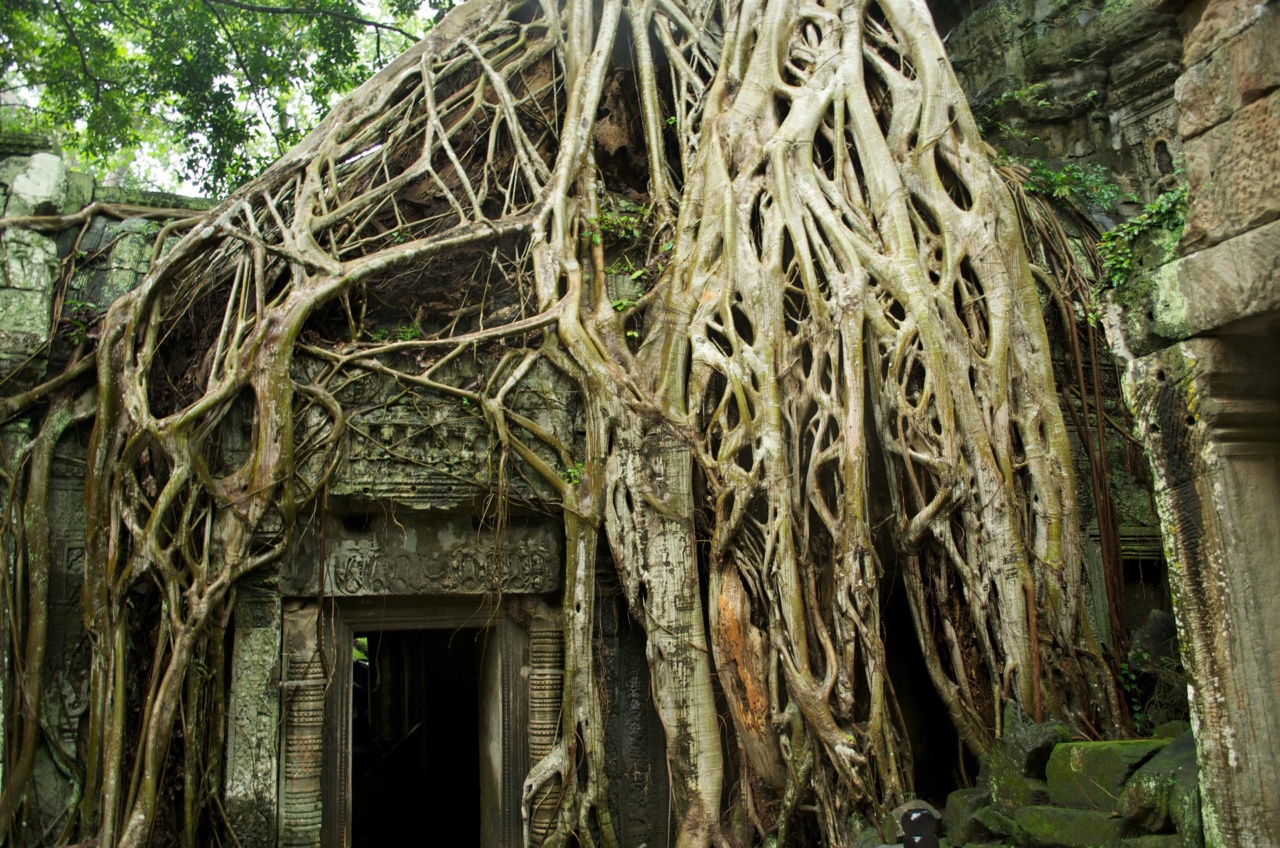
Roots can separate stone blocks while also holding some elements in place, so conserving the temple takes structural assessment rather than a blanket rule that every tree must stay. APSARA and the Archaeological Survey of India continue restoration at Ta Prohm. In June 2026 APSARA reported that the restoration of the South Gate, begun in early 2023, was about 75 percent complete and expected to finish by the end of 2026, alongside emergency stabilization and repairs to wooden platforms, handrails and bridges for visitors.[4] What looks like an untouched jungle ruin is also a carefully maintained monument.
Exploring Ta Prohm
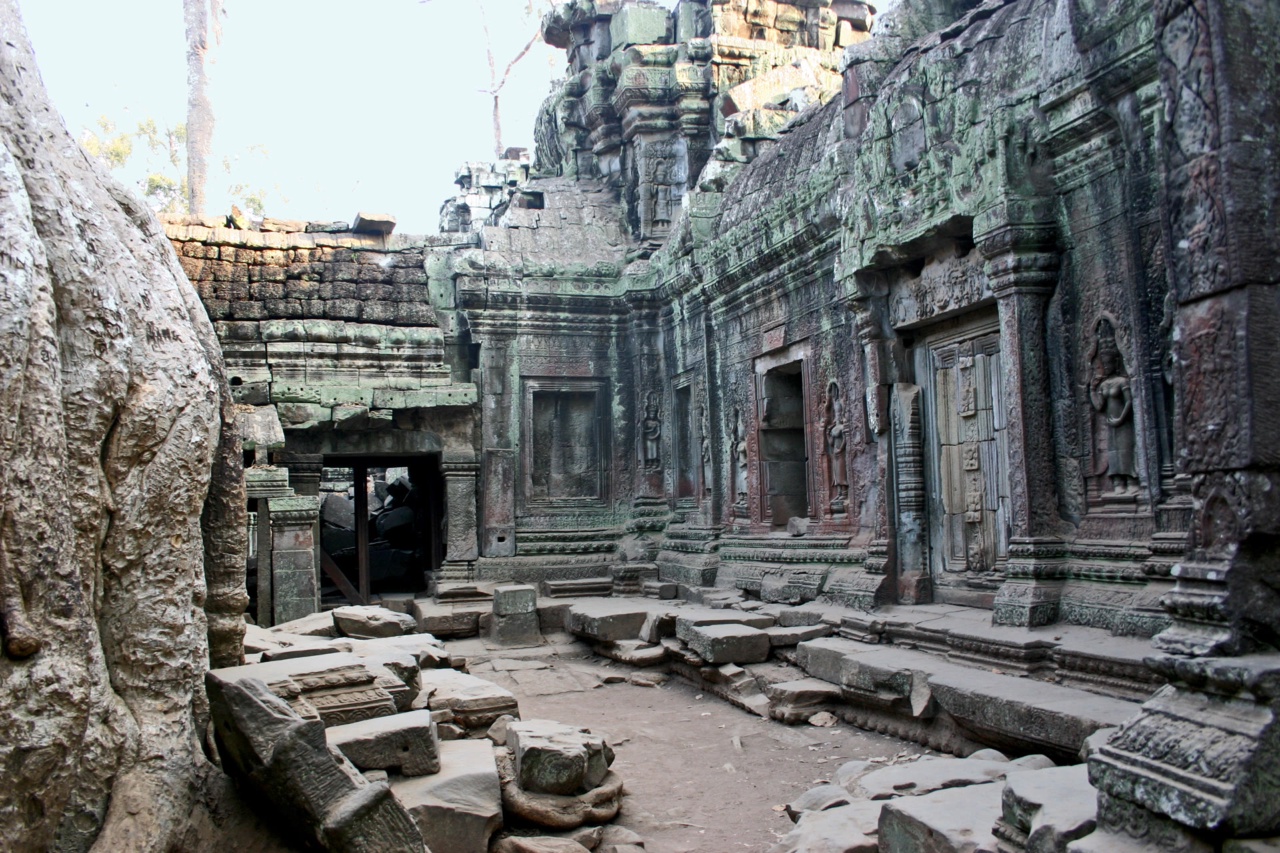
The outer enclosure measures roughly 1,000 by 700 metres. Inside it, the temple is arranged around concentric galleries with corner towers, gopuras and additional buildings.[1] The galleries lead towards the central sanctuary, and the pleasure lies in moving through courtyards and carved passages rather than climbing a temple mountain. The open inner sections are the focus of most visits.
Main Entrance and Approach
Visitors usually approach from the west, while the east was the historical ritual entrance.[1] The western approach leads through the forest towards the concentric galleries and the temple's central axis. Agree your drop-off and pickup with your driver before entering, and follow the entrance signs and staff directions.
Key Areas to Explore
- The tree roots associated with Tomb Raider: Ta Prohm was used for filming Lara Croft: Tomb Raider, a connection that helped make it internationally famous.[3] Look for the roots draped over the galleries, and leave room for other visitors taking photographs.
- Root formations: Around the inner walls, roots twist over stonework in shapes that visitors compare to a crocodile or other animal. Notice how the roots frame openings and follow the lines of the masonry, without climbing on either.
- The Hall of Dancers: The hall and the fine pediments with Buddhist imagery are features not to miss.[1] Restoration has included the southwest Hall of Dancers and the stone walls around it, so view the details from the open route.[4]
- Central sanctuary: The most important statue consecrated here represented Prajnaparamita, the personification of the Perfection of Wisdom, whom Jayavarman VII identified with his mother.[1] View the sanctuary from the open visitor route.
- Inner galleries: Narrow passages, carved doorframes and the meeting of roots and stone give the temple its atmosphere. Some galleries are damaged or under conservation, so stay on the open route rather than stepping into a closed corridor.
Visitor Route
Follow the marked visitor paths and any directions from staff. Restoration and safety barriers affect which galleries, doorways and tree formations you can reach. Use the wooden walkways where provided and do not cross barriers to reach a photograph. A tour takes about one to one and a half hours;[1] allow up to two hours if you want to study the carvings and wait at popular photo spots.
Visiting Ta Prohm
Tickets and Access
Ta Prohm is included in the Angkor Archaeological Park pass, with no separate temple ticket. The 1-day pass costs US$37, the 3-day pass US$62 for use within seven days, and the 7-day pass US$72 for use within 30 days.[5] Passes are sold only by the Angkor Ticket Office (Angkor Enterprise), and tickets bought elsewhere are not valid.[5] The pass lists park entry from 05:00 to 18:30, but Ta Prohm itself is open from 07:30 to 17:30.[1]
Best Time to Visit
For an early visit, enter from 07:30, not earlier.[1] Starting near opening lets you explore before the day grows hotter and enjoy the light filtering through the canopy. Early starts help, but they do not guarantee empty corridors.
Late afternoon is another option if it fits your temple circuit. Leave enough time for the visit before the 17:30 closing time, which is not a last-entry time.[1] Light fades quickly beneath the trees and inside the galleries, so do not leave the most uneven sections until the end.
After rain, moss and vegetation make the stonework particularly atmospheric, but wet stone and wooden walkways can be slippery. Carry water and rain protection, and slow down on steps and bridges.
Getting There
From Siem Reap, Ta Prohm is part of the Small Circuit, which includes Angkor Wat, Bayon and Banteay Kdei among others and is covered by a 1-day pass.[2] A tuk-tuk or car with a driver makes it easier to arrange several temple stops. Ask for a quote covering the route, waiting time and return journey. Cycling and electric bicycle rental are alternatives, but plan for heat, traffic and battery range.
- Tuk-tuk: Agree the temple stops, waiting time and return pickup before departure.
- Car with driver: Check the route, vehicle and whether the quote covers the full outing.
- Bicycle: Inspect brakes and tyres, carry water and allow time for temple stops and the return ride.
- Electric bicycle: Confirm battery range, charging arrangements and the rental conditions.
Tips for Visiting Ta Prohm
- Agree your pickup point. Visitors usually approach from the west, but your exit may depend on the day's routing. Confirm where the driver will wait and follow local signs.
- Watch your step. Uneven ground, exposed roots and wet surfaces call for care. Closed shoes with good grip are a practical choice. Take your time on steps and wooden walkways, particularly after rain.
- Consider a wide-angle lens. If you enjoy photography, a wide-angle lens shows roots and stone together in a tight space, and a lens that works in low light helps beneath the canopy. Keep the visitor route clear while taking pictures.
- Do not climb on the trees or ruins. Roped-off areas exist for preservation. The roots are fragile despite their size, and the stone structures are unstable in places. The visitor code of conduct prohibits touching carvings and sitting or leaning on fragile structures.[6]
- Cover shoulders and knees. Shorts and skirts above the knees or bare shoulders are prohibited in sacred places at Angkor.[6]
- Combine with Banteay Kdei. This temple is also on the Small Circuit.[2] Agree the extra stop with your driver.
- Allow time to look closely. One to one and a half hours is the usual visit; up to two hours gives more room for photographs and carvings.[1] Pause where you do not block the route.
Planning several temple stops? Use the Angkor Wat guide alongside this guide to arrange your Angkor itinerary, then confirm the route and pickup with your driver.
Sources and background
Numbers in the text such as [1] refer to these sources.
- [1] APSARA National Authority: Ta Prohm: history, architecture and published visiting hours. Retrieved October 15, 2026.
- [2] Angkor Enterprise: Official ticket conditions, children and temple circuits. Retrieved October 15, 2026.
- [3] Agence Kampuchea Presse: Tourism minister on film tourism and Tomb Raider at Ta Prohm. Retrieved October 15, 2026.
- [4] APSARA National Authority: Ta Prohm South Gate: June 2026 restoration and visitor infrastructure report. Retrieved October 15, 2026.
- [5] Angkor Enterprise: Angkor passes: prices and validity periods. Retrieved October 15, 2026.
- [6] Angkor Enterprise: Angkor visitor conduct, sacred places and conservation rules. Retrieved October 15, 2026.
Frequently Asked Questions
Ta Prohm is a late 12th-century Buddhist monastery in the Angkor Archaeological Park near Siem Reap, Cambodia. It is known for roots intertwined with stone galleries and carvings, and for its connection with Lara Croft: Tomb Raider.
Ta Prohm is included in the Angkor pass: US$37 for one day, US$62 for three days within seven days, or US$72 for seven days within 30 days. No separate temple ticket is needed.
Arrange a tuk-tuk or car with a driver from Siem Reap, or rent a bicycle or electric bicycle. Agree the route, waiting time and return pickup before you set out.
Start at the 07:30 opening, or choose an afternoon visit that leaves time before the 17:30 closing. Crowd levels vary, and neither time guarantees empty photo spots.
Ta Prohm was a filming location for Lara Croft: Tomb Raider, which increased its international visibility. The roots and galleries are part of its appeal, but a popular tree nickname does not pinpoint a specific scene location.
The vegetation was intentionally retained as part of Ta Prohm's appearance, while conservators worked to prevent further ruin. APSARA and ASI still assess and restore the structures, so this is active conservation, not a rule to leave every tree untouched.
One to one and a half hours is the usual visit. Allowing up to two hours gives more flexibility for carvings, photographs and any waiting along the open visitor route.
Cover shoulders and knees, wear shoes with good grip, and bring water and weather protection. A wide-angle lens is useful if you enjoy photography. Follow signs and avoid touching carvings or sitting on fragile structures.