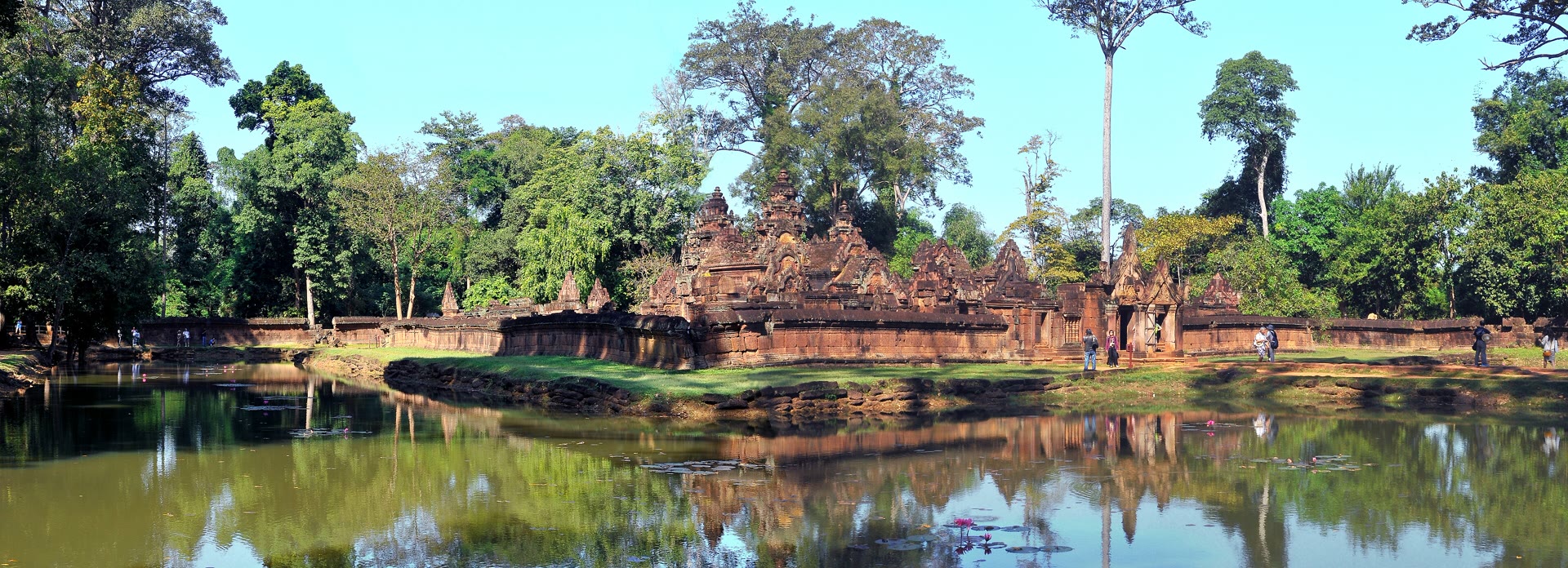
Most Angkor temples impress through sheer scale. Banteay Srei does the opposite. It is small, almost miniature by Angkorian standards, but its carvings are so intricate and so perfectly preserved that many archaeologists and art historians consider it the finest example of Khmer decorative art in existence. Built from rose-pink sandstone that glows warm in the morning light, every surface is covered with carvings of such delicacy that they look more like woodwork or filigree than stone.
Located about 25 kilometers northeast of the main Angkor temple group and 32 kilometers from Siem Reap, Banteay Srei requires a dedicated trip beyond the standard temple circuits. That extra effort filters out casual visitors and rewards those who make the journey with one of Cambodia's most remarkable cultural experiences.
History of Banteay Srei
Banteay Srei breaks several conventions of Angkorian temple building. Consecrated on 22 April 967 CE, it is the only major temple at Angkor not built by a king. It was commissioned by two courtiers, Yajnavaraha and Vishnukumara, who served as counselors to King Rajendravarman II and later to Jayavarman V. Yajnavaraha was a scholar and teacher of the young prince who would become Jayavarman V, and his intellectual standing is reflected in the temple's sophisticated iconographic program.
The temple is dedicated to the Hindu god Shiva. Its original name was Tribhuvanamahesvara, meaning "Great Lord of the Threefold World." The modern name Banteay Srei translates as "Citadel of Women" or "Citadel of Beauty," a reference either to the delicacy of its carvings or to the many female devata figures adorning its walls.
Banteay Srei gained international notoriety in 1923 when the young French writer Andre Malraux stole four devata sculptures from the temple. He was arrested in Phnom Penh, and the pieces were returned. The incident, ironically, drew attention to the temple's extraordinary artistic value and helped catalyze French conservation efforts at Angkor.
In the 1930s, Banteay Srei became the first Angkor temple to be restored using anastylosis, a technique where collapsed structures are carefully reassembled from their original stone blocks. This painstaking process produced the remarkably complete temple visitors see today.
Things to Do
Architecture and Carvings
The temple complex is oriented east-to-west and enclosed within three concentric walls. The buildings are strikingly small compared to the monumental temples of central Angkor. The central towers stand only about 10 meters high, and doorways are so low that adults must duck to pass through them. This intimate scale, combined with the density of decoration, creates a jewel-box effect unlike anything else in the Angkor complex.
The Pink Sandstone
Banteay Srei is built primarily from a hard red sandstone quarried from the nearby Phnom Dei hill. This stone has properties that set it apart from the grey sandstone used in most Angkor temples: it is harder, finer-grained, and can be carved with extraordinary precision. The stone ranges in color from deep rose to soft pink depending on the light, and it weathers to a warm patina that gives the temple its distinctive glow.
The Lintels and Pediments
The lintels above doorways and the pediments topping the temple structures are considered the masterpieces of Banteay Srei. They depict scenes from Hindu mythology with a level of detail that astonishes even seasoned temple visitors:
- Eastern pediment of the southern library: Depicts Ravana shaking Mount Kailasa while Shiva sits calmly on top with Uma. The scene shows animals fleeing in panic and a richly detailed forest landscape.
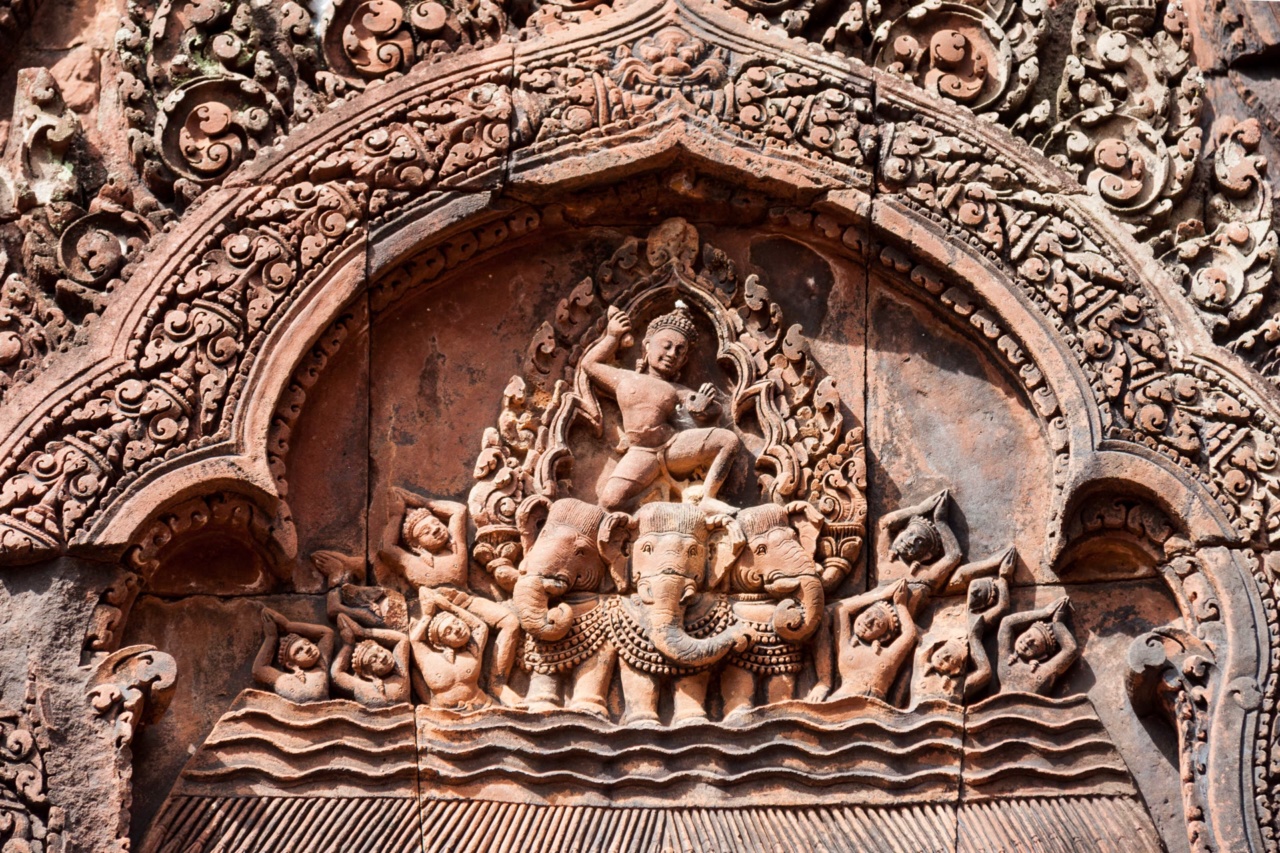
- Eastern pediment of the northern library: Shows Indra riding Airavata, his three-headed elephant, while rain falls to extinguish a forest fire set by the demon Agni. The rain is rendered as individual droplets carved into the stone.
- Western pediment of the southern library: Depicts the battle between the monkey brothers Valin and Sugriva from the Ramayana, with Rama watching from behind a tree.
These scenes are carved in deep relief with multiple layers of depth, creating an almost three-dimensional effect. Figures emerge from backgrounds of scrolling foliage, mythical creatures, and decorative borders with a sophistication that approaches sculpture rather than architectural decoration.
The Devatas and Dvarapalas
The temple is guarded by carved dvarapalas (guardian figures) at doorways and adorned with devatas (divine female figures) in niches along the walls. The devatas at Banteay Srei are among the most celebrated in Khmer art, with elaborately detailed hairstyles, jewelry, and clothing that provide invaluable information about 10th-century Khmer court fashion and aesthetics.
Decorative Motifs
Virtually every surface of Banteay Srei is carved. Columns feature intricate foliate patterns. False doors are decorated with geometric designs. Kala faces (fierce mythical beings) crown doorways with gaping mouths from which garlands of foliage emerge. The density and quality of this decoration is unmatched at any other Angkor site.
Visiting Banteay Srei
Tickets and Access
Banteay Srei is covered by the standard Angkor Archaeological Park pass (1-day $37, 3-day $62, 7-day $72). No separate ticket is needed. The temple is open from 7:30 to 17:30 daily.
Getting There
The temple is 25 kilometers northeast of the main Angkor group and about 32 kilometers from Siem Reap center.
| Transport | Duration | Cost (approx.) | Notes |
|---|---|---|---|
| Tuk-tuk | 45-60 minutes | $25-35 (round trip) | Scenic ride through villages and rice paddies |
| Car with driver | 30-40 minutes | $35-50 (round trip) | More comfortable, especially in hot season |
| Bicycle | 1.5-2 hours | $2-5 rental | Flat road but long distance; start very early |
| Organized tour | Half day | $20-40 | Often combined with other outer temples |
The road from Siem Reap is paved and in good condition. The drive passes through farming villages and rice fields, making it scenic in its own right. Most visitors combine Banteay Srei with the Grand Circuit or other outer temples like Kbal Spean (the River of a Thousand Lingas) to justify the longer drive.
Best Time to Visit
Early morning is ideal for two reasons: the pink sandstone glows most dramatically in the soft, warm light of the first hours, and the temple is relatively exposed with little shade, making midday visits uncomfortably hot. Arrive as close to opening (7:30) as possible. Late afternoon also works well for photography as the western light picks out the carvings in deep relief.
How Long to Spend
Allow one to 1.5 hours at the temple itself. The carvings reward slow, careful examination. A pair of binoculars is useful for studying the upper pediments and lintels in detail. The visitor center near the entrance has an informative exhibition about the temple's history and restoration that adds 15-20 minutes.
Combining with Nearby Sites
- Kbal Spean (River of a Thousand Lingas): Located 12 kilometers further north from Banteay Srei, this riverbed features thousands of Hindu carvings - lingas, yonis, and figures of Vishnu - carved directly into the sandstone river bottom. Reaching the carvings requires a 45-minute uphill jungle hike. Best visited in the wet season (June through November) when water flows over the carvings. Combine with Banteay Srei for a full day.
- Cambodia Landmine Museum: On the road between Angkor and Banteay Srei, this small but impactful museum was founded by former child soldier Aki Ra. It documents the landmine crisis in Cambodia and supports demining efforts and children affected by mines. Well worth a 30-45 minute stop.
- Banteay Samre: A well-preserved 12th-century temple closer to the main Angkor group, roughly on the route to Banteay Srei. Built in the same style as Angkor Wat but far less crowded, it makes a logical stop on the way out or back.
Tips for Visiting Banteay Srei
- Arrive early. The temple faces east, so the morning sun illuminates the carved facades directly. By mid-morning, tour buses arrive and the site becomes crowded. The intimate scale of the temple means crowds are more noticeable here than at larger sites.
- Bring binoculars or a zoom lens. Many of the finest carvings are on pediments and lintels several meters above eye level. A telephoto lens (200mm+) or compact binoculars let you study details that are invisible to the naked eye from ground level.
- Wear sun protection. The temple compound has minimal shade. A hat, sunscreen, and water are essential, especially if visiting outside the early morning window.
- Take your time with the lintels. The pediment scenes tell complete mythological stories with extraordinary detail. Study them panel by panel rather than rushing through. The eastern pediments of the two library buildings are the most celebrated.
- Visit the exhibition. The visitor center near the entrance includes an exhibition explaining the temple's iconography, history, and the anastylosis restoration process. Seeing it before entering the temple itself helps you understand what you are looking at.
- Cover shoulders and knees. The standard Angkor dress code applies.
- Plan the drive as part of the experience. The road to Banteay Srei passes through rural Cambodia that looks very different from Siem Reap. Ask your tuk-tuk driver to take a slow pace and enjoy the landscape.
Banteay Srei is often called the jewel of Khmer art, and the description is earned. For more on exploring the wider Angkor complex and planning your temple itinerary from Siem Reap, GoAsia.cc has detailed guides.
Frequently Asked Questions
Banteay Srei is a 10th-century Hindu temple in the Angkor complex, famous for its extraordinarily detailed carvings in rose-pink sandstone. Unlike the monumental scale of Angkor Wat or Bayon, Banteay Srei is small and intimate, with decoration so intricate it is widely considered the finest example of Khmer decorative art ever created.
Banteay Srei is included in the standard Angkor Archaeological Park pass. A 1-day pass costs $37, a 3-day pass is $62, and a 7-day pass is $72. There is no separate admission fee. The same pass covers all temples in the Angkor complex.
The temple is about 32 kilometers from Siem Reap center. A tuk-tuk takes 45-60 minutes and costs $25-35 round trip. A car with driver costs $35-50. The road is paved and scenic, passing through farming villages and rice paddies. Most visitors combine the trip with Kbal Spean or other outer temples.
Early morning right at opening (7:30) is ideal. The east-facing temple glows in warm morning light, temperatures are cooler, and crowds are thinner. The site has minimal shade, making midday visits uncomfortable. Late afternoon also offers good photography light as carvings are illuminated in deep relief.
The modern name translates as 'Citadel of Women' or 'Citadel of Beauty,' likely referring to the exceptional delicacy of its carvings or the numerous female devata figures adorning its walls. The original name was Tribhuvanamahesvara, meaning 'Great Lord of the Threefold World,' reflecting its dedication to Shiva.
Allow one to 1.5 hours at the temple itself. The intricate carvings reward slow, careful examination. Add 15-20 minutes for the visitor center exhibition. If combining with Kbal Spean and the drive from Siem Reap, plan for a full half-day excursion.
Yes, most visitors combine it with Kbal Spean (River of a Thousand Lingas), 12 kilometers further north, and the Cambodia Landmine Museum on the way back. Banteay Samre, a well-preserved 12th-century temple, also sits roughly on the route. This makes a full and varied day trip.
Banteay Srei is built from hard red sandstone quarried from nearby Phnom Dei hill. This stone is finer-grained than the grey sandstone used at most Angkor temples, allowing more precise carving. Its color ranges from deep rose to soft pink depending on the light and time of day, giving the temple its distinctive warm glow.