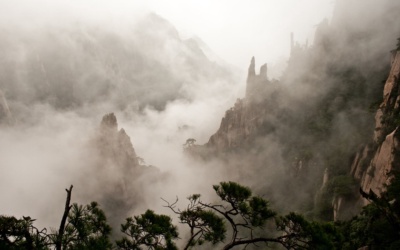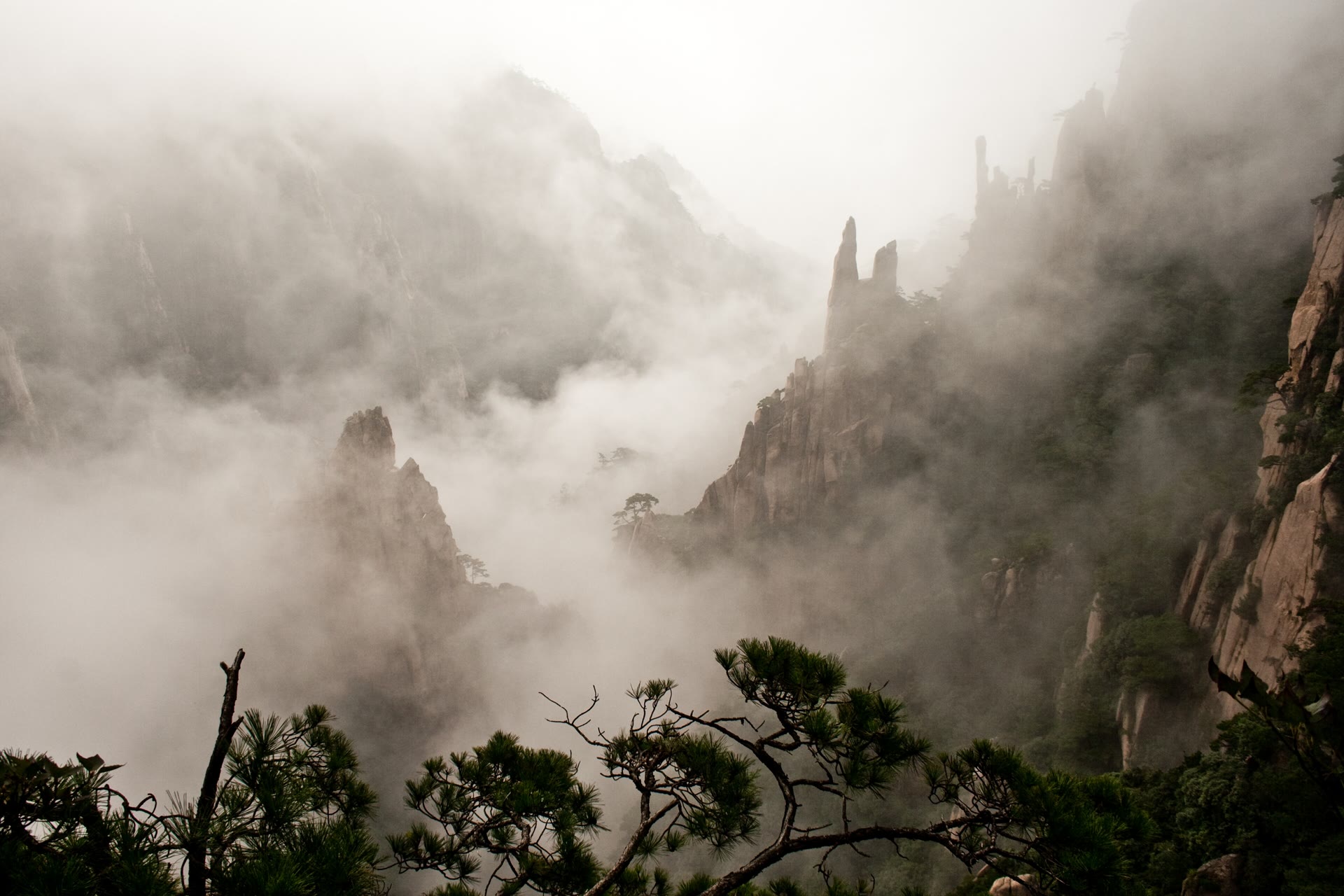
If you have ever seen a classical Chinese ink painting of jagged granite spires rising from a swirling sea of mist, with a lone twisted pine clinging to a cliff, you have already seen Huangshan. The Yellow Mountain in southern Anhui province is the landscape that shaped Chinese aesthetics for centuries, inspiring poets, painters, and emperors. It is not a single peak but a sprawling massif of over seventy named summits, threaded with stone staircases, perched hotels, and viewpoints that seem engineered for the perfect photograph.
Huangshan was inscribed as a UNESCO World Heritage Site for both its natural beauty and cultural significance. For independent travelers, it offers something rare: a genuinely world-class mountain experience that is reachable by high-speed rail, walkable on paved trails, and serviced by cable cars, yet still demanding enough that you feel you have earned the views. The catch is the weather, which can erase the entire spectacle behind a wall of fog within minutes.
This guide covers how to get there, how to choose between cable cars and climbing on foot, where to sleep on the summit, how to plan for sunrise and the famous cloud sea, and how to combine the mountain with the ancient villages of Hongcun and Xidi nearby.
What Huangshan Actually Is
Huangshan, which translates as Yellow Mountain, is a granite range famous for four signature features that locals call its wonders: oddly shaped pine trees, grotesque rock formations, the sea of clouds, and hot springs. A fifth feature, winter snow, is sometimes added. The Welcoming Pine near the summit, with its outstretched horizontal branch, is one of the most photographed trees in China and appears on artwork across the country.
The scenic area sits well above the town below. The main summits include Lotus Peak, Bright Summit, and Heavenly Capital Peak, with elevations roughly between 1,800 and 1,860 meters. While that is not extreme altitude, the relief is dramatic, and the trails involve thousands of stone steps cut directly into the rock, sometimes hugging sheer drops with chain railings.
It is important to separate the geography. There is Huangshan City, an administrative area that confusingly includes the historic old town of Tunxi. There is Tangkou, the gateway town at the base of the mountain. And there is the mountain scenic area itself, where the trails, peaks, and summit hotels are located. When booking transport or accommodation, always confirm which Huangshan you mean.
Things to Do
Getting to Huangshan
The most convenient approach for international travelers is high-speed rail. Huangshan North Railway Station connects to major hubs including Shanghai, Hangzhou, Nanjing, and Beijing. From Shanghai the journey takes around three hours, making Huangshan a feasible addition to an eastern China itinerary. Trains are frequent, comfortable, and far simpler than driving.
From Huangshan North Station you still need to reach the base of the mountain at Tangkou, roughly an hour away by bus or taxi. Shuttle buses run between the railway station, the old town of Tunxi, and the scenic area transit center. At the transit center you transfer to the official eco-friendly buses that wind up the mountain road to the cable car stations and trailheads. Private vehicles are generally not allowed on the upper mountain road, so this transfer is mandatory.
There is also a regional airport near Tunxi for those flying in from elsewhere in China, but rail is usually the smoother choice. Verify current schedules and ticketing rules before you travel, since timetables and station transfers change.
Cable Cars Versus Climbing on Foot
This is the central decision of any Huangshan trip, and it shapes how hard your day will be.
The mountain has several cable car lines that carry you from the base area up to the summit ridges in a matter of minutes. The main lines serve the eastern and western approaches, and a separate cable car operates on the western side connecting to the more remote canyon trails. Cable cars save hours of climbing and conserve your legs for the spectacular ridge walks at the top, which are the real reason to visit. For most travelers, taking the cable car up is the sensible default.
Climbing on foot is possible and rewarding for fit hikers. The eastern steps are shorter and easier; the western steps are longer, more scenic, and significantly more tiring. A full ascent on foot can take three to five hours depending on your route and fitness, all of it on stone stairs. Many people compromise by riding the cable car up and walking down, or vice versa.
A common and excellent strategy is to take the cable car up, spend your time walking the summit trails between viewpoints and your hotel, then either descend by cable car or walk down the eastern steps the next day. Be honest about your fitness. The summit trails themselves involve constant up-and-down stair climbing even if you skip the main ascent, so you will be on steps for hours regardless.
| Approach | Effort | Time | Best for |
|---|---|---|---|
| Cable car up and down | Low to moderate | Short transfers plus summit walking | Most visitors, families, limited time |
| Cable car up, walk down | Moderate | Add 2 to 4 hours | Hikers wanting variety without full climb |
| Climb up, cable car down | High | Add 3 to 5 hours | Fit hikers who want the achievement |
| Climb both ways | Very high | Long full days | Strong hikers, no luggage |
Staying Overnight on the Summit
The single most important planning decision is whether to sleep on the mountain. Huangshan rewards an overnight stay enormously. Day trippers arrive after the morning fog, leave before the evening light, and often miss both sunrise and sunset, the two times when the cloud sea and golden light are most likely to appear.
There are several hotels on the summit ridges, positioned near the major viewpoints. They range from basic to comfortable, but all share the same realities: prices are high because everything must be carried up by porters or cable car, rooms are simpler than the cost suggests, and availability is tight in peak periods. Book well ahead, especially for weekends, Chinese public holidays, and the autumn foliage season.
Sleeping on the mountain lets you reach a sunrise viewpoint within a short walk, watch the evening colors after the day crowds thin, and break the relentless stair climbing across two days. If summit hotels are full or beyond budget, some travelers stay at the hot spring area partway up or in Tangkou at the base, but you sacrifice the magic of dawn on the ridge.
Pack light if you are staying up top. You will carry your bag along the trails, and porters charge by weight. Bring layers, a power bank, basic snacks, and any medication, since summit prices for everything are steep.
Planning for Sunrise and the Sea of Clouds
The sea of clouds is Huangshan's headline attraction, and it is also the least predictable. It forms when temperature and humidity conditions create a low blanket of cloud below the peaks, leaving the summits floating above a white ocean. It is most common after rain, in cooler months, and in the early morning. It can also simply fail to appear, or wrap the whole mountain in featureless fog so you see nothing at all.
Sunrise is the classic time to chase it. Popular sunrise viewpoints include spots near the summit hotels, where crowds gather in the dark with the staff sometimes announcing the expected sunrise time the night before. Arrive early to claim a position, dress warmly even in summer, and accept that some mornings simply will not deliver. The unpredictability is part of the experience, and a clear sunrise over a cloud sea is genuinely one of the great sights in Asia.
To improve your odds, stay overnight so you are already on the ridge, build in a buffer of more than one morning if your schedule allows, and check the local weather forecast before committing. Even on a cloudy trip, the pines, granite spires, and stairways carved into the cliffs remain striking.
Weather Volatility and What to Expect
Huangshan weather changes fast and dramatically. A clear morning can vanish into thick mist by midday, then reopen into brilliant sunshine an hour later. This volatility is so reliable that experienced visitors treat shifting weather as the norm rather than the exception. Rain is common, especially in the summer wet season, and trails become slippery.
Each season offers something different. Spring brings greenery and flowering. Summer is lush but can be hot, humid, crowded, and rainy. Autumn offers crisp air, colorful foliage, and often the clearest conditions, which makes it the most popular and busiest season. Winter delivers snow scenes, rime ice on the pines, and the thinnest crowds, though some facilities and trails may have weather restrictions and the cold is serious.
Whatever the season, bring waterproof layers, shoes with good grip, and a willingness to adapt. Cable cars can be suspended in high winds or severe weather, which can strand you or force a long walk, so always have a contingency in mind.
Tickets, Access, and Practical Logistics
Visiting Huangshan involves several separate costs that catch people off guard. There is an entrance ticket to the scenic area, a separate fare for the mandatory eco-bus up the access road, and additional fares for each cable car you use. If you stay overnight you pay for the hotel, and if you use porters you pay for that too. Budget for the total, not just the entrance.
Entrance tickets are sometimes cheaper in the off-peak season. Cable car tickets can sell out or involve long queues at busy times, so consider buying transport and entry in advance where possible. Bring your passport, as identification is required for ticketing and entry in China, and many bookings are tied to your passport number.
Within the scenic area, the trails are well marked with bilingual signs, and the network of stone paths connects the major peaks and viewpoints. Distances on the summit are deceptive because everything is measured in stairs, not flat kilometers. Allow more time than the map suggests.
Suggested Itinerary on the Mountain
A practical two-day plan works well for most independent travelers. On the first day, travel from your origin to the base, transfer via the transit center and eco-bus to a cable car station, and ride up to the summit ridge by early afternoon. Check into your summit hotel, drop your bag, and spend the afternoon walking to nearby viewpoints and pine trees, catching the evening light.
On the second day, wake before dawn for sunrise at a nearby viewpoint, then spend the morning hiking the ridge trails while crowds are thinner. After lunch, descend by cable car or on foot, reverse the transfer to the base, and continue to your next destination or to the ancient villages.
Travelers with only one day can still see a great deal by taking the earliest possible transport up and prioritizing the central summit viewpoints, but they accept worse odds on light and atmosphere. For continued trip planning across the region, GoAsia.cc is a useful resource for connecting Huangshan with the rest of eastern China.
Pairing Huangshan with Hongcun and Xidi
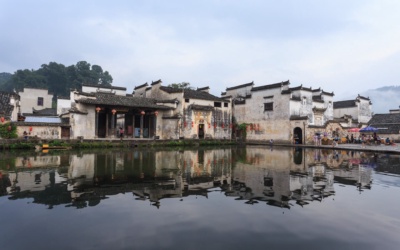
Two of China's most beautiful historic villages sit within easy reach of Huangshan, and they make an ideal complement to the mountain. Hongcun and Xidi are exceptionally well-preserved Huizhou-style villages, both inscribed as UNESCO World Heritage Sites for their traditional architecture, narrow lanes, whitewashed walls with dark tiled roofs, and ornate carved woodwork.
Hongcun is built around a central pond and a network of waterways that thread through the village, and its reflective ponds and arched bridges are famous for photography. It also gained international fame as a filming location for a celebrated martial arts movie. Xidi is quieter and prized for its intact ancestral halls and memorial archways. Together they show the refined merchant culture of historic southern Anhui in a way the mountain cannot.
Logistically, the villages are reached from the same general area as the mountain base and the old town of Tunxi, with buses and taxis connecting them. Many travelers spend a half day or more in the villages either before or after the mountain. The contrast between the dramatic granite peaks and the serene water villages makes for a balanced and memorable Anhui trip.
Realistic Downsides and Common Mistakes
Huangshan is beautiful, but it is not a wilderness escape. In peak seasons the trails and cable cars can be extremely crowded, with queues and bottlenecks at popular viewpoints. The famous Welcoming Pine in particular draws dense crowds. If solitude is your goal, visit midweek, in shoulder seasons, or start your walks at dawn.
The most common mistake is underestimating the physical demand. Even with cable cars, the summit involves hours of stair climbing, and people with knee or heart issues should plan carefully. The second common mistake is treating it as a day trip and missing the best light. The third is ignoring the weather and being disappointed by fog, then leaving before conditions improve.
Other practical pitfalls include carrying too much luggage up the mountain, failing to book summit hotels early, and not budgeting for the layered ticket, bus, and cable car costs. Bring cash and mobile payment options, since some facilities prefer one or the other.
Practical Tips for Climbing Huangshan
- Stay overnight on the summit if at all possible. It transforms the trip and maximizes your chances at sunrise and the cloud sea.
- Pack light for the mountain and leave large luggage at your base hotel or a station locker. You will be carrying your bag on stairs.
- Wear shoes with strong grip and bring waterproof layers regardless of the forecast. Conditions change within the hour.
- Bring your passport for ticketing and entry, plus a power bank, snacks, and water to avoid steep summit prices.
- Buy cable car and entrance tickets in advance during busy periods, and have a backup plan if cable cars are suspended by weather.
- Start summit walks early in the morning to beat the day-tripper crowds arriving on the cable cars.
- Allow extra time on the trails, since distances are measured in stairs rather than flat kilometers.
- Build flexibility into your dates so a foggy morning does not ruin the whole experience.
Is Huangshan Worth It?
For travelers willing to manage the logistics and the unpredictable weather, Huangshan is one of the most rewarding mountain destinations in China. The combination of granite spires, ancient pines, and the floating sea of clouds genuinely lives up to the centuries of art it inspired. Paired with the water villages of Hongcun and Xidi, it makes a complete and deeply scenic regional trip.
Go with realistic expectations about crowds, stairs, and fog, plan an overnight stay, and treat a clear sunrise as a bonus rather than a guarantee. When the conditions align, the view from the ridge at dawn is the kind of sight that defines a journey through China.
Frequently Asked Questions
Two days is ideal, with one overnight stay on the summit so you can experience both sunset and sunrise. A single day is possible if you take the earliest transport up and the cable car both ways, but you risk missing the best light and the sea of clouds. Adding a half day for Hongcun or Xidi makes a well-rounded trip.
Costs come in layers: a scenic area entrance ticket, a mandatory eco-bus fare up the access road, and separate fares for each cable car you use. If you stay overnight, summit hotels are significantly more expensive than equivalent rooms at the base because supplies are carried up. Budget for all of these together and verify current prices before you travel.
Take a high-speed train from Shanghai to Huangshan North Railway Station, which takes around three hours. From the station, transfer by bus or taxi to the Tangkou gateway area and the scenic transit center, then board an official eco-bus to the cable car stations or trailheads. Private cars are not allowed on the upper mountain road.
For most visitors the cable car up is the sensible choice, since it saves hours and preserves energy for the spectacular ridge walks at the top. Fit hikers can climb the eastern steps in a few hours or walk down for variety. Remember that even with the cable car, the summit trails involve constant stair climbing.
It is never guaranteed. The cloud sea forms under specific humidity and temperature conditions, most often after rain and in the early morning during cooler months. Staying overnight on the summit and allowing a flexible schedule improves your odds, but some mornings bring only thick fog or clear skies with no cloud sea at all.
Yes, and it is highly recommended. Both Hongcun and Xidi are UNESCO-listed Huizhou-style villages reachable from the same base area near the mountain. Many travelers spend a half day or more in the villages before or after climbing, enjoying the contrast between dramatic granite peaks and tranquil water-laced lanes.