
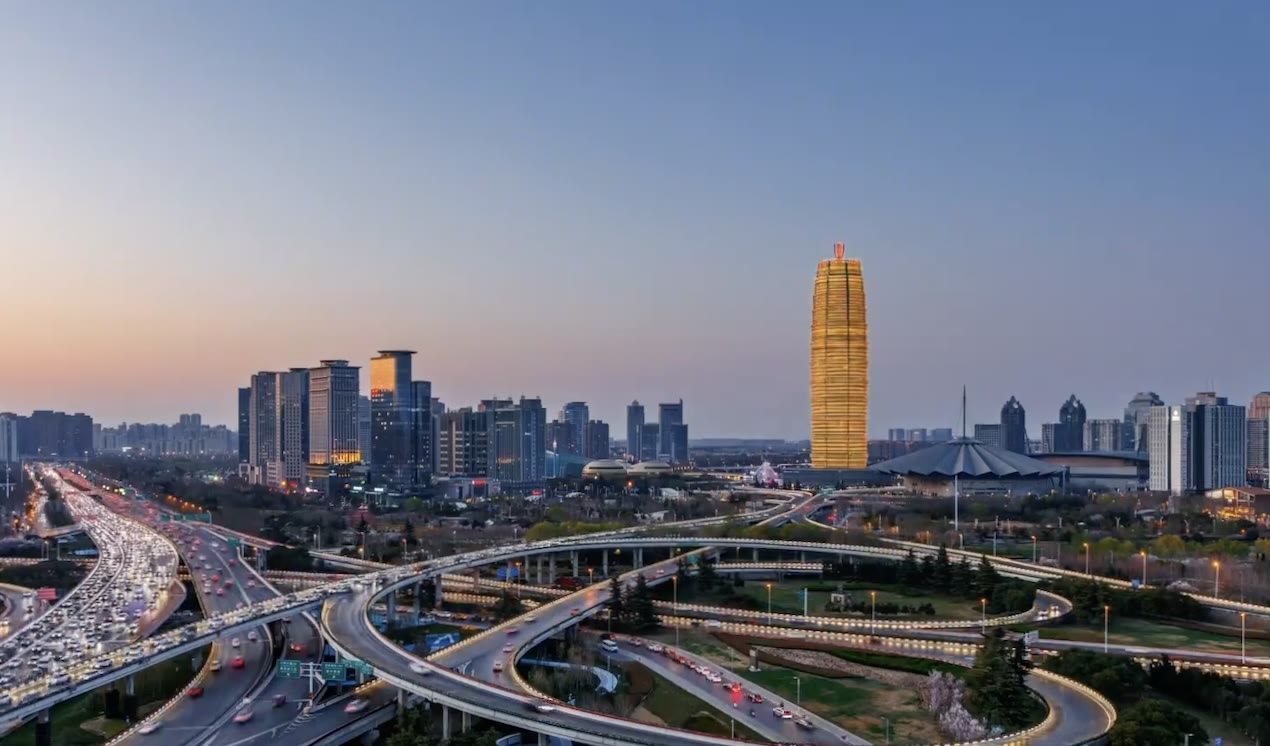
Photo: 白诗棋 / Wikimedia Commons, CC0
Contents
- 1. Getting Around Zhengzhou by Metro
- 1.1 Getting to and from the airport
- 2. Getting Around Zhengzhou by Taxi
- 3. Getting Around Zhengzhou by DiDi (Ride-Hailing)
- 4. Getting Around Zhengzhou by Bus
- 5. Getting Around Zhengzhou by Bike and E-Bike Share
- 6. Getting Around Zhengzhou on Foot
- 7. Comparing Your Options
- 8. Practical Tips for Getting Around Zhengzhou
- 9. Popular Routes and Destinations
- 10. Frequently Asked Questions
- 11. Sources and background
Zhengzhou rarely lands at the top of a traveler's list, yet anyone crossing central China almost inevitably passes through it. As the capital of Henan and one of the country's busiest rail crossroads, the city has the restless energy of a place built for movement. Construction cranes share the skyline with glass office towers, and wide multi-lane boulevards cut between sprawling residential districts.
The good news for visitors is that Zhengzhou has a modern metro system that keeps expanding, and the streets are full of taxis and ride-hailing cars. The less convenient truth is that the city is large and flat, distances between sights are long, and very little English is spoken or signposted once you leave the metro. Walking works in pockets, but you will lean on the metro, buses and DiDi to stitch a day together.
Think of Zhengzhou as a practical transit city rather than a stroll-and-discover one. Pin your destinations and keep a translation app handy.
Getting Around Zhengzhou by Metro
The Zhengzhou Metro is the backbone of urban travel and the easiest option for a foreign visitor. Multiple lines crisscross the city, connecting the East Railway Station (Zhengzhoudong, the high-speed hub), the main Zhengzhou Railway Station, the airport and the central commercial districts around Erqi Square and the CBD.
Stations are modern and air-conditioned, and signs are bilingual in Chinese and English. Fares are distance-based: 2 yuan covers the first 6 km, and the fare rises by 1 yuan for each further 7 km (6 to 13 km), 8 km (13 to 21 km) or 9 km (beyond 21 km).[1] To pay, buy a single-journey ticket from the machines, tap a rechargeable transit card, or use a QR code through Alipay or WeChat Pay if you have set them up with a foreign card. Bags are screened at station entrances, so allow a couple of extra minutes, and expect crowds in the morning and evening rush.
Getting to and from the airport
Zhengzhou Xinzheng International Airport lies well south of the city. The metro's suburban line (Chengjiao line) is the cheapest way in: it continues south from Line 2 and ends at Xinzheng Airport station, which is directly connected to Terminal 2 and has a transport center linking metro, intercity rail, buses, coaches and taxis.[2] If you arrive late or carry heavy luggage, a taxi or DiDi to the central districts is the easier option, and the traffic decides the travel time.
Getting Around Zhengzhou by Taxi
Metered taxis are everywhere and remain affordable. Hailing on the street is easy on busy roads, harder during shift changes in the late afternoon and during rain. Always insist the driver runs the meter ("da biao"); most do without prompting. Few drivers speak English, so have your destination written in Chinese characters or shown on a map. Keep small notes, as drivers may not break a large bill, and note that many now prefer payment by WeChat or Alipay QR code over cash.
Getting Around Zhengzhou by DiDi (Ride-Hailing)
DiDi is the dominant ride-hailing app in China and the smoothest option for foreign travelers in Zhengzhou. You set your pickup and drop-off on a map, so there is no language barrier with the driver, and the fare is calculated and paid in-app. Prices are usually similar to taxis, with surge pricing during rush hours and bad weather.
DiDi has an English-language interface and you can link an international card or pay through Alipay. The app shows the car, license plate and driver in advance, which removes any haggling. You can compare ride and transit options on GoAsia.cc when planning your routes in advance.
Getting Around Zhengzhou by Bus
Zhengzhou has an extensive city bus network reaching corners the metro does not, including a Bus Rapid Transit (BRT) system that runs in dedicated lanes for faster crossings. Fares are low, paid with a transit card or a QR code.
Buses are the local choice for short hops and for neighborhoods off the metro grid, but they come with real friction for visitors: route information and stop announcements are almost entirely in Chinese, buses get packed, and navigating transfers without local knowledge is tricky. Use a map app that shows live bus routing if you want to attempt them. For most travelers, buses are best reserved for a specific short connection rather than general roaming.
Getting Around Zhengzhou by Bike and E-Bike Share
Shared bikes from operators such as Meituan and Hellobike are scattered across the city and unlocked by scanning a QR code through their apps or via Alipay. Zhengzhou is flat, and many main roads have separated bike lanes, so cycling is practical for short distances and last-mile trips from a metro station.
The catch is traffic: junctions are busy and not always orderly, and the size of the city means cycling suits hops of a kilometer or two rather than crossing town. Park within marked zones to avoid penalties, and avoid the heaviest rush-hour roads if you are not a confident urban cyclist.
Getting Around Zhengzhou on Foot
Walking is pleasant within compact zones such as the area around Erqi Square, the pedestrian shopping streets, and the parks and lakeside promenades. Footpaths are generally wide and well maintained in the center.
That said, Zhengzhou is built for cars and long distances. Blocks are huge, crossings can be far apart, and summer heat and winter chill make long walks uncomfortable in season. Treat walking as a way to explore a single district once you have arrived there by metro or car, not as a way to travel between districts.
Comparing Your Options
| Mode | Best For |
|---|---|
| Metro | Crossing the city cheaply and reliably |
| Taxi | Door-to-door with luggage |
| DiDi | Easy booking with no language barrier |
| Bus / BRT | Cheap hops off the metro grid |
| Shared bike | Last-mile and flat short trips |
| Walking | Exploring a single district |
Practical Tips for Getting Around Zhengzhou
A little preparation before you arrive removes nearly all the friction of moving around this city. The single most important step is to set up mobile payment, since cash is increasingly the fallback rather than the norm.
- Install Alipay or WeChat Pay and link an international card. Both support foreign cards and let you pay with a QR code in many places.
- Download DiDi for ride-hailing and Amap (Gaode) or Baidu Maps for navigation, as Google Maps does not work reliably in China.
- Carry a translation app such as Pleco or Google Translate with the offline Chinese pack, and save your hotel address in Chinese characters to show taxi drivers.
- Keep some small cash as a backup for buses and older taxis.
- Avoid the metro and main roads during the morning and evening rush if you can; crowding and traffic both spike sharply.
On scams, Zhengzhou is far less touristy than coastal megacities, so aggressive tourist traps are rare. The main thing to watch is the occasional taxi driver who declines to run the meter, especially near the railway stations; either insist on the meter or simply use DiDi instead. At the busy stations, ignore touts offering unofficial "taxi" rides and head to the marked queue.
Public transport is generally safe for visitors. Check the last train time of your line before you go out in the evening, and keep DiDi as the fallback for late returns. Keep an eye on your belongings in crowded buses and station crushes.
Popular Routes and Destinations
The most common journey for visitors is between the airport and the city center, covered by the metro's suburban line, or by taxi or DiDi if you prefer door-to-door.
For arrivals by high-speed train at Zhengzhoudong (East Station), the metro connects directly into the central districts and is the quickest, cheapest way to reach most hotels. From the central commercial core around Erqi Square, the metro and short DiDi rides reach almost every point of interest, and the flat street grid makes shared bikes a fun way to cover the last stretch.
Frequently Asked Questions
Use this guide to compare local transport in Zhengzhou. When bookable tickets are available, the booking tool shows current options and prices.
The metro is the best all-round option, being cheap, clean and signed in English. For door-to-door trips, especially with luggage or at night, DiDi ride-hailing is the most convenient since you set the destination on a map and avoid any language barrier.
Metro fares are distance-based: 2 yuan covers the first 6 km and the fare rises by 1 yuan for each further 7 to 9 km. City buses are cheap, and taxis and DiDi are priced by distance and traffic.
Public transport is generally safe for visitors. The main precaution is guarding against petty pickpocketing in crowded stations and buses. Check the last train time of your line in the evening and use DiDi for late returns.
Yes, DiDi is widely used and works well for foreign travelers. It has an English interface, lets you set pickup and drop-off on a map, and you pay in-app through a linked card or Alipay, removing both haggling and the language barrier.
It is strongly recommended. Alipay and WeChat Pay accept international cards and let you pay by QR code in many places. Carry some small cash as a backup, but mobile payment is the smoothest way to pay.
Metro signs are bilingual, so the metro is easy. For taxis, save your destination in Chinese characters or show it on a map, since few drivers speak English. A translation app like Pleco or offline Google Translate helps with everything else.
The metro's suburban line runs from Xinzheng Airport station, which connects directly to Terminal 2, into Line 2 and the city center, and is the cheapest option. A taxi or DiDi is the door-to-door alternative, with travel time depending on traffic.
Sources and background
Numbers in the text such as [1] refer to these sources.
- [1] Zhengzhou Rail Transit (Zhengzhou Metro): 郑州轨道交通1号线二期、城郊线票价出炉 (Fares of Zhengzhou Metro Line 1 phase 2 and the suburban line). Retrieved October 15, 2026.
- [2] China Civil Aviation News (CAAC): 新郑机场站实现7种交通方式无缝换乘 (Xinzheng Airport station: seamless transfer between 7 modes of transport). Retrieved October 15, 2026.
Guide prices and journey times are indicative, not live quotes. A booked package may include transfers and waiting time as well as the main journey. Check the selected offer, pickup point and current conditions before booking.