Sukhothai Historical Park: temples, zone tickets and transport
Photo: Yothin Inbanleng / Unsplash
Contents
Start with the central monuments if your time or walking range is limited. Add Wat Si Chum in the north for its giant seated Buddha, or the western hill if you like a climb. The UNESCO property includes Sukhothai, Si Satchanalai and Kamphaeng Phet. They are 3 separate historic towns, and a Sukhothai park ticket does not cover the other 2.[1]
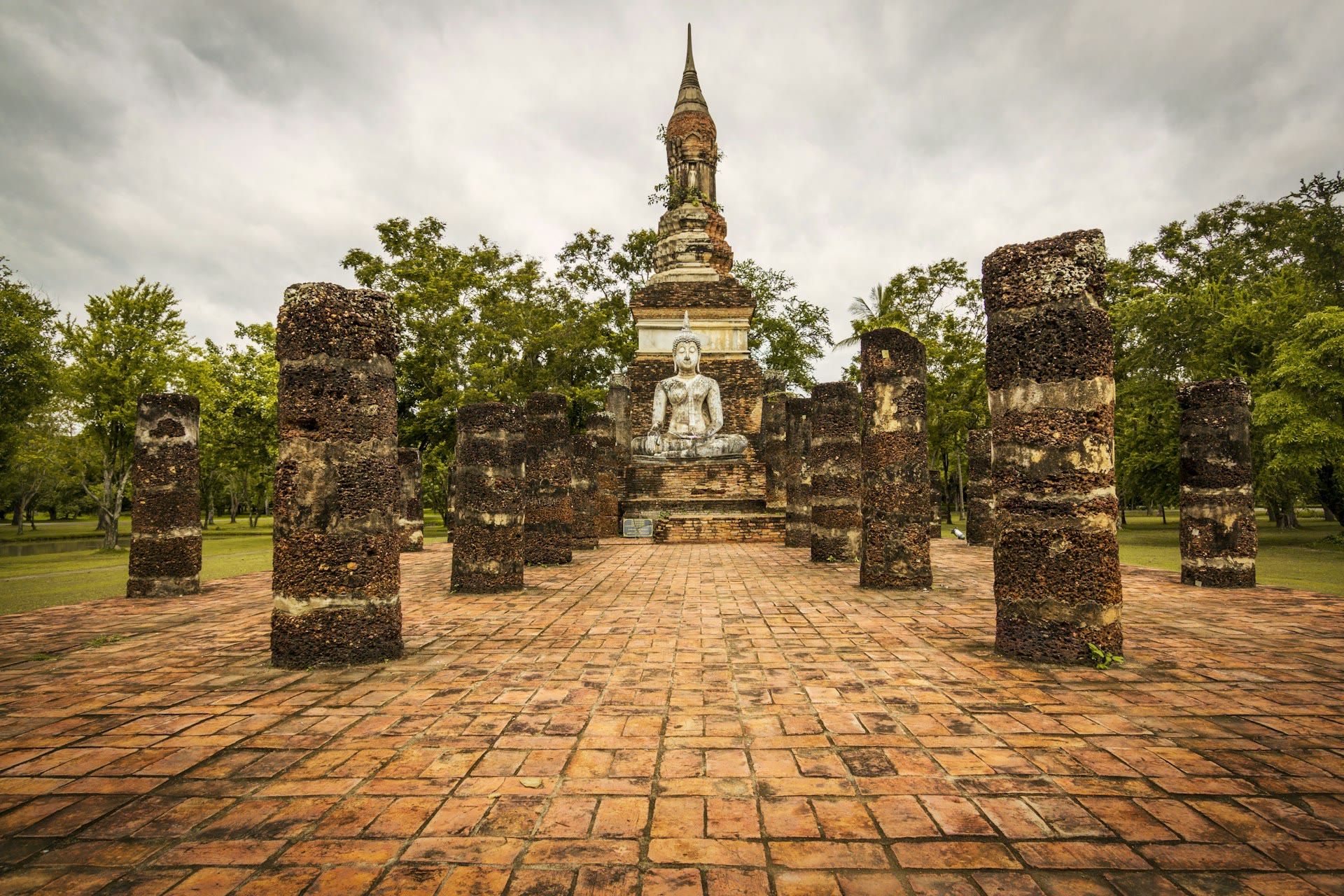
Sukhothai was the capital of the first Kingdom of Siam in the 13th and 14th centuries, and its monuments are part of the UNESCO site Historic Town of Sukhothai and Associated Historic Towns.[1] In the park, temple ruins, Buddha images, walls, moats and ponds let you walk through that history. The Sukhothai part of the property covers about 70 km².[1]
Choose your monuments
Wat Mahathat has a lotus-bud main chedi in classic Sukhothai style, surrounded by 8 smaller chedis on the same base. Wat Sa Si sits on an island in the Traphang Trakuan pond and has a Sri Lankan-style main chedi.[2] Pair these with Wat Si Sawai for a central-area visit rather than trying to photograph every monument. Go early or late in the day when the light is soft and the heat is lower.
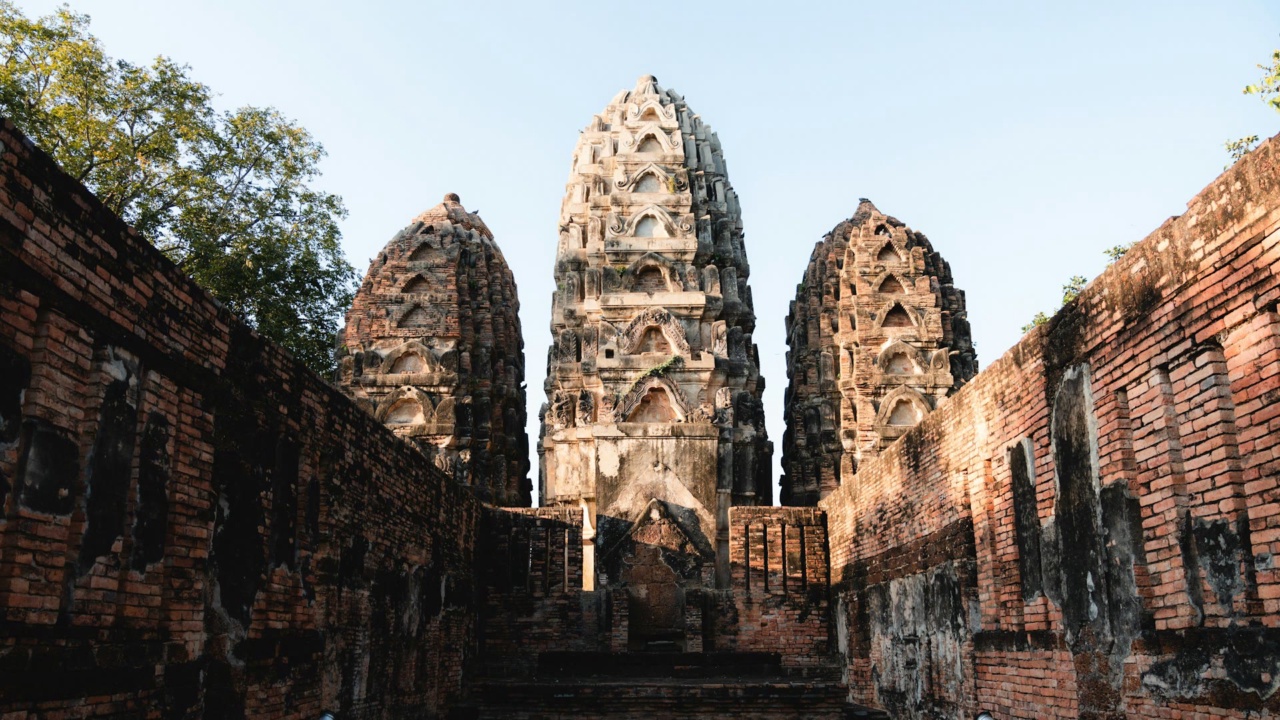
Wat Si Sawai is recognisable by 3 Khmer-style prangs standing in a row.[2] Look for the surviving stucco details and notice how different this layout feels from the bell-shaped and lotus-bud chedis nearby.
Wat Si Chum shelters the seated Phra Achana Buddha, a large stucco image in the Subduing Mara posture, inside a square mandapa. The Buddha is 11.30 metres wide across the knees and 15 metres high from the base to the tip of the flame.[3] The ceiling of the passage inside the wall holds more than 50 engraved slate slabs with Jataka scenes, but the passage is closed for safety.[4] Look at the Buddha from the permitted areas.
Wat Saphan Hin belongs in a western-area itinerary. A standing Buddha 12.50 metres tall waits at the top of the hill.[2] Allow time for the uphill walk, and choose a cooler hour.
East of the old walls, Wat Chang Lom has half-body elephants in stucco around the base of its round chedi.[2] Wat Chetuphon to the south has a slate mandapa with Buddha images in 4 postures: sitting, reclining, standing and walking.[2] These are optional extensions with their own access conditions.
Things to Do
Offers are only loaded from GetYourGuide after you click. GetYourGuide can then process your IP address and set cookies. Privacy Policy
GetYourGuide partner offers. GoAsia may earn a commission if you book through these offers. Check whether tickets or transfers are included, and follow the attraction's official booking and admission rules.
Understand the tickets
Admission is charged per zone. The inner historic zone costs 200 baht for foreign visitors and 20 baht for Thai visitors. The northern zone (Wat Si Chum and Wat Phra Phai Luang) and the western zone (Aranyik area) cost 120 baht for foreign visitors and 20 baht for Thai visitors each. A combined ticket costs 400 baht for foreign visitors and 40 baht for Thai visitors. A bicycle costs 10 baht per zone, which is an entry charge and not a rental fee.[5] The Ramkhamhaeng National Museum has a separate ticket.
Match the opening hours
The central area is open from 06:30 to 19:30 Monday to Friday and Sunday, and until 21:00 on Saturday. The Aranyik area is open from 08:00 to 16:30, and Wat Si Chum and Wat Phra Phai Luang from 07:30 to 17:30.[5] An early start in the centre does not open the northern sites earlier.
The Ramkhamhaeng National Museum is open daily from 09:00 to 16:00. Admission is 200 baht for foreign visitors and 30 baht for Thai visitors.[6] It displays finds from the excavations, among them statue fragments from the Ta Pha Daeng shrine.[2] If you start in the park before 09:00, save the museum for later.
Choose how to move
A bicycle is a pleasant way to link the central monuments and the nearby areas, as the central zone is fairly flat. Test brakes and saddle height, ask when the bike has to be back, and shade yourself from the midday sun. Agree the route, the stops and the price before you book a tram or an electric cart. For limited mobility, ask about the surfaces and steps at the monuments you want to see.
Arrange arrival and return
Bangkok Airways flies to Sukhothai Airport, which it operates itself, in Sawankhalok district.[7] The airport is not at the park entrance, so arrange the onward journey to the old town. By bus or rail, you travel via Phitsanulok or direct to the Sukhothai bus station.
The old town lies about 12 km from modern Sukhothai. Local songthaews to the old town leave from the bus station or from the stop about 200 metres from the Yom River bridge, every 20 minutes between 06:00 and 18:00.[2] Ask where the last return leaves before you go too far. Accommodation near the old town saves you the transfer.
Build a realistic itinerary
Reserve a half-day for a selection of central monuments and add time for the museum or the northern zone. A longer day can take in more areas when heat, opening hours and transport allow. Begin in a zone that is open, take shaded breaks, carry water and sun protection, and plan your way back before dusk. Si Satchanalai is a separate trip with its own entrance and journey.
Loy Krathong brings crowds, traffic and extra events to Sukhothai. Look up the programme for the year you travel, and follow local rules instead of releasing a lantern on your own.
Sources and background
Numbers in the text such as [1] refer to these sources.
- [1] UNESCO World Heritage Centre: Historic Town of Sukhothai and Associated Historic Towns. Retrieved October 21, 2026.
- [2] Tourism Authority of Thailand: Sukhothai Historical Park: monuments, areas and visitor information. Retrieved October 21, 2026.
- [3] Tourism Authority of Thailand: Wat Si Chum: Phra Achana width and base-to-flame-tip height. Retrieved October 21, 2026.
- [4] Tourism Authority of Thailand: Wat Si Chum: Jataka ceiling slabs and passage safety closure. Retrieved October 21, 2026.
- [5] Fine Arts Department, Thailand: Sukhothai Historic Park visitor information. Retrieved October 21, 2026.
- [6] Fine Arts Department, Thailand: Ramkhamhaeng National Museum: admission and opening hours. Retrieved October 21, 2026.
- [7] Bangkok Airways: Sukhothai Airport: operator and Sawankhalok location. Retrieved October 21, 2026.
Frequently Asked Questions
The UNESCO property includes Sukhothai, Si Satchanalai and Kamphaeng Phet. They are 3 separate historic towns, and a Sukhothai park ticket does not cover the other 2. The Sukhothai part covers about 70 km², so it is not one enclosed visitor circuit.
The inner historic zone costs 200 baht for foreign visitors and 20 baht for Thai visitors. The northern and western zones cost 120 baht for foreign visitors and 20 baht for Thai visitors each. A combined ticket costs 400 baht for foreign visitors and 40 baht for Thai visitors. A bicycle costs 10 baht per zone. The Ramkhamhaeng National Museum has a separate ticket: 200 baht for foreign visitors and 30 baht for Thai visitors.
A bicycle is a pleasant way to link the central monuments and the nearby areas. Test brakes and saddle height, ask when the bike has to be back, and shade yourself from the midday sun. Agree the route, the stops and the price before you book a tram or an electric cart.
Reserve a half-day for a selection of central monuments and add time for the museum or the northern zone. A longer day can take in more areas when heat, opening hours and transport allow. Si Satchanalai is a separate trip with its own entrance and journey.
Bangkok Airways flies to Sukhothai Airport in Sawankhalok district. The airport is not at the park entrance, so arrange the onward journey to the old town. The old town lies about 12 km from modern Sukhothai. Songthaews to the old town leave from the bus station or from the stop about 200 metres from the Yom River bridge, every 20 minutes between 06:00 and 18:00.
The central area is open from 06:30 to 19:30 Monday to Friday and Sunday, and until 21:00 on Saturday. The Aranyik area is open from 08:00 to 16:30, and Wat Si Chum and Wat Phra Phai Luang from 07:30 to 17:30. The museum is open daily from 09:00 to 16:00.
Si Satchanalai is a separate historic town with its own entrance and journey, so treat it as a trip of its own. Reserve a half-day for central Sukhothai and add time for the museum or the northern zone before you add Si Satchanalai.
Wat Mahathat has a lotus-bud main chedi, and Wat Sa Si stands on an island in a pond. Wat Si Sawai has 3 Khmer-style prangs. Wat Si Chum shelters the 15-metre seated Phra Achana Buddha. Wat Saphan Hin has a 12.50-metre standing Buddha on its hill. Wat Chang Lom has half-body elephants around its chedi base, and Wat Chetuphon has Buddha images in 4 postures.