
Contents
- 1. Getting Around Nanjing by Metro
- 2. Getting Around Nanjing by Bus
- 3. Getting Around Nanjing by Taxi
- 4. Getting Around Nanjing by Ride-Hailing (Didi)
- 5. Getting Around Nanjing by Bike and E-Scooter
- 6. Getting Around Nanjing on Foot
- 7. Comparing Your Options
- 8. Practical Tips for Getting Around Nanjing
- 9. Popular Routes and Destinations
- 10. Frequently Asked Questions
Nanjing wears its history on every street. Beneath the plane trees that arch over the boulevards (a legacy of the early Republican era), you will find one of China's most efficient metro networks humming below ground while electric scooters glide silently past in dedicated lanes above. The contrast is striking: ancient city walls and Ming Dynasty tombs sit a short train ride from glass towers and tech parks, and the transport system stitches all of it together.
For a city of well over eight million people, Nanjing is surprisingly easy to move around. The metro reaches most places a traveler wants to go, the streets are flat and tree-shaded, and traffic, while heavy at peak times, is calmer than in Shanghai or Beijing. The river splits the city, the central districts cluster around Xinjiekou, and the historic sites spread out along the eastern hills near Purple Mountain.
The biggest hurdle is not infrastructure but payment and language. Cash is fading fast, most locals tap their phones, and English signage is decent on the metro but thin everywhere else. Sort out your payment method early and the city opens up quickly.
Getting Around Nanjing by Metro
The Nanjing Metro is the backbone of getting around the city and almost always your best first option. It is clean, fast, air-conditioned, and extensive, with more than ten lines covering the city center, the suburbs, the airport, and both major railway stations. Trains run frequently, usually every few minutes during the day, and stations are clearly marked in both Chinese and English.
Line 1 and Line 2 form the central cross and intersect at Xinjiekou, the bustling commercial heart of the city and reportedly one of the largest underground shopping complexes in Asia. From Xinjiekou you can reach the Confucius Temple area (Fuzimiao) on the Qinhuai River, the Nanjing South high-speed rail station, and the eastern sites near Purple Mountain with a single transfer.
Fares are distance-based, typically starting around 2 yuan and rising to roughly 7 to 10 yuan for longer trips, which is a few cents to about a dollar. You can buy single-journey tokens from machines that accept cash and have an English option, but the smoothest approach is to scan a QR code through Alipay or WeChat at the gate. Service generally runs from around 6 am until about 11 pm, with the last trains slightly earlier on outer sections, so check the platform clock if you are out late.
Avoid the metro during the morning crush (roughly 7:30 to 9 am) and the evening return (5:30 to 7 pm) when central stations like Xinjiekou and Gulou pack tight. Outside those windows it is comfortable and you will rarely wait long.
Getting Around Nanjing by Bus
Nanjing's bus network is dense and cheap, reaching corners the metro misses, including narrow lanes around the old town and routes along the city wall. Most rides cost a flat fare of around 2 yuan, paid by tapping your transit card, scanning a QR code, or dropping exact cash into the farebox (drivers do not give change).
Buses are useful for short hops and for scenic stretches the metro tunnels beneath, but they come with caveats: route information and announcements are almost entirely in Chinese, and during rush hour they crawl through traffic. If you do not read Chinese, lean on a maps app to track your stop. Many buses are now electric and surprisingly quiet and smooth. There are also tourist-oriented sightseeing buses that loop the Purple Mountain scenic area, handy for linking Sun Yat-sen Mausoleum, the Ming Xiaoling Tomb, and Linggu Temple, which are spread far apart on foot.
Getting Around Nanjing by Taxi
Metered taxis are plentiful and reasonably priced. The flag-fall is typically around 11 yuan covering the first few kilometers, with modest per-kilometer charges after that, plus a small fuel surcharge and higher night rates after 11 pm. A cross-town trip often lands in the range of 20 to 50 yuan, roughly 3 to 7 dollars.
Hail them on the street, at hotels, or at stations. Most drivers are honest and use the meter without prompting, but a few habits help: insist the meter is running, have your destination written in Chinese characters or pulled up on a map, and keep small cash as a backup even though many cabs now accept Alipay and WeChat. Drivers rarely speak English, so showing the Chinese name and address of your destination removes all friction. Avoid unofficial drivers loitering outside the railway stations who quote fixed prices.
Getting Around Nanjing by Ride-Hailing (Didi)
Didi is the dominant ride-hailing app in China and works seamlessly in Nanjing. You can set it to English, link an international credit card or a local payment method, and book everything from budget shared rides to comfortable private cars. Because the pickup and destination are entered in the app, Didi neatly sidesteps the language barrier that makes flagging a regular taxi awkward.
Prices are comparable to or slightly above metered taxis, with surge pricing during rain and rush hour. The big advantage is convenience: no fumbling with addresses, a clear fare estimate up front, and a digital record of the trip. For late-night journeys or trips to spread-out attractions, Didi is often the most stress-free choice. You can compare these options against the metro and buses on GoAsia.cc before you head out.
Getting Around Nanjing by Bike and E-Scooter
Nanjing is flat and bike-friendly, with broad dedicated lanes on most major roads, and shared bikes are everywhere. Look for the bright bikes from Meituan, HelloBike, and other operators parked on sidewalks. Unlock them by scanning a QR code in the corresponding app (Meituan and Alipay both integrate bike unlocking), and pay a small fee of roughly 1.5 yuan per half hour.
Cycling is one of the most pleasant ways to explore central neighborhoods, the area around Xuanwu Lake, and the leafy streets near the universities. Just be aware that the same lanes carry fast electric scooters and mopeds, so stay alert. You generally need a local payment account and sometimes a small deposit to register, so set this up in advance if you want the freedom of two wheels.
Getting Around Nanjing on Foot
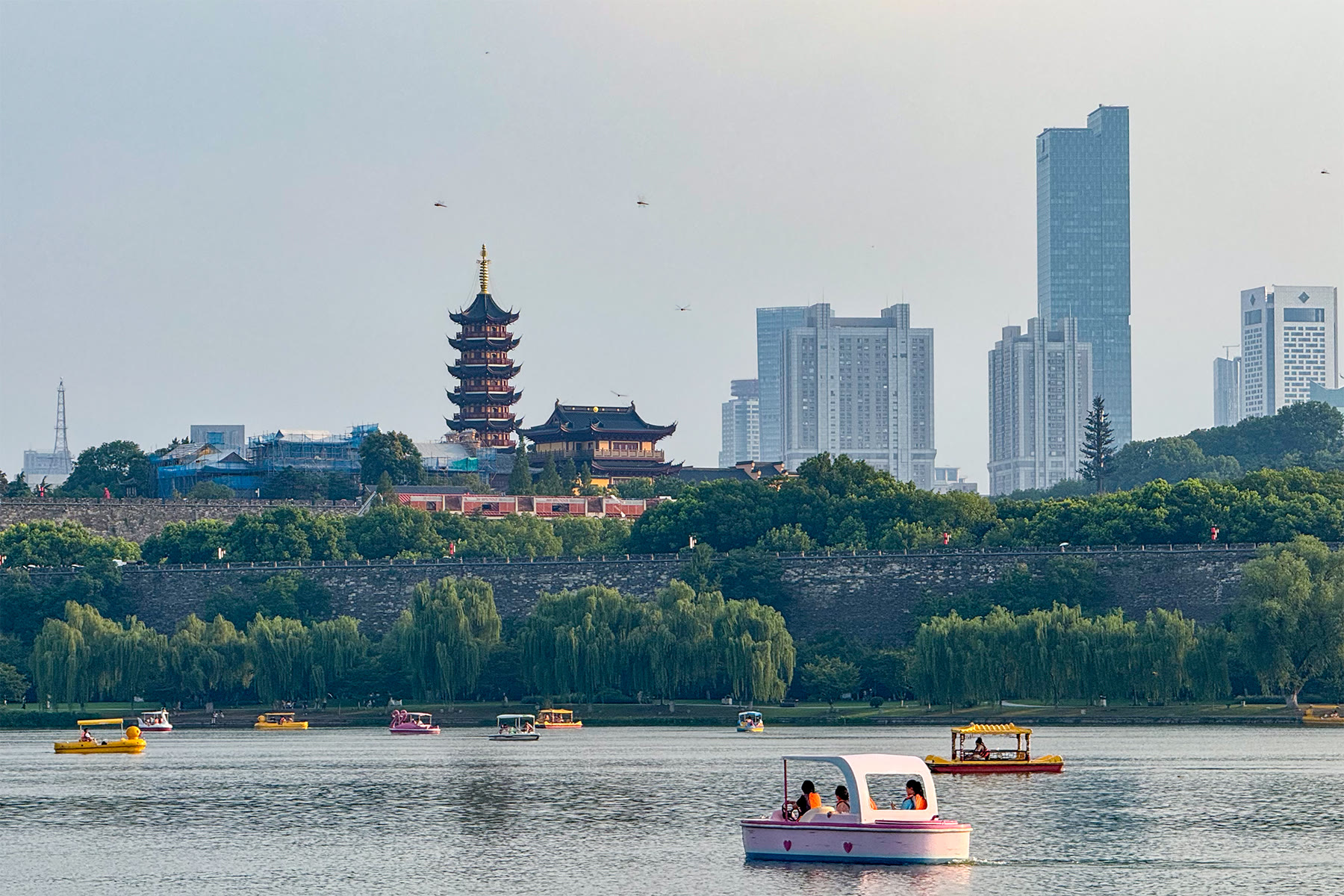
Central Nanjing rewards walking. The Fuzimiao and Qinhuai River district is best explored on foot, especially in the evening when the lantern-lit waterfront glows. The stretch of preserved Ming city wall, Xuanwu Lake park, and the streets around Gulou and Xinjiekou are all walkable, and the famous plane-tree avenues make for shaded, atmospheric strolls.
Distances between major sights can be deceptive, though. Purple Mountain's attractions are far apart and the eastern districts sprawl, so plan to combine walking with the metro or a short Didi rather than relying on your feet for everything. Pedestrian crossings exist but watch for turning vehicles and silent electric scooters, which do not always yield.
Comparing Your Options
| Mode | Typical Cost | Duration | Best For |
|---|---|---|---|
| Metro | 2 to 10 yuan | Fast, frequent | Crossing the city quickly and reliably |
| Bus | Around 2 yuan | Slow in traffic | Short hops and routes the metro misses |
| Taxi | 20 to 50 yuan typical trip | Door to door | Direct trips when the metro is inconvenient |
| Didi | Similar to taxis, sometimes higher | Door to door | Language-free booking and late nights |
| Shared bike | Around 1.5 yuan per 30 min | Flexible | Exploring central neighborhoods at your own pace |
| Walking | Free | Varies | The Qinhuai riverside and historic core |
Practical Tips for Getting Around Nanjing
Nanjing runs on mobile payments, so the single most useful thing you can do is set up Alipay or WeChat Pay with an international card before you arrive. Both now allow foreign visitors to link overseas cards, and they unlock the metro, buses, shared bikes, taxis, and almost every shop. Keep some small cash as a fallback, but you will rarely need it.
- Download Didi for ride-hailing and set it to English. Amap (Gaode) or Baidu Maps give far better local transit directions than Google Maps, which is unreliable inside China.
- Consider a transit card (the local public transport card) if you plan heavy metro and bus use, though QR scanning via your phone is usually simpler for short visits.
- Carry your destination written in Chinese characters or saved on a map; taxi drivers and bus staff rarely speak English.
- A translation app such as Google Translate with the offline Chinese pack or the built-in translator in WeChat helps enormously for quick exchanges.
- Avoid the morning and evening rush windows on the metro if you can, and skip buses entirely during peak traffic.
For scams, Nanjing is relatively low-risk. The main thing to watch is unlicensed drivers at railway stations and the airport who approach you offering fixed-price rides; politely decline and use the official taxi queue or Didi. With metered taxis, simply confirm the meter is on. Crime on public transport is rare and the metro is safe at all hours, though late at night Didi is more convenient than waiting for a bus.
Note that to use mainland China's internet, including the apps you will depend on, many travelers set up a working data plan or VPN before arriving, since some foreign apps are blocked. Sorting connectivity out is part of sorting out transport here.
Popular Routes and Destinations
The most common arrival points are Nanjing Lukou International Airport and the two main railway hubs, Nanjing South and Nanjing Railway Station. The airport connects to the city by Metro Line S1, which links to the main network for an affordable, traffic-proof ride into the center; a taxi or Didi from the airport to downtown is faster but costs considerably more. From Nanjing South high-speed rail station, Metro Lines 1 and 3 fan out across the city, making onward travel simple.
For sightseeing, the metro reaches Fuzimiao and the Qinhuai River district directly, while the cluster of Purple Mountain attractions (Sun Yat-sen Mausoleum, Ming Xiaoling Tomb, Linggu Temple) is best reached by metro to the eastern stations and then a sightseeing bus or short Didi, since these sites sit far apart within a large scenic park. Xuanwu Lake and the Ming city wall are an easy metro ride plus a short walk from the center.
Frequently Asked Questions
Use this guide to compare local transport in Nanjing. When bookable tickets are available, the booking tool shows current options and prices.
The metro is the best all-round option for visitors: it is fast, cheap, clean, and reaches most major sights and transport hubs. For door-to-door trips or late nights, the Didi ride-hailing app is the most convenient, and shared bikes are great for exploring central neighborhoods.
Local transport is inexpensive. Metro fares run from around 2 to 10 yuan depending on distance, buses cost a flat fare of about 2 yuan, and shared bikes are roughly 1.5 yuan per half hour. A typical cross-town taxi trip costs about 20 to 50 yuan, or roughly 3 to 7 dollars.
Yes, Nanjing's public transport is very safe, including the metro at all hours. Crime is rare, the main thing to avoid is unlicensed drivers touting fixed-price rides at stations and the airport. Use the official taxi queue or book through Didi instead.
Yes, Didi is the dominant ride-hailing app and works throughout Nanjing. You can switch it to English and link an international credit card, and because you enter your destination in the app it removes the language barrier of flagging a regular taxi.
Nanjing runs almost entirely on mobile payments, so the most useful step is linking an international card to Alipay or WeChat Pay before you arrive. These unlock the metro, buses, bikes, and taxis. A physical transit card is optional and QR scanning by phone is usually simpler for short visits.
The central districts are very walkable and pleasantly shaded by plane trees, especially around the Qinhuai River, Fuzimiao, and Xuanwu Lake. However, the city is large and sights like the Purple Mountain attractions are spread far apart, so combine walking with the metro or a short Didi ride.
Metro Line S1 connects the airport to the main network and is the cheapest, most traffic-proof way into the city. A taxi or Didi is faster but costs noticeably more. Avoid drivers who approach you inside the terminal offering fixed prices and use the official taxi queue if you prefer a cab.
Guide prices and journey times are indicative, not live quotes. A booked package may include transfers and waiting time as well as the main journey. Check the selected offer, pickup point and current conditions before booking.