
Contents
- 1. Getting Around Takayama on Foot
- 1.1 Key Walking Distances from JR Takayama Station
- 2. Getting Around Takayama by Local Bus (Nohi Bus / Sarubobo Bus)
- 3. Getting Around Takayama by Bicycle
- 4. Getting Around Takayama by Taxi
- 5. Getting Around Takayama by Regional and Highway Bus
- 6. Getting Around Takayama by Train (JR Takayama Line)
- 7. Comparing Your Options
- 8. Practical Tips for Getting Around Takayama
- 9. Popular Routes and Destinations
- 10. Frequently Asked Questions
Takayama is the kind of place that rewards you for slowing down. Tucked into the mountains of Gifu Prefecture in the Japanese Alps, this compact city feels more like a large town, and that is precisely what makes it so easy to explore. The historic Sanmachi Suji district, the riverside morning markets, the sake breweries, and the hilltop shrines are all clustered within a remarkably walkable area radiating out from JR Takayama Station.
Unlike Tokyo or Osaka, there is no subway system here, no sprawling rail network to decode. Takayama's transport ecosystem is refreshingly simple: your own two feet will handle most of the work, supplemented by local buses for hillside temples and outlying attractions, and bicycles for those who want to cover more ground at their own pace. Taxis fill in the gaps, and long-distance buses connect you to the wider region. The rhythm of travel here is unhurried, matching the pace of the town itself.
That simplicity does not mean there is nothing to figure out. Bus schedules can be infrequent, cycling routes deserve some planning, and knowing when to walk versus when to hop on a bus can save you real time and energy, especially if you are heading to Hida Folk Village or the temple district on the hillside east of town.
Getting Around Takayama on Foot
Walking is the default way to experience Takayama, and for good reason. The city's core is flat, compact, and designed at a human scale. From JR Takayama Station, you can reach the Sanmachi Suji old town district in about 10 minutes on foot, the Miyagawa Morning Market in 12, and most restaurants, ryokans, and sake breweries within a 15 to 20 minute stroll.
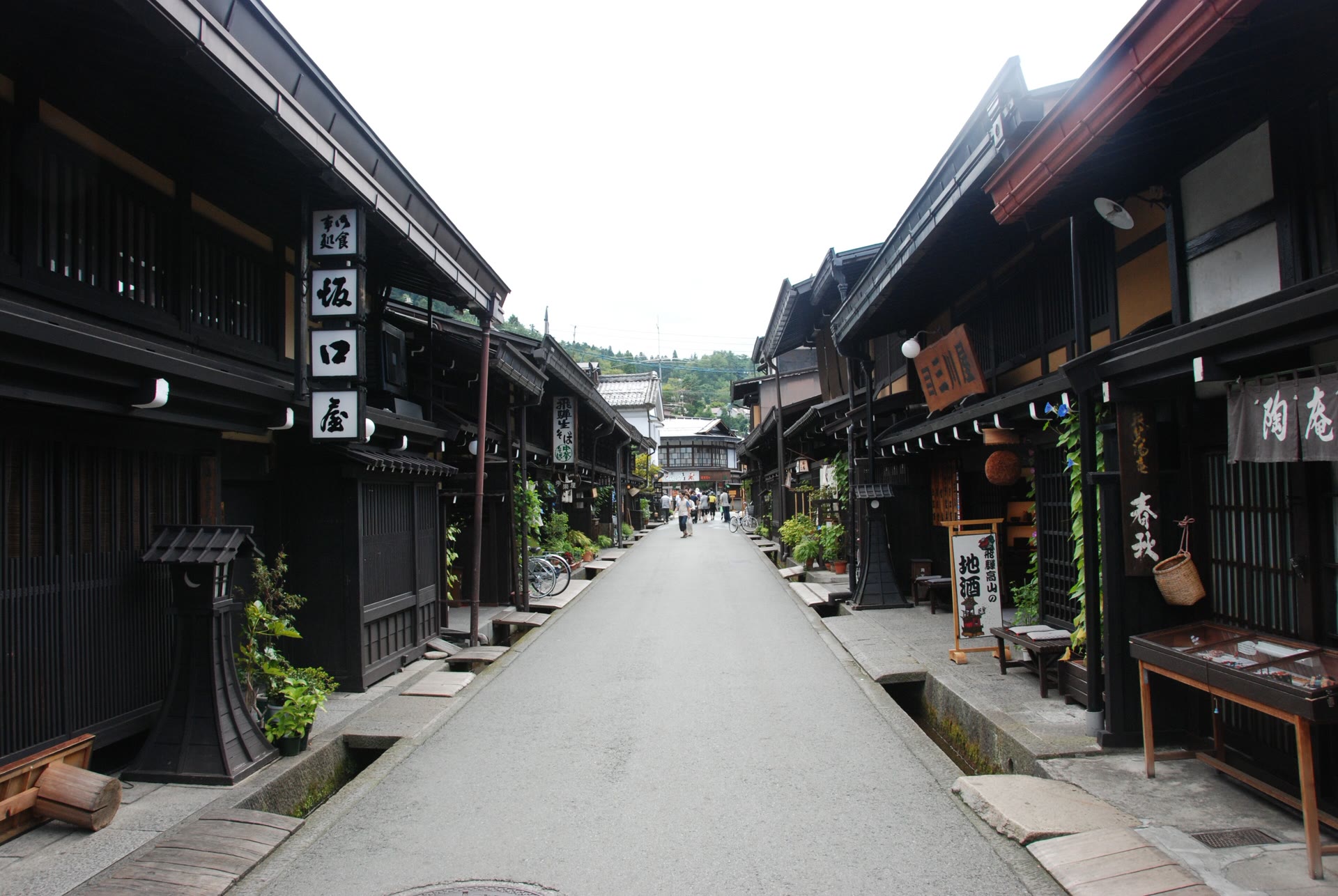
The streets of the old town are narrow and atmospheric, lined with dark-wood merchant houses, latticed storefronts, and small canals. Cars are rare here, and the pedestrian experience is excellent. You will find yourself wandering without a map, ducking into craft shops and snacking on Hida beef skewers and mitarashi dango along the way.
Where walking becomes less practical is when heading to attractions on the eastern hillside, like the cluster of temples along Higashiyama Walking Course, or to Hida no Sato (Hida Folk Village), which sits about 2.5 kilometers west of the station. These are doable on foot if you enjoy a longer walk, but a bus or bicycle makes more sense if time or energy is limited. The Higashiyama Walking Course itself is a lovely 3.5 kilometer trail connecting temples and shrines along the hillside, best done as a dedicated walking excursion.
Key Walking Distances from JR Takayama Station
- Sanmachi Suji (Old Town): roughly 10 minutes
- Miyagawa Morning Market: roughly 12 minutes
- Takayama Jinya (former government house): roughly 10 minutes
- Sakurayama Hachimangu Shrine: roughly 20 minutes
- Higashiyama Walking Course start: roughly 25 minutes
- Hida Folk Village: roughly 30 minutes (mostly flat)
Getting Around Takayama by Local Bus (Nohi Bus / Sarubobo Bus)
Takayama's local bus network is operated by Nohi Bus, and while it is modest compared to big-city systems, it covers the key attractions that sit beyond easy walking distance. The most useful service for tourists is the Sarubobo Bus, a loop line that circles the main sightseeing spots including Hida Folk Village, the old town area, and the station.
The Sarubobo Bus runs roughly every 30 to 40 minutes, and a single ride typically costs around 100 to 210 yen depending on distance. If you plan to use it multiple times in a day, the Takayama City Sightseeing One-Day Pass (around 630 yen for adults) is excellent value. It covers unlimited rides on designated city routes and pays for itself after just a couple of trips.
Bus stops are well-marked and most have schedules posted in both Japanese and English. The main bus terminal sits directly in front of JR Takayama Station, making it easy to orient yourself. You board from the rear door, take a numbered ticket, and pay when you exit at the front. Payment is in cash (exact change is ideal) or with an IC card if you have one, though IC card acceptance on local Takayama routes can be inconsistent, so carry coins.
Beyond the city loop, Nohi Bus also operates regional routes to destinations like Shirakawa-go, Kamikochi, and Shin-Hotaka Ropeway. These are not city transport per se, but they depart from the same bus terminal, so it is worth checking schedules in advance at the Nohi Bus Center next to the station.
Tips: Bus frequency drops significantly after late afternoon, and the last buses on some routes run as early as 5 or 6 PM. Plan your return trips from outlying attractions accordingly. On weekends and during festival periods, buses can be crowded.
Getting Around Takayama by Bicycle
Cycling is arguably the most enjoyable way to explore Takayama beyond the immediate old town. The terrain in the central valley is flat, traffic is light, and the distances between attractions are perfect for a leisurely ride. Several rental shops operate near JR Takayama Station, and many guesthouses and ryokans offer bicycles to guests for free or a small fee.
Expect to pay around 300 to 500 yen per hour or roughly 1,000 to 1,500 yen for a full day at a rental shop. Some places offer electric-assist bikes for a bit more, which are worth considering if you plan to ride up to the hillside temples. Shops typically open around 8 or 9 AM and ask you to return bikes by 5 PM.
A bicycle lets you comfortably reach Hida Folk Village in about 10 minutes, loop through the temple district, ride along the Miyagawa River, and explore quieter residential neighborhoods that most tourists never see. The riverside paths are particularly scenic, and you can easily combine cycling with stops at sake breweries, miso shops, and small cafes scattered across town.
Parking your bike is straightforward. Most attractions have bicycle racks, and the old town streets, while narrow, accommodate cyclists comfortably outside of peak hours. During the famous Takayama Matsuri festival periods, however, certain streets are closed and cycling becomes impractical in the center.
Getting Around Takayama by Taxi
Taxis in Takayama are reliable, clean, and run on meters, as is standard across Japan. You will find them lined up at the taxi rank outside JR Takayama Station, and your hotel or ryokan can call one for you at any time. Flagfall is typically around 660 to 750 yen, with the meter ticking up for distance and waiting time.
For most in-town trips, a taxi ride will cost between 750 and 1,500 yen. A ride from the station to Hida Folk Village, for example, runs around 1,000 to 1,200 yen and takes about 5 to 7 minutes. Taxis become especially useful at night when buses have stopped running, if you are carrying luggage, or if you are traveling with small children or anyone with mobility concerns.
There is no Uber or major ride-hailing app that functions reliably in Takayama. The GO taxi app (Japan's domestic ride-hailing app) has limited coverage here, so your best bet is to hail one at the station, find a taxi stand, or ask your accommodation to call ahead. Drivers are honest and courteous, and while English is limited, showing your destination on a map or in Japanese text on your phone works perfectly.
For groups of three or four, taxis can actually be cost-competitive with bus fares, especially for short hops. Some visitors also hire taxis for half-day excursions to nearby attractions like Okuhida Onsen or scenic viewpoints, though this gets expensive quickly (expect around 15,000 to 20,000 yen for a half-day charter).
Getting Around Takayama by Regional and Highway Bus
While not strictly city transport, the regional bus network is essential knowledge for anyone based in Takayama, since many of the area's best attractions sit outside the city limits. Nohi Bus and Hokutetsu Bus operate highway and regional routes from the Takayama Bus Terminal (Takayama Nohi Bus Center), directly adjacent to the train station.
The most popular route is the bus to Shirakawa-go, the UNESCO-listed thatched-roof village. This scenic ride through mountain valleys takes around 50 minutes to 1 hour and costs roughly $14 to $28 one way depending on the specific stop and service. Reservations are strongly recommended, especially during autumn foliage and winter illumination seasons, as buses fill up quickly. You can book online through the Nohi Bus website or in person at the bus center.
Other useful regional bus routes from Takayama include services to Shin-Hotaka Ropeway (around 1 hour 30 minutes), Kamikochi (seasonal, around 1 hour 30 minutes with a transfer at Hirayu Onsen), and Matsumoto. These buses are comfortable highway coaches with reserved seating on popular routes.
Getting Around Takayama by Train (JR Takayama Line)
JR Takayama Station sits on the JR Takayama Main Line, which runs between Toyama to the north and Nagoya to the south through spectacular mountain scenery. While you will not use the train for getting around within Takayama itself, it is the primary way most travelers arrive and depart.
The Limited Express Hida service connects Takayama to Nagoya in about 2 hours 20 minutes and to Toyama in about 1 hour 30 minutes. Both are covered by the Japan Rail Pass. Local trains also run on this line but are slow and infrequent. For day trips, the train to nearby Hida-Furukawa (the town that inspired the anime "Your Name") takes just 15 minutes on a local service and is a delightful excursion.
Comparing Your Options
| Mode | Typical Cost | Duration | Best For |
|---|---|---|---|
| Walking | Free | Varies (most attractions within 10-25 min) | Old town, morning markets, sake breweries, short distances |
| Local Bus (Sarubobo Bus) | Around 100-210 yen per ride; day pass around 630 yen | 10-20 min per route segment | Hida Folk Village, hillside temples, saving energy on longer hops |
| Bicycle | Around 300-500 yen/hour or 1,000-1,500 yen/day | 5-15 min to most attractions | Exploring beyond the old town, riverside rides, temple district loop |
| Taxi | Around 750-1,500 yen for in-town trips | 5-10 min for most destinations | Night travel, luggage, rainy days, groups splitting the fare |
| Regional Bus | $14-$28 one way (e.g. Shirakawa-go) | 39 min - 1 hr 45 min | Day trips to Shirakawa-go, Shin-Hotaka, Kamikochi |
| JR Train | Varies (around 240 yen to Hida-Furukawa) | 15 min to Hida-Furukawa | Arriving/departing Takayama, day trip to Hida-Furukawa |
Practical Tips for Getting Around Takayama
Carry cash and coins. Takayama is not a cashless city. Many small shops, market stalls, and even some bus routes prefer or require cash. Have a supply of 100 yen and 10 yen coins for buses, and keep small bills for taxis and bicycle rental. There are ATMs at the post office near the station and at 7-Eleven stores that accept international cards.
Download offline maps. Cell signal can be spotty in the mountainous areas around Takayama. Download Google Maps or Maps.me for offline use before you arrive. The Nohi Bus website also has downloadable timetables in English.
Timing matters. Takayama is a morning town. The Miyagawa Morning Market runs from around 7 AM to noon, and many shops and attractions close by 5 PM. Buses thin out in the late afternoon. Plan your furthest excursions for the morning and save the old town strolling for the afternoon.
- Language: English signage is decent at major attractions and the bus terminal, but limited elsewhere. Save your destination names in Japanese on your phone to show taxi drivers and locals. The phrase "Sumimasen, koko wa doko desu ka?" (Excuse me, where is this?) paired with a map is universally effective.
- Luggage forwarding: If you are arriving with large bags and heading out to explore, use the coin lockers at JR Takayama Station (various sizes from 300 to 700 yen) or the luggage storage at the tourist information office inside the station. Dragging suitcases through the old town's narrow streets is no fun.
- Festival days: During the Takayama Matsuri (mid-April and mid-October), the old town streets are packed and partially closed to vehicles. Walking becomes the only realistic option in the center, and buses may be rerouted. It is magical but requires patience.
- Winter travel: Snow can be heavy from December through March. Sidewalks are generally cleared, but cycling becomes impractical and walking requires good footwear with grip. Buses remain the most reliable option in winter for reaching outlying attractions.
- No ride-hailing: Forget Uber. The GO app has minimal coverage. Stick with taxi stands or phone-dispatched taxis through your hotel.
For comparing transport options and planning connections from Takayama to other destinations across Japan, GoAsia.cc can help you sort through schedules and prices quickly.
Popular Routes and Destinations
Takayama to Shirakawa-go by bus: This is the route most visitors want to know about. Nohi Bus operates direct highway coaches from the Takayama Bus Terminal to Shirakawa-go, taking between 39 minutes and 1 hour 45 minutes depending on the specific service and stop. Expect to pay between $14 and $28 one way. Book in advance online, especially during peak seasons, as seats are limited and sell out. The earliest morning departures give you the most time in the village before day-trip crowds arrive.
JR Takayama Station to Hida Folk Village (Hida no Sato): Take the Sarubobo Bus from the station (around 10 minutes, roughly 210 yen) or cycle there in about 10 minutes on flat roads. A taxi costs around 1,000 to 1,200 yen. Walking takes about 30 minutes and is pleasant in good weather along the river.
JR Takayama Station to Sanmachi Suji (Old Town): Walk. It takes 10 minutes, the route is obvious (head east from the station across the river), and there is no reason to take any other transport unless you have mobility issues, in which case a taxi will cost the minimum fare.
Takayama to Hida-Furukawa: A quick 15-minute local JR train ride (around 240 yen) takes you to this quieter, equally charming town with its own white-walled storehouses and carp-filled canals. An easy half-day trip.
Frequently Asked Questions
Use this guide to compare local transport in Takayama. When bookable tickets are available, the booking tool shows current options and prices.
Walking is the best way to explore Takayama's compact center, including the old town, morning markets, and sake breweries. For attractions further out like Hida Folk Village or the hillside temples, renting a bicycle or taking the Sarubobo Bus loop are the most practical options. Taxis are useful at night or in bad weather.
Local bus rides cost around 100 to 210 yen per trip, with a day pass available for around 630 yen. Bicycle rental runs roughly 1,000 to 1,500 yen per day. Taxi rides within the city typically cost between 750 and 1,500 yen. Most of the central sightseeing area is free to explore on foot.
Absolutely. Takayama is extremely safe, and public transport is clean, punctual, and well-maintained, as you would expect in Japan. Buses run on schedule, taxis use meters honestly, and there are no scams or safety concerns to worry about at any time of day.
Ride-hailing apps like Uber do not operate in Takayama. Japan's domestic GO taxi app has very limited coverage here. Your best options are taxi stands at JR Takayama Station or asking your hotel or ryokan to call a taxi for you.
Very much so. The main sightseeing area, including Sanmachi Suji, Takayama Jinya, the morning markets, and most restaurants, is clustered within a 15 to 20 minute walk of JR Takayama Station. The terrain is flat in the center, and the streets are pedestrian-friendly with light traffic.
Take a Nohi Bus highway coach from the Takayama Bus Terminal next to JR Takayama Station. The journey takes between 39 minutes and 1 hour 45 minutes and costs $14 to $28 one way. Advance reservations are strongly recommended, especially during autumn and winter peak seasons.
Renting a bicycle is an excellent choice from spring through autumn. The city is flat, traffic is light, and you can easily reach Hida Folk Village, the temple district, and riverside paths in minutes. Rental shops near the station charge around 1,000 to 1,500 yen per day. In winter, snow makes cycling impractical.
An IC card like Suica or ICOCA is not essential in Takayama, as acceptance on local bus routes can be inconsistent. Carrying cash, especially coins, is more reliable for bus fares. If you already have an IC card from another Japanese city, bring it along, but do not count on it working everywhere.
Guide prices and journey times are indicative, not live quotes. A booked package may include transfers and waiting time as well as the main journey. Check the selected offer, pickup point and current conditions before booking.