Tuol Sleng Genocide Museum (S-21): Bearing Witness in Phnom Penh
Photo: Adam PENN / Unsplash
Contents
- 1. History of S-21
- 2. What You Will See
- 2.1 Building A: The Detention Rooms
- 2.2 Building B: Photographs
- 2.3 Building C: The Cells
- 2.4 Building D: History and Context
- 3. Survivor Talks
- 4. Visiting Tuol Sleng
- 4.1 Tickets and Hours
- 4.2 Getting There
- 4.3 How Long to Spend
- 5. Combining with the Killing Fields
- 6. Tips for Visiting Tuol Sleng
- 7. Sources and background
- 8. Frequently Asked Questions
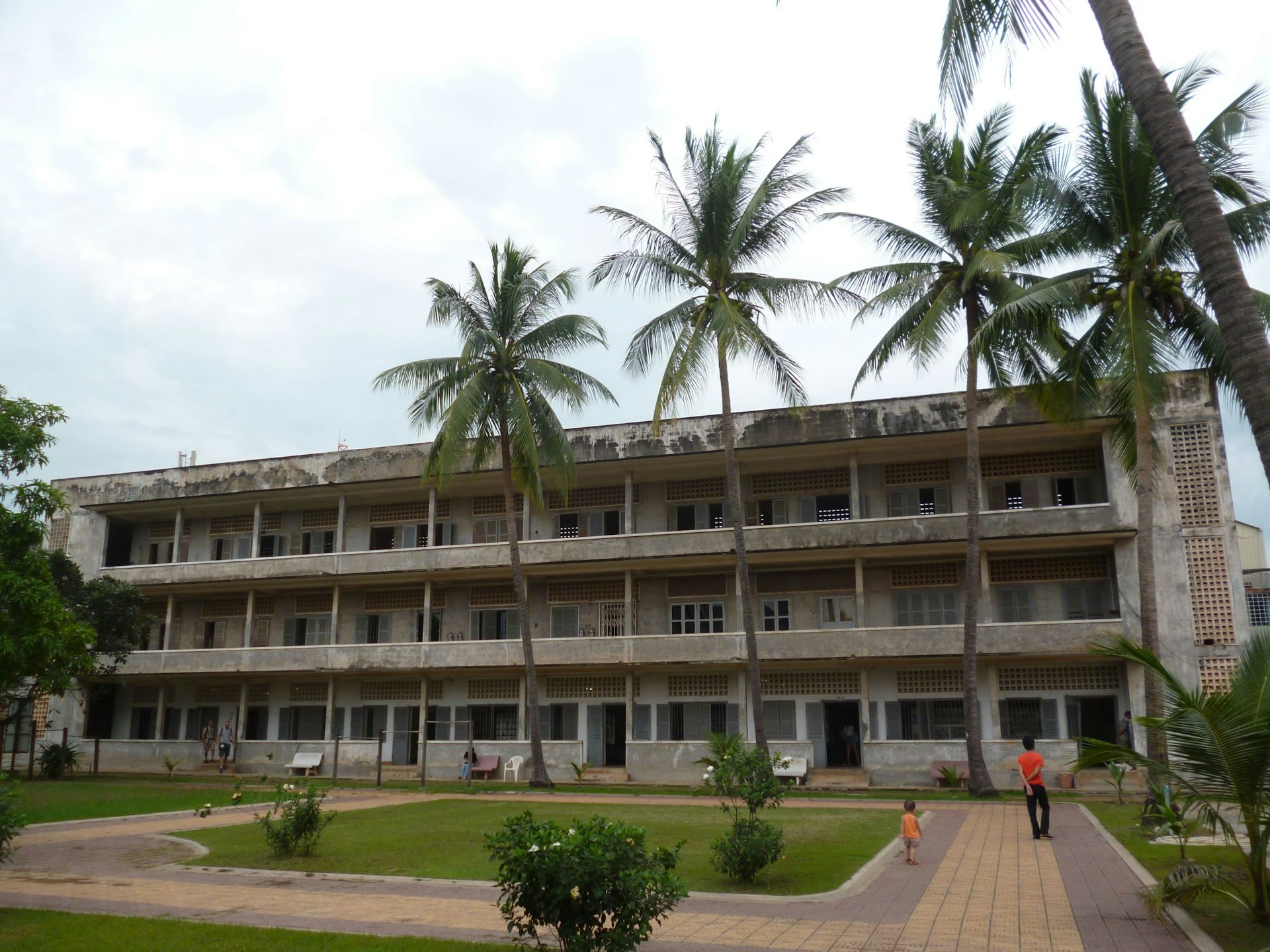
Tuol Sleng in Phnom Penh was S-21, the Khmer Rouge detention and interrogation centre, set up in a former school. The museum says 15,000 to 20,000 people were imprisoned here, and twelve former inmates, including four children, survived.[1] The site became a museum in 1979.[1] The exhibits can be deeply distressing. Come with time for breaks rather than treating it as a quick sightseeing stop.
History of S-21
The school was built in 1962 as Preah Ponhea Yat High School and later renamed Tuol Svay Prey. In Lun, also known as Nath, was the first chief of S-21, followed by Duch in 1976.[1]
Former classrooms became individual cells or communal detention rooms. People held here were interrogated and tortured, and the museum displays the instruments, shackles and chains.[1][2]
S-21 and Choeung Ek belonged to the same system of detention and execution. Prisoners who survived torture were killed nearby at first, and later taken to the Choeung Ek killing field just outside the city.[1] Visiting both helps you tell the place of detention from the execution site.
Things to Do
Offers are only loaded from GetYourGuide after you click. GetYourGuide can then process your IP address and set cookies. Privacy Policy
GetYourGuide partner offers. GoAsia may earn a commission if you book through these offers. Check whether tickets or transfers are included, and follow the attraction's official booking and admission rules.
What You Will See
The museum occupies four main buildings, labelled A to D, plus the grounds around them.
Building A: The Detention Rooms
On the ground floor of Building A, a classroom was divided into two rooms to hold high-ranking Khmer Rouge cadres accused of treason, who were kept in single cells and chained to iron beds.[1] Paintings by the S-21 survivor Vann Nath hang here.[2]
Building B: Photographs
In Building B, the cells have been removed to make space for the museum's most haunting exhibit: photographs of the thousands of people who lost their lives at S-21.[1] They show men, women, elderly people, teenagers and children. Some look terrified, some confused, some stare straight at the camera with expressions that are impossible to read.
Take time with the photographs and pause when you need to. These are records of real people. Choose a pace that gives you room to reflect, and do not feel you have to look at every image.
Building C: The Cells
Building C is preserved exactly as it was during the Khmer Rouge period.[2] Classrooms are divided into small cells, where family members were chained.[1] The cells measure 0.8 by 2 metres, barely large enough to lie down in.[1] They give a visceral sense of the confinement prisoners endured.
Building D: History and Context
Building D displays the torture instruments used by S-21's interrogators.[1] Vann Nath's paintings in Buildings A, B and D depict scenes of torture and the living conditions in the prison.[2]
For the wider legal context, the Extraordinary Chambers in the Courts of Cambodia (ECCC) state that over a million people were killed or perished in Democratic Kampuchea. Its investigations and court proceedings ran from 2006 to 2022, and since January 2023 it carries out residual functions such as victim and witness protection, supervising the enforcement of sentences and giving the public access to documents.[3]
Survivor Talks
The museum runs a testimony program called "Childhood without color" every Monday, Wednesday and Friday, except national holidays, from 14:30 to 15:00. Ask at the museum on the day.[4]
Visiting Tuol Sleng
Tickets and Hours
| Detail | Information |
|---|---|
| Entrance fee (international adults, 18+) | $5[4] |
| Entrance fee (ages 10 to 17) | $3, with proof of identity[4] |
| Under 10 | Free, with proof of identity[4] |
| Cambodian citizens | Free[4] |
| Opening hours | 08:00 to 17:00 daily[4] |
| Audio guide | $5 for non-Cambodians, in 11 languages[4] |
| Documentary films | 10:00 to 10:15 and 15:00 to 15:15[4] |
Tickets are sold only at the entrance booth, in cash, in Cambodian riel or US dollars. Foreign visitors with a K-VISA enter free and must show the K-VISA confirmation. The audio guide is available in Khmer, English, French, German, Chinese, Vietnamese, Korean, Japanese, Spanish, Dutch and Italian. Personal guides speak Khmer and English and work for a contribution.[4]
The ground floors of all buildings are wheelchair-accessible, while upper floors are reached only by stairs, so ask staff for help. Strollers are not allowed inside the exhibition buildings.[4] Cover your arms and legs, as is customary at Cambodian commemorative and religious sites.[4]
Getting There
The museum is on Street 113 in Boeng Keng Kang III, Phnom Penh.[4] Show the address to your driver or app, and agree whether waiting time and the return trip are included before you set off.
How Long to Spend
Allow a few hours, with extra time for breaks, the documentary or the testimony program. Check those times before you plan your onward journey.
Combining with the Killing Fields
A visit to Choeung Ek complements Tuol Sleng: one tells the story of S-21 detention, the other of its execution site. UNESCO lists both among the Cambodian Memorial Sites.[5] Check each site's hours and admission separately, and agree the route, waiting time and return journey with your driver before departure.
Visiting both sites in one day is emotionally heavy. Some travellers spread them across two days with lighter activities in between. There is no wrong approach, but be prepared for the cumulative impact.
Tips for Visiting Tuol Sleng
- Prepare emotionally. This is not a typical tourist attraction. The content is graphic and deeply distressing. Read about the Khmer Rouge beforehand for context, and give yourself permission to take breaks in the courtyard.
- Use the audio guide. The exhibits are powerful on their own, and the audio guide adds context, personal stories and historical detail.
- Arrive when the museum opens. It opens at 08:00, and an early start leaves room for the exhibits and for breaks.[4]
- Respect the photography rules. Photographs for non-commercial personal or research use are permitted, and commercial work needs permission. Using mobile phones inside the exhibition buildings and flying drones without authorization are prohibited.[4]
- Think about children. The museum warns that its exhibits may not be appropriate for visitors aged 14 and younger.[4]
- Allow time afterwards. Many visitors need quiet time to process the experience. Plan a low-key activity for the rest of the day, whether a walk along the riverfront, a cafe or a return to your hotel.
Tuol Sleng exists so that what happened here is not forgotten. Visiting is an act of witness. For more on Phnom Penh's historical sites and planning your time in Cambodia, GoAsia.cc has comprehensive guides.
Sources and background
Numbers in the text such as [1] refer to these sources.
- [1] Tuol Sleng Genocide Museum: S-21 history and museum buildings. Retrieved October 21, 2026.
- [2] Tuol Sleng Genocide Museum: Permanent exhibition and preserved Building C. Retrieved October 21, 2026.
- [3] Extraordinary Chambers in the Courts of Cambodia: Khmer Rouge crimes, judicial proceedings and residual functions. Retrieved October 21, 2026.
- [4] Tuol Sleng Genocide Museum: Museum visitor information and programs. Retrieved October 21, 2026.
- [5] UNESCO World Heritage Centre: Cambodian Memorial Sites: former S-21 and Choeung Ek. Retrieved October 21, 2026.
Frequently Asked Questions
Tuol Sleng in Phnom Penh was S-21, the Khmer Rouge detention and interrogation centre, set up in a former school. The museum says 15,000 to 20,000 people were imprisoned here and twelve former inmates, including four children, survived. It became a museum in 1979.
International adults pay $5 and ages 10 to 17 pay $3, with proof of identity. Under-10s and Cambodian citizens enter free, and so do foreign visitors with a K-VISA. Tickets are sold at the entrance booth for cash in riel or US dollars. The audio guide costs $5 for non-Cambodians.
The museum is on Street 113 in Boeng Keng Kang III. Show the address to your tuk-tuk driver or ride-hailing app, and agree whether waiting time and the return trip are included.
Allow a few hours, with extra time for breaks, the documentary films and the testimony program. Check their times before you plan your onward journey.
The museum runs a testimony program called "Childhood without color" every Monday, Wednesday and Friday, except national holidays, from 14:30 to 15:00. Ask at the museum on the day.
You can, since one explains S-21 detention and the other its execution site, and UNESCO lists both among the Cambodian Memorial Sites. Consider two separate days if the material becomes overwhelming, and check each site's hours and admission separately.
The museum warns that its exhibits may not be appropriate for visitors aged 14 and younger. Photographs and accounts of torture can be deeply distressing, so consider your child's maturity and sensitivity.
Cover your arms and legs, as is customary at Cambodian commemorative and religious sites, and behave with solemnity and respect on the grounds.