
Photo: Sakai Yayoi / Wikimedia Commons, CC0
Contents
- 1. Getting Around Osaka by Subway (Osaka Metro)
- 2. Getting Around Osaka by JR and Private Railways
- 2.1 JR West
- 2.2 Private Railways
- 3. Getting Around Osaka by Bus
- 4. Getting Around Osaka by Taxi
- 5. Getting Around Osaka by Ride-Hailing Apps
- 6. Getting Around Osaka on Foot
- 7. Getting Around Osaka by Bicycle
- 8. Comparing Your Options
- 9. Practical Tips for Getting Around Osaka
- 9.1 Get an IC Card Immediately
- 9.2 Consider a Day Pass
- 9.3 Apps to Download
- 9.4 Rush Hour and Timing
- 9.5 Navigating the Language Barrier
- 9.6 Common Mistakes to Avoid
- 9.7 Safety
- 10. Popular Routes and Destinations
- 10.1 Osaka to Kansai International Airport (KIX)
- 10.2 Osaka to Itami Airport (Osaka International Airport)
- 10.3 Getting to Osaka Castle
- 10.4 Getting to Universal Studios Japan (USJ)
- 11. Frequently Asked Questions
Osaka moves fast, eats well, and rarely sits still. Japan's third-largest city sprawls across a flat river delta on the shores of Osaka Bay, and its transport network matches the energy of its people - efficient, layered, and relentless. Unlike Tokyo's sometimes intimidating complexity, Osaka's transit system feels approachable. Two subway lines handle the bulk of tourist travel, a web of private railways fans out to the suburbs and beyond, and the entire city sits on flat terrain that rewards anyone willing to walk or cycle between stops.
Step out of your hotel in Namba or Umeda and you will notice something immediately: Osaka's major districts are close together. Shinsaibashi, Dotonbori, Namba, Tennoji, and Umeda form a surprisingly compact core. Many travelers find they walk far more than expected, ducking through underground shopping arcades that stretch for blocks and popping up near their destination without ever touching a ticket gate. But when you need to cover real distance - reaching Osaka Castle from the bay area, getting to the aquarium, or heading out to Universal Studios Japan - the trains and subway are fast, punctual, and clearly signed in English.
The key to moving around Osaka like a local comes down to three things: an IC card in your pocket, a basic grasp of which rail company goes where, and the confidence to hop on and off trains without overthinking it. This guide breaks down every transport mode you will actually use.
Getting Around Osaka by Subway (Osaka Metro)
Osaka Metro is the backbone of inner-city travel. Nine color-coded lines crisscross the city, but as a visitor you will likely rely on just two or three. The Midosuji Line (red, M) is the single most useful route, running north-south through Shin-Osaka, Umeda, Shinsaibashi, Namba, and Tennoji - essentially connecting every major tourist hub in a straight line. The Chuo Line (green, C) runs east-west, linking Osaka Castle (Morinomiya or Tanimachi-yonchome stations) to the bay area and Osaka Port for the aquarium. The Tanimachi Line (purple, T) is handy for Osaka Castle's northeast side and Tennoji.
Fares start at around 190 yen (roughly $1.30) for short trips and top out at about 390 yen for the longest cross-city rides. Trains run from approximately 5:00 AM to midnight, with frequencies of every 3 to 7 minutes during the day. Rush hour (7:30-9:00 AM and 5:30-7:30 PM on weekdays) on the Midosugi Line is genuinely packed - if you are carrying luggage, avoid these windows.
All stations have English signage, numbered station codes (M20, C18, etc.), and platform displays showing the next train's destination and arrival time. Ticket machines offer an English interface, but the easiest approach is to tap in and out with an IC card (more on that below).
Getting Around Osaka by JR and Private Railways
Osaka's rail landscape is shared by multiple operators, which can confuse newcomers. Here is what matters in practice:
JR West
JR runs the Osaka Loop Line (Kanjo-sen), a circular route that rings the city center and connects Osaka Station (Umeda), Tennoji, Namba (via JR Namba, a short walk south), Bentencho (transfer for Universal Studios), and Tsuruhashi. If you hold a Japan Rail Pass, the Loop Line is included, making it essentially free for pass holders. Without a pass, fares start around 150 yen. JR also operates the Yamatoji Rapid and Kansai Airport Rapid services that share Loop Line tracks before branching off.
Private Railways
Several private rail companies serve Osaka and are critical for day trips or reaching specific areas:
- Nankai Railway - runs from Namba to Kansai International Airport (the Rapi:t limited express and the cheaper Airport Express) and south toward Sakai and Wakayama.
- Hankyu Railway - connects Umeda (Hankyu Osaka-Umeda Station) to Kyoto, Kobe, and Takarazuka. Known for its elegant maroon trains.
- Hanshin Railway - also from Umeda, primarily to Kobe and Nishinomiya (for baseball fans heading to Koshien Stadium).
- Kintetsu Railway - from Osaka-Namba and Tennoji to Nara, Yoshino, and parts of Mie Prefecture.
- Keihan Railway - connects Yodoyabashi and Kitahama in central Osaka to Kyoto along the east bank of the river.
These private lines do not accept the Japan Rail Pass, but they all accept IC cards. Fares are generally affordable - a Hankyu ride from Umeda to Kyoto Kawaramachi costs around 410 yen.
Getting Around Osaka by Bus
Osaka City Bus covers areas the subway misses, but honestly, most tourists rarely need it within the city center. Buses are more useful for reaching residential neighborhoods or specific temples off the rail grid. A flat fare of 210 yen applies to most city bus routes. You board from the front, pay when you get on (tap your IC card or drop exact change into the fare box), and exit from the rear or middle doors.
Where buses shine is for airport transfers and intercity connections. Limousine buses to Kansai International Airport and Itami Airport depart from major hubs like Namba (OCAT) and Umeda, offering a luggage-friendly alternative to trains. Route information at bus stops is mostly in Japanese, so Google Maps is your friend here - it integrates Osaka bus routes and gives real-time departure info.
Getting Around Osaka by Taxi
Osaka taxis are metered, clean, and honest. The rear passenger door opens and closes automatically - do not try to grab it yourself. Base fare is around 680 yen for the first 1.7 km, then roughly 80 yen per additional 296 meters. A typical ride from Namba to Umeda costs around 1,500 to 2,000 yen and takes 15 to 25 minutes depending on traffic.
Taxis are most useful late at night after the trains stop, for groups of three or four splitting the fare, or when you are hauling luggage across the city. A late-night surcharge of 20% applies between 11:00 PM and 5:00 AM. Most taxis accept credit cards and IC cards, though it is wise to confirm before getting in - look for the card logos on the window.
One practical tip: have your destination written in Japanese or show it on your phone's map. Many Osaka taxi drivers speak limited English, but they are resourceful and will use their navigation systems if you can communicate the address clearly.
Getting Around Osaka by Ride-Hailing Apps
Japan's ride-hailing scene is more limited than in Southeast Asia, but it is evolving. GO (formerly JapanTaxi) is the dominant taxi-hailing app in Osaka. It summons a regular metered taxi to your GPS location, which is incredibly convenient when you cannot find a taxi stand or do not want to flag one down on the street. The app works in English and lets you pay by credit card through the app.
Uber exists in Osaka but functions primarily as a taxi dispatcher rather than the rideshare model used elsewhere. Prices are similar to metered taxis. Having both GO and Uber installed gives you the best chance of finding a car quickly, especially during busy periods or rain.
Getting Around Osaka on Foot
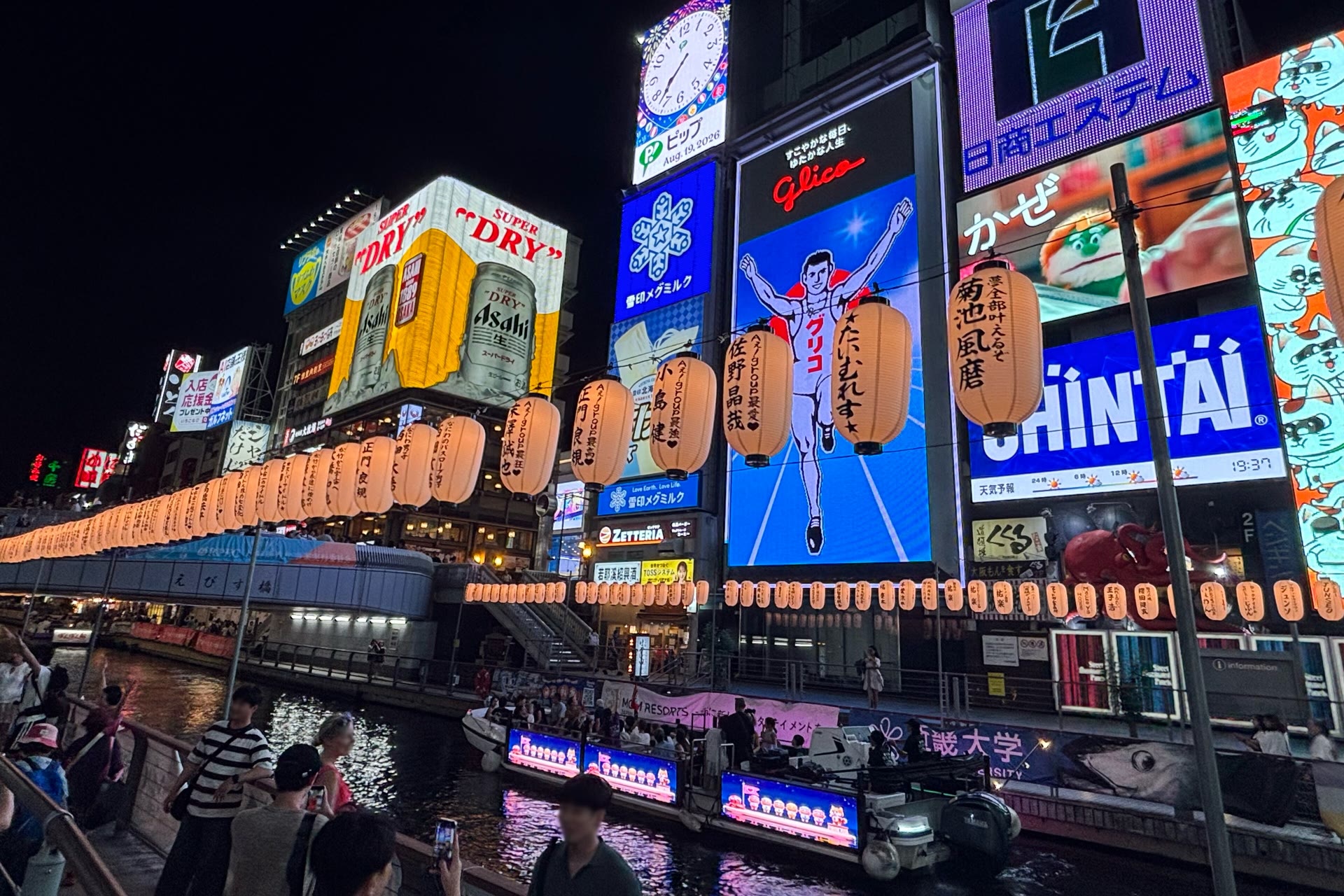
Osaka rewards walkers. The central districts are flat, the streets are safe at any hour, and the underground pedestrian networks beneath Umeda and Namba are vast. The walk from Shinsaibashi to Namba along the covered Shinsaibashi-suji shopping arcade takes about 15 minutes and is one of the city's great experiences - you pass through the neon chaos of Dotonbori midway. From Namba to Tennoji is a pleasant 25-minute stroll through Shinsekai, the retro neighborhood famous for kushikatsu and Tsutenkaku Tower.
Umeda's underground city, nicknamed "Umechika," is a labyrinth of shops, restaurants, and connecting passages between JR Osaka Station, Hankyu Umeda, Hanshin Umeda, and several subway stations. It can be disorienting at first, but colored signage and numbered exits help. On rainy days, you can cover a surprising amount of ground entirely underground.
Getting Around Osaka by Bicycle
Osaka's flat geography makes cycling a genuine option. The city operates a bike-share system called HUBchari (also branded as Charichari in some areas), with docking stations scattered across the central wards. Rates are typically around 70 yen per 15 minutes. You register through the app with a credit card, unlock a bike at any station, and return it to any other station.
Cycling along the riverbanks - particularly the Okawa River near Osaka Castle or the Dotonbori canal area - is a lovely way to see the city. Ride on the left side of the road (Japan drives on the left), use designated cycling lanes where available, and park only at designated areas to avoid having your bike impounded.
Comparing Your Options
| Mode | Typical Cost | Duration | Best For |
|---|---|---|---|
| Osaka Metro (Subway) | 190-390 yen ($1-$3) | 5-30 min | Moving between major districts quickly and reliably |
| JR Loop Line | 150-220 yen ($1-$2) | 5-40 min (full loop) | Circling the city center; free with Japan Rail Pass |
| Private Railways | 160-500 yen ($1-$4) | Varies | Day trips to Kyoto, Nara, and Kobe; reaching Kansai Airport |
| City Bus | 210 yen flat ($1) | Varies | Reaching areas off the rail grid |
| Taxi | 680-3,000 yen ($5-$21) | 10-30 min | Late-night travel, luggage, groups splitting fares |
| Ride-Hailing (GO/Uber) | Same as taxi | 10-30 min | Convenience when no taxi stand is nearby |
| Walking | Free | Varies | Exploring Dotonbori, Shinsekai, Umeda underground |
| Bicycle (HUBchari) | Around 70 yen per 15 min | Varies | Riverside rides, short hops between neighborhoods |
Practical Tips for Getting Around Osaka
Get an IC Card Immediately
An ICOCA card (Osaka's local IC card) or a Suica/Pasmo from Tokyo works on every subway, JR train, private railway, city bus, and most taxis and convenience stores in Osaka. Load it with cash at any station ticket machine. Tap in, tap out - no fumbling with tickets. As of recent changes, physical IC cards can sometimes be hard to find for tourists, but a mobile Suica or ICOCA on Apple Wallet works perfectly and can be set up before you arrive.
Consider a Day Pass
The Osaka Metro 1-Day Pass (Enjoy Eco Card) costs 820 yen on weekdays and 620 yen on weekends and holidays. It covers unlimited rides on all Osaka Metro subway lines and city buses. If you plan three or more subway trips in a day, it pays for itself. It also gets you discounts at attractions like Osaka Castle and the Tempozan Ferris Wheel. For visitors exploring more broadly, the Osaka Amazing Pass bundles transport with free entry to dozens of attractions - worth calculating if your itinerary aligns.
Apps to Download
- Google Maps - the single most important tool. It shows real-time train schedules, platform numbers, transfer walking times, and even which car to board for the fastest transfer. It handles multi-operator journeys seamlessly.
- Navitime or Japan Transit Planner - alternatives with detailed fare breakdowns and pass compatibility info.
- GO (taxi app) - essential for hailing taxis without the language barrier.
- Charichari/HUBchari - for bike-share access.
Rush Hour and Timing
Weekday mornings (7:30-9:00 AM) and evenings (5:30-7:30 PM) are brutal on the Midosugi Line and JR Loop Line. Trains still run on time, but you may be pressed against strangers in a way that is deeply uncomfortable with a backpack. Travel mid-morning or after 7:30 PM for a calmer experience. Weekend trains are much more relaxed.
Navigating the Language Barrier
Osaka is better than you might expect for English signage - all subway and JR stations have English names, announcements are bilingual, and ticket machines have English modes. That said, bus route signs and some private railway stations lean heavily Japanese. Keep your hotel's address written in Japanese characters on your phone. For taxis, showing a map pin is far more effective than trying to pronounce a destination.
Common Mistakes to Avoid
- Confusing JR Osaka Station and Osaka-Umeda subway stations - they are in the same area but different buildings. Follow signs carefully when transferring.
- Walking on the wrong side of the escalator - Osaka stands on the right, walks on the left. This is the opposite of Tokyo, and locals notice.
- Eating or drinking on trains - it is considered rude on local trains and subways (long-distance limited expresses are an exception).
- Ignoring the last train - most lines stop around midnight. Miss the last train and you are looking at a taxi ride or a few hours in a manga cafe until morning service resumes around 5:00 AM.
Safety
Osaka's public transport is exceptionally safe at all hours. Women-only cars are available on most subway and JR lines during morning rush hours - they are marked with pink signs on the platform. Petty crime is rare, but keep an eye on your belongings in crowded tourist areas like Dotonbori.
Popular Routes and Destinations
Osaka to Kansai International Airport (KIX)
You have two main options. By train, the JR Kansai Airport Rapid from Tennoji or the Nankai Airport Express/Rapi:t from Namba will cost between $9 and $44 depending on whether you choose the regular rapid service or a reserved-seat limited express. Travel time is 39 minutes to 50 minutes. By limousine bus from Namba OCAT or Umeda, expect to pay around $11 with a journey of 1 hour to 1 hour 10 minutes. The bus is ideal if you have heavy luggage and want a direct, no-transfer ride; the train is faster and more frequent. You can compare these options in detail on GoAsia.cc.
Osaka to Itami Airport (Osaka International Airport)
Itami handles mostly domestic flights but also some regional connections. Limousine buses run from Umeda, Namba, and other city hubs for around $12, taking 49 minutes to 1 hour 7 minutes. Alternatively, the Osaka Monorail connects to Itami from the Hankyu Senri Line, but the bus is simpler for most travelers.
Getting to Osaka Castle
Take the Chuo Line or Tanimachi Line to Tanimachi-yonchome Station, or the JR Loop Line to Osakajokoen Station. From Namba, the subway takes about 15 minutes. The castle park is large, so expect a 10 to 15 minute walk from any station to the main tower.
Getting to Universal Studios Japan (USJ)
From JR Osaka Station, take the JR Loop Line to Nishikujo Station, then transfer to the JR Yumesaki Line for one stop to Universal City Station. Total journey is about 20 minutes and costs around 190 yen. Arrive early - the trains heading to USJ on weekend mornings are packed with families.
Frequently Asked Questions
Use this guide to compare local transport in Osaka. When bookable tickets are available, the booking tool shows current options and prices.
The Osaka Metro subway system is the most convenient way to get around for most visitors. The Midosugi Line alone connects Shin-Osaka, Umeda, Shinsaibashi, Namba, and Tennoji. Combined with the JR Loop Line and short walks through Osaka's flat streets, you can reach virtually any major attraction without difficulty. An IC card makes all train and subway travel seamless.
Osaka's public transport is affordable. Subway rides range from 190 to 390 yen ($1 to $3), and JR Loop Line fares start at 150 yen. City buses charge a flat 210 yen. A taxi across the city center typically costs 1,500 to 3,000 yen ($10 to $21). Day passes for the subway are available for 820 yen on weekdays and 620 yen on weekends.
Osaka's public transport is extremely safe at all hours. Crime on trains and in stations is virtually nonexistent. Women-only cars are available during morning rush hours on most lines. The biggest risk is simply getting caught in a crowded train during peak commuting times, which is uncomfortable but not unsafe.
While not strictly required, an IC card like ICOCA is highly recommended. It works on all subways, JR trains, private railways, buses, and even in convenience stores and vending machines. You can also set up a mobile ICOCA or Suica on Apple Wallet before arriving. It saves significant time compared to buying individual tickets.
Yes, the GO app is the most popular taxi-hailing service in Osaka and works in English. Uber also operates but functions as a taxi dispatcher rather than a rideshare service. Both charge standard metered taxi rates. They are especially useful late at night or when you cannot easily find a taxi stand.
Very much so, especially in the central areas. Osaka is flat, and major districts like Namba, Dotonbori, Shinsaibashi, and Shinsekai are within walking distance of each other. The extensive underground pedestrian networks beneath Umeda and Namba let you cover long distances on foot even in bad weather.
By train, you can take the JR Kansai Airport Rapid or Nankai services from central Osaka for $9 to $44, arriving in 39 to 50 minutes depending on the service. Limousine buses from Namba OCAT or Umeda cost around $11 and take 1 hour to 1 hour 10 minutes. The bus is easier with heavy luggage, while the train is faster.
Most subway and train lines stop running around midnight, with morning service resuming around 5:00 AM. If you miss the last train, your options are a taxi (with a 20% late-night surcharge), a manga cafe or capsule hotel to wait out the night, or the GO app to hail a cab. Plan your evening around the last train time to avoid the extra expense.
Guide prices and journey times are indicative, not live quotes. A booked package may include transfers and waiting time as well as the main journey. Check the selected offer, pickup point and current conditions before booking.