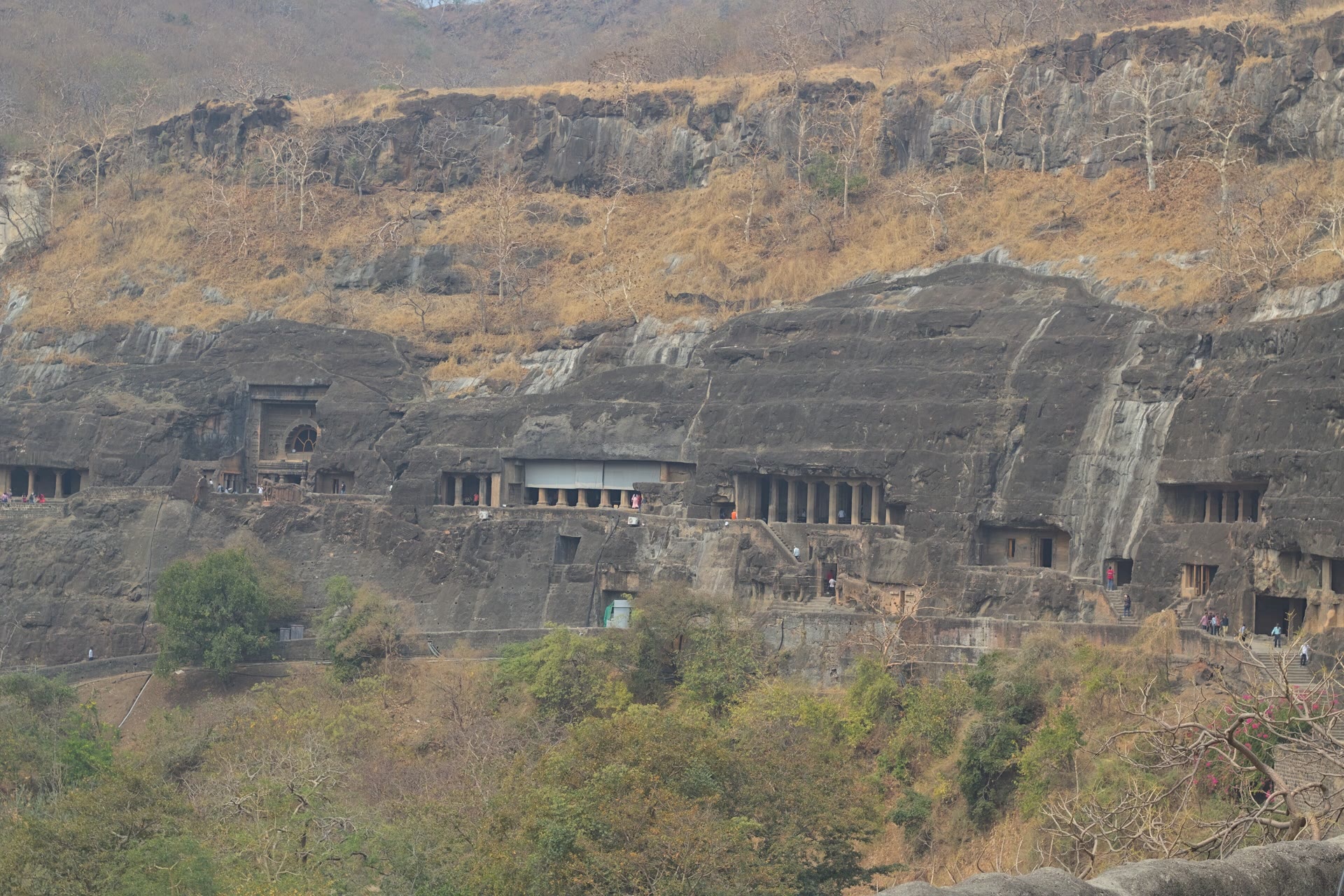
Carved into the basalt cliffs of Maharashtra over a span of nearly a thousand years, the Ajanta and Ellora caves represent one of the most extraordinary artistic achievements in human history. Yet despite being just 100 kilometers apart, the two sites are fundamentally different. Ajanta is exclusively Buddhist, a horseshoe-shaped ravine containing 30 caves adorned with paintings that have survived for nearly two millennia. Ellora is a multi-faith monument spanning 34 caves dedicated to Buddhism, Hinduism, and Jainism, built side by side in an astonishing display of religious coexistence.
Together they form a UNESCO World Heritage double act that draws travelers to the dusty Deccan plateau of central India. The nearest city, Aurangabad (now officially Chhatrapati Sambhajinagar), serves as the base for visiting both sites. While it is technically possible to see both in a single grueling day, doing so means rushing through two of the most important art historical sites in Asia. Giving each site a full day, with Aurangabad as your base, is the approach that does them justice.
The Ajanta Caves
The 30 caves at Ajanta line a crescent-shaped gorge above the Waghora River, about 100 kilometers northeast of Aurangabad. They were carved in two distinct phases: the earliest caves date from the 2nd century BCE, while the majority were created during the Vakataka dynasty in the 5th and 6th centuries CE. After the dynasty fell, the caves were gradually abandoned and swallowed by jungle, remaining hidden for over a thousand years until a British hunting party stumbled upon them in the early 19th century.
The Paintings
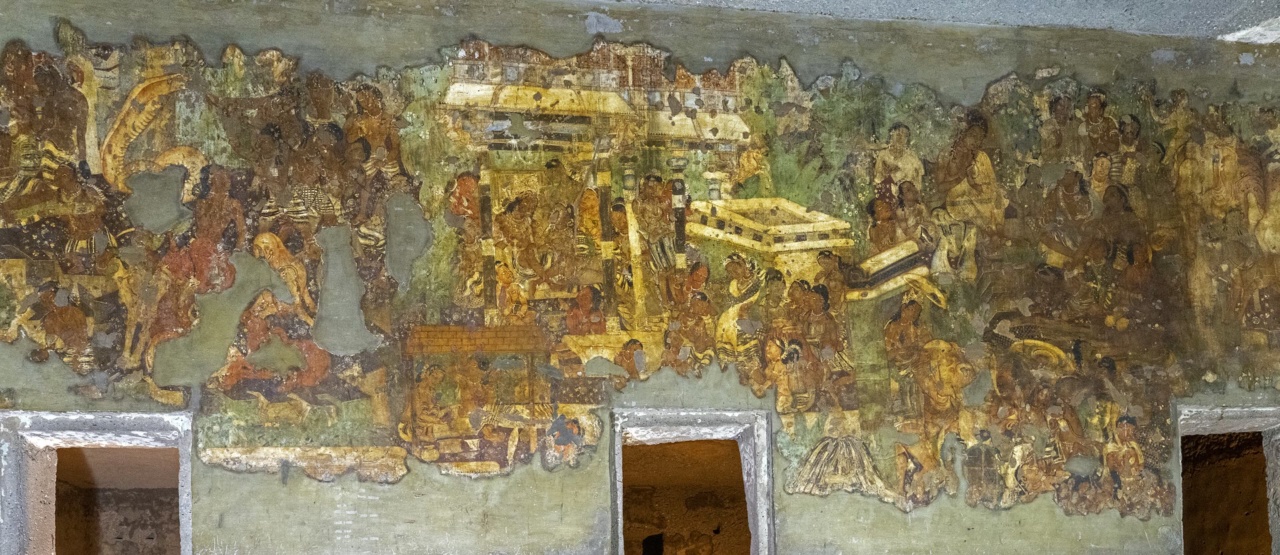
Ajanta's fame rests on its murals, which are among the finest surviving examples of ancient Indian painting. The artists worked on a dry plaster surface (not true fresco), applying mineral and vegetable pigments to create scenes from the Jataka tales (stories of the Buddha's previous lives), courtly life, and religious ceremonies. The level of detail is staggering: individual eyelashes, textile patterns, and facial expressions remain legible after nearly 1,500 years.
The best-preserved paintings are found in Caves 1, 2, 16, and 17. Cave 1 contains the famous Bodhisattva Padmapani and Bodhisattva Vajrapani figures flanking the main shrine, considered masterpieces of Indian art. Cave 17 has the most extensive and varied narrative paintings, covering virtually every surface with Jataka scenes. Flash photography is strictly prohibited to protect the pigments, and the dim interior lighting requires your eyes to adjust before the paintings fully reveal themselves.
The Sculptures
Beyond the paintings, Ajanta contains remarkable rock-cut sculptures. Cave 26 features a dramatic 7-meter reclining Buddha depicting the moment of parinirvana (final death), carved from the living rock with extraordinary serenity. Cave 19 is a chaitya (prayer hall) with an ornate facade and a vaulted ceiling that demonstrates the full sophistication of late Buddhist rock-cut architecture.
Practical Details for Ajanta
| Detail | Information |
|---|---|
| Number of caves | 30 (not all open to visitors) |
| Entry fee (foreigners) | Rs. 600 |
| Entry fee (Indians) | Rs. 40 |
| Opening hours | 09:00 to 17:30 |
| Closed | Mondays |
| Distance from Aurangabad | 100 km (about 2.5 to 3 hours by road) |
| Time needed | 3 to 4 hours |
Private vehicles must park at the designated lot, from where MTDC shuttle buses (Rs. 20) transport visitors to the cave entrance. The walk from the drop-off point to the farthest caves involves significant uphill sections, so comfortable shoes are essential.
Things to Do
The Ellora Caves
Ellora sits about 30 kilometers northwest of Aurangabad and contains 34 caves carved between the 6th and 11th centuries CE. What makes Ellora unique is that it represents three religions in a single complex: 12 Buddhist caves (Caves 1 to 12), 17 Hindu caves (Caves 13 to 29), and 5 Jain caves (Caves 30 to 34). The chronological sequence shows the transition from Buddhism to Hinduism as the dominant faith in the Deccan region, with all three traditions sharing the same cliff face.
The Kailasa Temple (Cave 16)
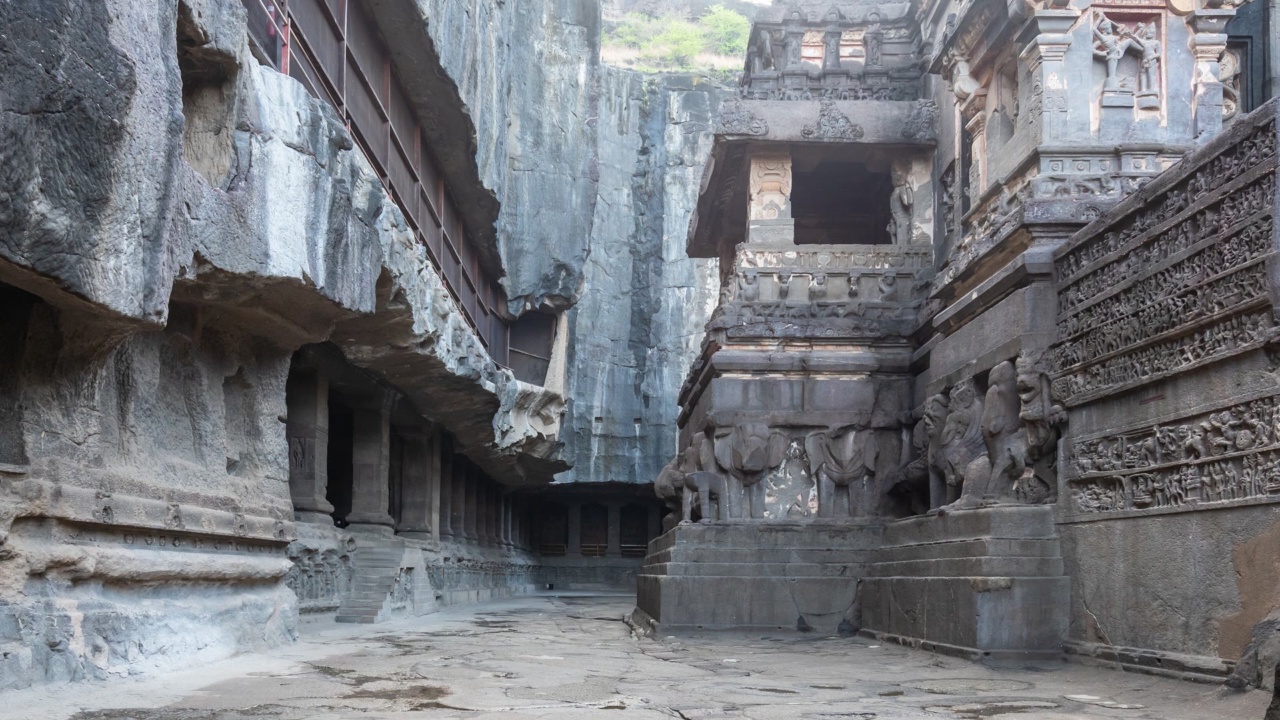
The undisputed centerpiece of Ellora is the Kailasa Temple, and it is difficult to overstate its ambition. This is not a cave carved into rock but an entire freestanding temple carved by removing an estimated 200,000 tons of rock from the top down, chiseling a monolithic structure that stands 30 meters high. It was carved to represent Mount Kailash, the abode of Shiva, and every surface is covered with sculptural panels depicting scenes from the Ramayana, Mahabharata, and Shaivite mythology.
The scale becomes clear when you realize that the temple is larger than the Parthenon in Athens, yet carved from a single piece of basalt rather than assembled from quarried blocks. Elephants support the base, lions guard the entrance, and the main shrine contains a Shiva lingam. Walking around the gallery that encircles the temple reveals new sculptural details at every turn. Plan to spend at least an hour here.
The Buddhist Caves
The Buddhist section (Caves 1 to 12) includes monasteries (viharas) and prayer halls. Cave 10, known as the Carpenter's Cave, is a chaitya with a vaulted ceiling that mimics wooden beams in stone. Cave 12 (Tin Thal) is a three-story monastery with a large Buddha figure on the top floor. These caves predate the Hindu ones and show the transition from simpler, functional monastery spaces to increasingly elaborate decorative schemes.
The Jain Caves
The five Jain caves (Caves 30 to 34) at the northern end are the most easily overlooked but among the most finely carved. Cave 32 (Indra Sabha) features delicate lotus ceilings, detailed Jain Tirthankara figures, and a small courtyard with a monolithic elephant. The Jain caves are less crowded than the Hindu section and reward visitors who make the walk to the far end of the complex.
Practical Details for Ellora
| Detail | Information |
|---|---|
| Number of caves | 34 |
| Entry fee (foreigners) | Rs. 600 |
| Entry fee (Indians) | Rs. 40 |
| Opening hours | 06:00 to 18:00 |
| Closed | Tuesdays |
| Distance from Aurangabad | 30 km (about 45 minutes by road) |
| Time needed | 3 to 5 hours |
Planning Your Visit
The key logistical fact is that Ajanta closes on Mondays and Ellora closes on Tuesdays. This means you should not arrive in Aurangabad on a Sunday night planning to see Ajanta first, because Monday it will be closed. The ideal sequence is to visit Ellora on day one (closer, easier to reach) and Ajanta on day two (farther, requiring more travel time).
Getting to Aurangabad
- By air: Aurangabad Airport receives daily flights from Delhi and Mumbai (1 to 1.5 hours). The airport is 10 kilometers from the city center, with taxis costing Rs. 300 to Rs. 500.
- By train: Aurangabad railway station connects to Mumbai (7 to 8 hours), Hyderabad (10 hours), and Delhi (via connections). The Tapovan Express from Mumbai is a popular option.
- By bus: Government and private buses run from Mumbai (8 hours), Pune (5 hours), and other Maharashtra cities. Overnight sleeper buses from Mumbai are convenient.
Getting to the Caves from Aurangabad
| Option | To Ellora (30 km) | To Ajanta (100 km) |
|---|---|---|
| MSRTC bus | Rs. 30 to Rs. 50, every 30 min | Rs. 150, limited departures |
| Private taxi (full day) | Rs. 1,500 to Rs. 2,000 | Rs. 2,500 to Rs. 3,500 |
| Shared tour | Rs. 500 to Rs. 800 per person | Rs. 800 to Rs. 1,200 per person |
For Ajanta, hiring a private taxi for the full day is the most practical option given the distance and the lack of frequent public transport. For Ellora, regular MSRTC buses from the Aurangabad bus stand run every 30 minutes.
Tips for Visiting Ajanta and Ellora
- Visit Ellora first, Ajanta second. Ellora is closer and its early opening time (06:00) lets you beat the heat and crowds. Save Ajanta for the second day, allowing for the longer drive.
- Check closure days carefully. Ajanta is closed Mondays, Ellora is closed Tuesdays. Plan your Aurangabad arrival around these schedules to avoid losing a day.
- Bring a flashlight for Ajanta. The cave interiors are intentionally kept dim to protect the ancient paintings. A small flashlight or phone torch helps you see details that the overhead lighting misses, especially in the deeper recesses. Never use camera flash.
- Arrive early at both sites. Tour buses from Mumbai and Pune arrive around 10:00 to 11:00. Being at the entrance when it opens gives you at least an hour of relative solitude.
- Hire a guide. Both sites have licensed guides at the entrance who charge Rs. 1,000 to Rs. 2,000 for a comprehensive tour. The art and mythology are far richer than the signage suggests, and a good guide transforms the visit from impressive to revelatory.
- Carry water and snacks. Both complexes are extensive and exposed. Small shops near the entrances sell water and basic food, but options are limited once you start exploring. Aurangabad itself is a useful base for more India travel information, and further planning resources are available on GoAsia.cc.
- Wear sturdy shoes. The paths at Ajanta involve steep climbs and uneven steps. Ellora's Kailasa Temple requires navigating narrow passages and stone staircases. Flip-flops are inadequate for both sites.
- Visit November to February. The Maharashtra plateau gets extremely hot from March to May, and monsoon rains from June to September can make the paths slippery and the caves damp. The cool, dry winter months are by far the most comfortable for extended outdoor exploration.
Frequently Asked Questions
Ajanta contains 30 exclusively Buddhist caves famous for their ancient paintings dating back nearly two millennia. Ellora has 34 caves representing three religions: Buddhist, Hindu, and Jain, with the monumental Kailasa Temple as its centerpiece. They are 100 kilometers apart and were carved in different periods, making them complementary rather than overlapping experiences.
Each site charges Rs. 600 ($7) for foreign visitors and Rs. 40 for Indian nationals. Children under 15 enter free. A guide costs Rs. 1,000 to Rs. 2,000 per site. Transport from Aurangabad adds Rs. 1,500 to Rs. 3,500 per day depending on whether you take a shared tour or private taxi.
It is technically possible but not recommended. The two sites are 100 kilometers apart, each requires 3 to 5 hours to explore properly, and the combined travel time is around 5 to 6 hours. Rushing both in one day means missing the depth that makes them extraordinary. Budget two days using Aurangabad as your base.
Ajanta Caves are closed every Monday. Ellora Caves are closed every Tuesday. Plan your itinerary carefully around these days. The ideal approach is to visit Ellora on day one and Ajanta on day two, avoiding arrival in Aurangabad on a day that would conflict with your preferred sequence.
Ellora is 30 kilometers away with regular MSRTC buses every 30 minutes (Rs. 30 to Rs. 50) or private taxis (Rs. 1,500 to Rs. 2,000 for a full day). Ajanta is 100 kilometers away, best reached by private taxi (Rs. 2,500 to Rs. 3,500 for a full day) since public bus service is limited.
November to February offers the most comfortable weather with mild temperatures and no rain. The Maharashtra plateau becomes extremely hot from March to May, and monsoon rains from June to September make paths slippery and caves damp. Winter mornings provide the best light for the cave interiors.
The Kailasa Temple (Cave 16) is a monolithic Hindu temple carved from top down by removing an estimated 200,000 tons of rock. Standing 30 meters high and larger than the Parthenon, it represents Mount Kailash and is covered with sculptural panels from Hindu mythology. It is widely considered the single most impressive rock-cut structure in the world.
Cameras without flash are allowed at both sites. Flash photography is strictly prohibited inside Ajanta to protect the ancient murals, and tripods are not permitted. Phone cameras work well in the dim interiors. At Ellora, most caves are open-air enough for natural light photography, especially the Kailasa Temple.