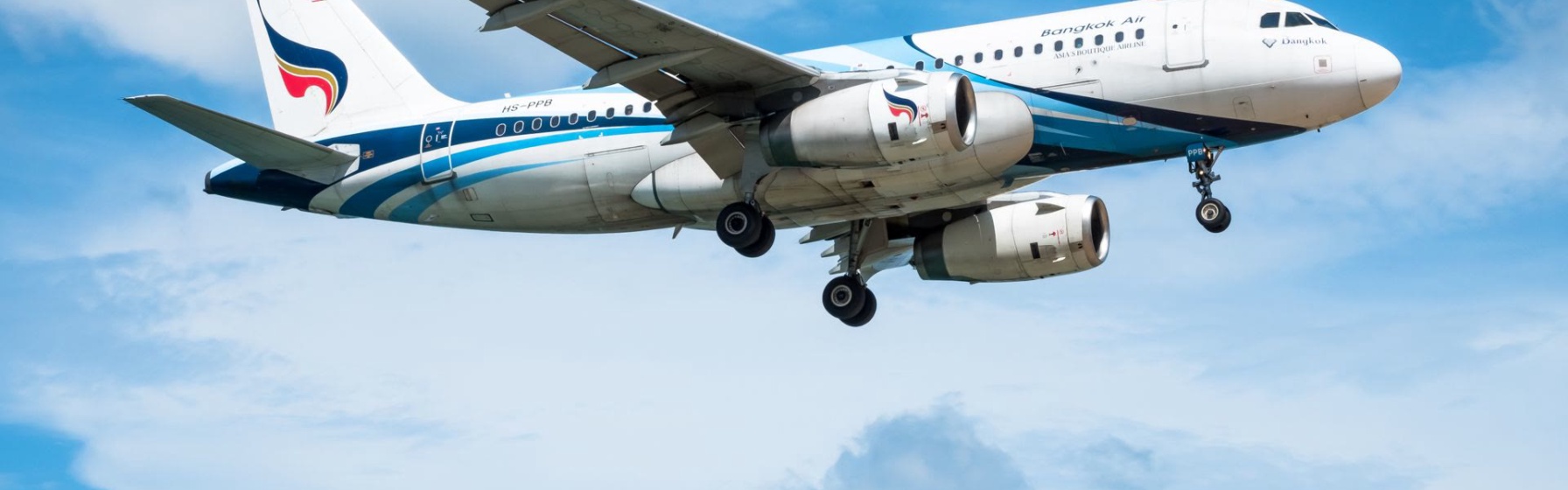
The Flight Network in Thailand
Bangkok has two airports. Suvarnabhumi (BKK) is the operation base of Bangkok Airways[2] and the airport from which Thai Airways lists its domestic routes.[3] Don Mueang (DMK) is a hub for low-cost carriers, and its Terminal 2 handles domestic flights.[4] Thai AirAsia flies from both airports, but it cut its Suvarnabhumi domestic network back to Chiang Mai and Phuket for May and June 2026.[5] Check which airport your booking uses.
Thai Lion Air flies from Don Mueang to Chiang Mai, Chiang Rai, Phuket, Krabi, Surat Thani, Hat Yai, Udon Thani, Ubon Ratchathani, Khon Kaen, Phitsanulok, Nakhon Si Thammarat, Trang and Nakhon Phanom.[1] Koh Samui, Sukhothai, Trat and Lampang are served by Bangkok Airways,[3] while Nok Air adds smaller airports such as Nan, Mae Sot and Chumphon.[6]
Thai Airways and Bangkok Airways are the full-service carriers.[3][2] Low-cost flights are sold by Thai AirAsia and Nok Air.[5][6] Thai Lion Air and Thai Vietjet also fly domestic routes.[1][7]
Bangkok Airways built Samui Airport, which opened in 1989, and its company profile also lists Sukhothai and Trat among its airports.[2] Flights from Bangkok to Samui are operated by Bangkok Airways, and Thai Airways sells seats on them as a codeshare.[3] One-way fares from Bangkok to Samui start at THB 2,500, or THB 2,730 including airport tax and the ticketing fee.[8]
Chiang Mai and Phuket are served by several airlines from Bangkok, among them Thai AirAsia, Thai Lion Air and Bangkok Airways.[9][10] Most domestic flights run to or from Bangkok, but some routes skip it. Bangkok Airways connects Samui with Chiang Mai, Phuket, Krabi and Pattaya (U-Tapao),[8] and Thai Lion Air links Udon Thani with Hat Yai and U-Tapao with Chiang Mai and Udon Thani.[1]
Classes and Comfort Levels
Low-cost carriers sell economy fares in tiers that differ mainly in checked baggage. On domestic routes Nok Air's Lite fare includes no checked baggage, X-Tra 15 kg and MAX 25 kg.[11] Thai Lion Air's domestic Saver fare includes none, Value 15 kg and Flexi 25 kg, plus 7 kg of cabin baggage.[1] Thai AirAsia allows two cabin bags with a combined weight of up to 7 kg, and checked baggage is a paid add-on unless you buy a bundle such as Value Pack or Premium Flex.[12]
Bangkok Airways includes a 20 kg checked bag, seat selection and meals and drinks on every flight, even in economy.[13] Its Boutique Lounges are open to all passengers, economy included, and offer light snacks, Thai desserts, drinks and free Wi-Fi. For domestic flights they are at Suvarnabhumi (Concourse A), Chiang Mai and Phuket.[14] At Samui there is a Boutique Lounge courtesy corner for all passengers and a Blue Ribbon Club lounge for business class passengers and other eligible guests.[15]
Thai Airways offers economy and business class on domestic routes. Business class has a checked baggage allowance of 40 kg against 30 kg in economy (20 kg on the cheapest economy booking classes), both classes include 7 kg of carry-on baggage, and seat assignment and meal service are included in both.[3]
Booking and Tickets
Every airline sells tickets on its own website and app. Third-party platforms, including GoAsia.cc, let you compare fares across several carriers side by side, which is useful because fares on the same route and date can differ a lot.
Book early for the best fares on budget carriers, because prices climb towards departure and around peaks such as Songkran (mid-April), Loy Krathong, Chinese New Year and the New Year period. Thai Airways publishes the regulated ceiling fares for its domestic routes, for example THB 7,358 one-way in economy and THB 9,565 in business class from Suvarnabhumi to Chiang Mai.[3]
Online check-in is the easiest option. Bangkok Airways, for example, offers it from 24 hours until 1 hour before departure, and its domestic check-in counters close 40 minutes before departure.[16] Keep a screenshot or printout of your boarding pass for smaller airports in case a phone fails.
What to Expect on Board
Domestic flights from Bangkok are short. Bangkok to Chiang Mai takes about 1 hour 10 minutes and Bangkok to Phuket about 1 hour 20 minutes.[9][10] Bangkok Airways quotes about 1 hour 10 to 20 minutes to Samui[13] and about 1 hour to Trat.[17]
Bangkok Airways serves meals and drinks on every flight, and Thai Airways includes meal service in economy and business class.[13][3] On low-cost carriers, treat food and drinks as paid extras unless your fare says otherwise.
Window seats on clear days offer spectacular views. Flying south toward Phuket or Krabi, you can see the limestone karst islands of the Andaman Sea rising from turquoise water. Northern routes show the green ridges and rice paddies of Thailand's mountainous interior. Samui's terminal is made of open-air pavilions without walls, built with coconut palm wood.[15]
Do not count on Wi-Fi or a charging port at your seat on a short domestic flight. Download entertainment beforehand or bring a book.
Tips for Flight Travel in Thailand
- Mind the two Bangkok airports. Don Mueang is about 25 kilometers north of central Bangkok and about 46 kilometers from Suvarnabhumi.[4] Airports of Thailand runs a free shuttle bus between the two every 30 minutes from 05:00 to 24:00, but only for passengers transferring between flights, who need a flight ticket or proof of onward travel and a passport or national ID card.[18] If you connect between carriers at different airports, leave a generous buffer, more in rush hour. Mixing up the airports is an easy mistake to make.
- Pack a layer. Cabins are air-conditioned, and a light sweater or scarf makes the flight more comfortable after the tropical heat outside.
- Weigh your bags before heading to the airport. Pre-buying baggage is cheaper than paying at the counter. At Nok Air an extra 20 kg bought with a domestic ticket costs THB 750, while the flat airport fee for the first 20 kg on a Lite fare is THB 1,200, or THB 1,500 on Fridays, Saturdays, Sundays and public holidays.[11] AirAsia likewise says baggage is cheapest when pre-booked and costs more at the airport.[12]
- Arrive early for island and regional airports. Bangkok Airways recommends arriving at least 1.5 hours before a domestic departure.[16] Budget airlines set their own check-in cut-off times, so check your booking.
- Consider the full journey cost to the Gulf islands. Koh Phangan and Koh Tao have no airports. Seatran runs coach and ferry connections from Surat Thani airport to Koh Samui and Koh Phangan,[19] and Nok Air sells Fly'n'Ferry combinations from Nakhon Si Thammarat to Koh Phangan, Koh Samui and Koh Tao, operated by Lom Phraya Speedboat.[6] Compare these with flying directly to Samui.
- Watch for holiday surges. Songkran, Chinese New Year and long Thai weekends push domestic fares up. If your dates are flexible, shifting by a day or two around these peaks can cut costs.
- Plan connections carefully. If you fly from a northern city to a southern beach, you will usually connect in Bangkok, so choose connections through the same airport. Thai Lion Air's LION CONNECT through-booking is not available for domestic-to-domestic connections, such as Chiang Mai to Hat Yai, so leave a comfortable buffer between flights.[1]
- Language is rarely a barrier. Signs at the major airports are in Thai and English, and airline staff generally speak functional English.