Plan your Thailand train journey with our guide to SRT routes, sleeper classes, booking tips, and what to expect on board across the Thai rail network.
Overnight sleepers to Chiang Mai depart from Krung Thep Aphiwat Central Terminal, not Hua Lamphong. Thailand's railways offer a slower way to watch rice paddies, limestone hills and coastal plains pass outside your window. The State Railway of Thailand (SRT) moved its main long-distance trains (Special Express, Express and Rapid) on the Northern, Northeastern and Southern lines to this terminal on 19 January 2023.[1] Some Ordinary and commuter trains still start at Hua Lamphong, and Western Line trains to Nam Tok start at Thonburi.[2] Check the departure station printed on your ticket. See the official announcement on the long-distance station transfer.
The Train Network in Thailand
Thailand's rail network is operated by the State Railway of Thailand (SRT) and radiates outward from Bangkok along five lines. The Northern Line runs through Ayutthaya, Phitsanulok and Lampang to Chiang Mai, about 752 kilometers from Hua Lamphong. The Northeastern Line splits into two branches, reaching Nong Khai on the Laos border and Ubon Ratchathani in the heart of Isan. The Eastern Line is shorter, connecting Bangkok to Aranyaprathet near the Cambodian border. The Southern Line runs from Thonburi down the Malay Peninsula through Hua Hin, Chumphon, Surat Thani (the gateway to Koh Samui and Koh Phangan) and Hat Yai to Sungai Kolok, with a branch to Padang Besar on the Malaysian border. The Western Line runs from Nong Pladuk Junction to Nam Tok in Kanchanaburi province.[3]
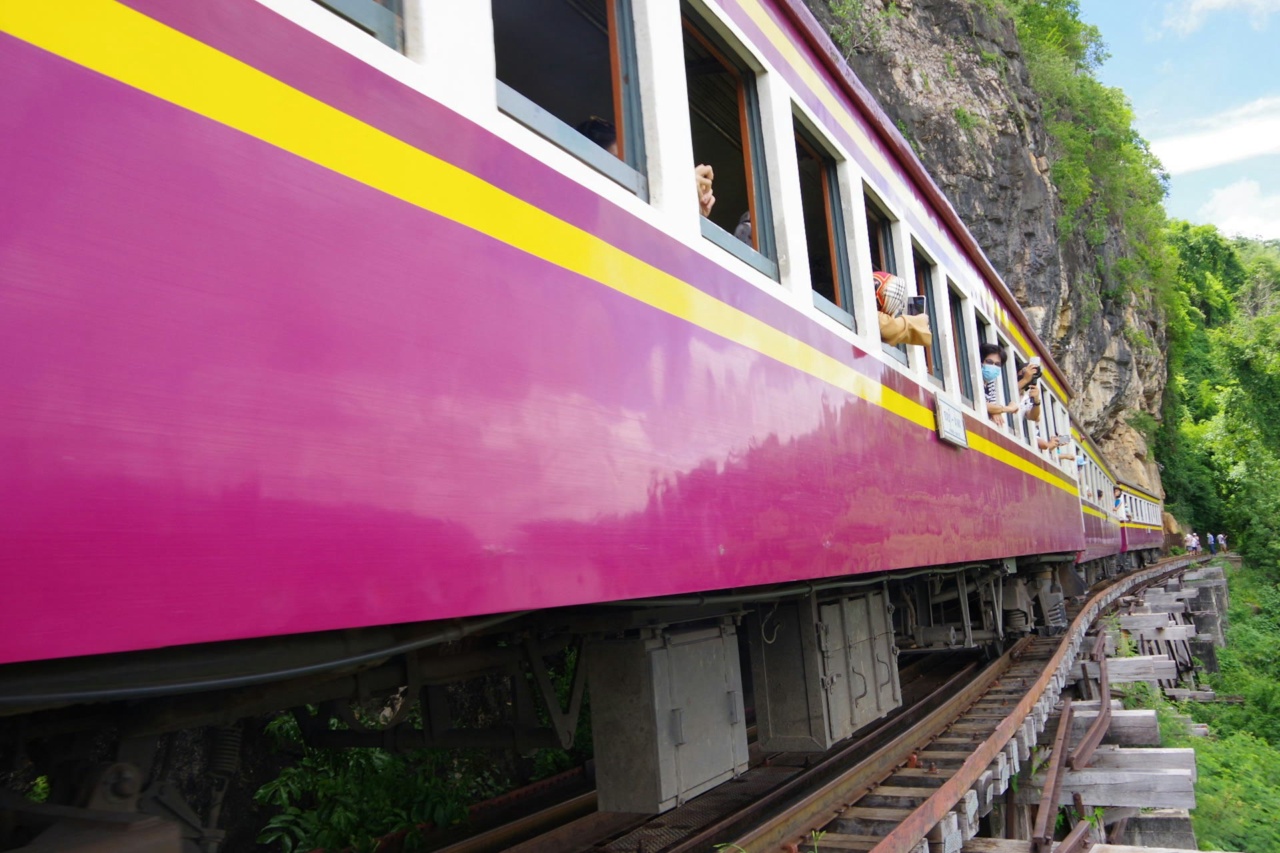
A pink and yellow passenger train running along a rock facePhoto: Hata Life / Unsplash
Bangkok is also served by the Airport Rail Link connecting Suvarnabhumi Airport to the city center, and the BTS Skytrain and MRT metro handle urban transit. These systems are separate from SRT's long-distance trains.
Coverage is strongest along the main trunk lines. Not every province has a railway line, so buses or minivans fill the gaps. The major tourist corridors, Bangkok to Chiang Mai, Bangkok to Chumphon and Surat Thani for the southern islands, and Bangkok to Isan, all have long-distance trains.[2]
Classes and Comfort Levels
SRT carries three classes of coach, and the gap between them is significant.[4]
Class
Seating
Air Conditioning
Best For
First Class
Private two-berth rooms (upper and lower berth), 12 rooms per car[4]
Ultra-budget travelers; short journeys; experiencing local life
First Class is carried only on some Special Express and Express trains, not on Rapid, Ordinary or Local trains.[2] Each first class car has 12 rooms with two berths each.[4] Check the coach list of your train when booking, because not every Chiang Mai service offers it.
Second Class sleeper with air conditioning is the sweet spot for most visitors. SRT runs air-conditioned second class sleeper cars with 36 or 40 berths, half upper and half lower, on Special Express trains such as 9 and 13 to Chiang Mai, on Express trains and on some Rapid trains. Express 51 to Chiang Mai also carries non-air-conditioned sleeper cars with 32 berths.[4] Second class seats (not sleepers) are reclining seats.[4]
Third Class is the budget option and suits shorter daytime trips. Ordinary trains stop at every station and carry third class (and second class) seats, while Local trains carry third class only.[2] Some Express and Rapid trains also have third class cars.[4]
Booking and Tickets
Tickets can be bought at SRT stations nationwide, by phone through the SRT call center on 1690 (every day, 24 hours) or in advance on the SRT D-Ticket website and in the SRT D-Ticket app. An e-ticket received as a PDF by e-mail, or shown in the D-Ticket app, replaces a paper ticket.[5]
Special Express, Express and Rapid trains are reserved-seat trains. Since 30 April 2026, how far ahead you can buy depends on how much of the train's route you ride: under 25 percent of the route, one day ahead; 25 to 59 percent, up to 30 days; 60 percent or more, up to 90 days. SRT's own example is Bangkok to Phitsanulok (381 km) on train 9 to Chiang Mai (743 km), which is 51 percent of the route, so the 30-day window applies. Ordinary, suburban and local trains with unreserved seats sell tickets on the day of travel, within 2 hours before departure.[5]
Reserved-seat tickets carry the name and ID or passport number of every traveler. Since 1 July 2024, SRT does not allow changing the traveler name or transferring a ticket to another person. Changing the travel date is possible up to 24 hours before departure for a fee of 20 percent of the ticket price (3 or more days before departure), 30 percent (2 days) or 50 percent (1 day).[5]
Third-party platforms such as GoAsia.cc let you compare train options alongside other transport modes, making it easy to weigh travel times and comfort levels before committing.
What to Expect on Board
On the Northern Line, SRT's 2026 timetable shows the daytime Special Express 7 leaving Krung Thep Aphiwat at 07:30 and reaching Chiang Mai at 17:50 (10 hours 20 minutes). The overnight trains take longer: Uttrawithi (train 9) takes 12 hours 35 minutes and Special Express 13 takes 12 hours 40 minutes (20:05 to 08:45), while Express 51 takes 13 hours 10 minutes.[6] On the Southern Line, the daytime Special Express 43 reaches Surat Thani in 8 hours 50 minutes (07:30 to 16:20), and the overnight trains take roughly 9.5 to 11 hours, for example Thaksinarath (train 31) at 16:50 to 02:23 or Express 83 at 18:50 to 05:01.[7] SRT notes that schedules are subject to change, so check with the station.[6] Delays can happen, so avoid tight connections and embrace the pace rather than fighting it.
Scenery is a highlight and varies by line: the central plains on the northern line before the hills around Lampang, stretches near the Gulf coast around Prachuap Khiri Khan on the southern line, and the wide Isan plateau on the northeastern line.
Food and drinks are sold at many stops, but food service varies by train. Bringing your own snacks and water is wise, especially for overnight trips.
Each traveler may carry free of charge up to 50 kg in first class, 40 kg in second class and 30 kg in third class on Special Express, Express, Rapid and Ordinary trains and on diesel railcars outside the suburban services. On the suburban railcar trains between Bangkok and Prachin Buri, Kaeng Khoi, Lop Buri or Ratchaburi the limit is 15 kg. Luggage you keep with you should not exceed 50 x 50 x 50 cm (or the same volume in another shape) and must fit on the luggage rack or under the seat; larger or heavier pieces are charged a fee. See the official SRT baggage rules for your train.[8]
Tips for Train Travel in Thailand
Book sleeper berths early. Sleepers on popular routes sell out, and reserved-seat tickets can be bought up to 90 days ahead when you ride 60 percent or more of the train's route.[5]
Bring layers. Air-conditioned carriages can be cold at night. A light jacket, long pants and warm socks will make overnight journeys far more comfortable.
Buy your ticket before boarding. A passenger found without a ticket pays the fare plus a 250 baht fee on Special Express, Express and Rapid trains, and 100 baht on other trains. Keep some small baht notes for small vendors.[5]
Carry your passport. Reserved-seat tickets are issued with the name and ID or passport number of the traveler, and they cannot be transferred.[5]
Watch for Songkran and long weekends. Songkran (Thai New Year) falls on 13 to 15 April.[9] Locals travel to their home provinces during Songkran and other major holidays, so book as early as your booking window allows.
Consider the historic Death Railway. SRT's Western Line runs to Nam Tok, the last station on the remaining 130 km of the Burma-Thailand Railway.[3] The train does not run through Hellfire Pass: the Hellfire Pass Interpretive Centre is approximately 20 km from Nam Tok and requires a separate road transfer by taxi or by the hourly public bus.[10] Check current train services and access to the centre before travelling.
Use trains strategically. Overnight sleepers save a night of accommodation and let you wake up in a new city. The Bangkok-Chiang Mai and Bangkok-Surat Thani routes are ideal for this approach.
Stay flexible with timing. Delays happen. Avoid booking tight connections: if your train arrives in Surat Thani and you need a ferry to Koh Samui, leave a buffer of a few hours rather than relying on a precise schedule.
Sources and background
Numbers in the text such as [1] refer to these sources.